
Collector guides • Valuation
How much are Hot Wheels worth? This Hot Wheels value guide starts with three things: the exact version you have, its condition and packaging, and what buyers have actually paid for that same version recently. Together, these provide a more useful estimate for your individual car than a general price list. This guide shows you how to check all three, then gives you a free worksheet that turns real sold listings into a realistic value range.
When comparable sales are limited, a record of your findings gives you a useful starting point for further research.
Quick start: value a Hot Wheels car in five steps
- Identify the exact release. Note the casting name, body color, wheels, graphics, base markings and packaging.
- Record the condition honestly. Loose or carded, plus any specific damage you can see.
- Find reported sold prices. Collect recent sales of the same version in comparable condition.
- Screen and calculate. Select matching sales, then work out the median and the observed range of what buyers paid.
- Check the strength of your evidence. Aim for at least three strong matches. With fewer, record your findings for further research and mark the estimate inconclusive.
Each step is explained below, with a worked example and a copyable worksheet in the calculation section.
Key terms used in this guide
| Term | What it means here |
|---|---|
| Casting | The body design and tooling behind a model. The same casting can be reused across years, colors and product lines. |
| Variation | One specific version of a casting, set apart by color, graphics, wheels, base, packaging or line. |
| Tampo | A printed graphic on the car’s body, such as stripes, logos or numbers. |
| Sold comparable (comp) | A reported sale of the same variation, in comparable condition, in the same market and time window. |
| Loose | A car that’s out of its original packaging. |
| Carded | A car still sealed on its original blister card. Boxed releases should be recorded separately. |
| Median | The middle value when sales are sorted from lowest to highest. With an even number of sales, it’s the average of the two middle values. |
| Buyer-paid total | The item price plus the shipping the buyer paid, before sales tax. |
Step 1: Identify your exact Hot Wheels release
Accurate identification is the foundation of valuation. Two cars can share a name and look almost identical, yet sell very differently because of their wheels, tampos or product lines. Match the exact variation using the details below.
Work through these details and photograph each one:
- Base: the casting name, any text, the country of manufacture and the copyright year.
- Wheels: the style and color, including any colored stripe on the tire.
- Color and graphics: the body color, every tampo, and the window and interior colors.
- Line or series: mainline, premium, multipack, collector exclusive or something else. Our guide to the difference between premium and mainline Hot Wheels explains how line and packaging change what you’re looking at.
- Packaging: the card art, series name and number, any visible toy number, and stickers or punch-outs on the card.
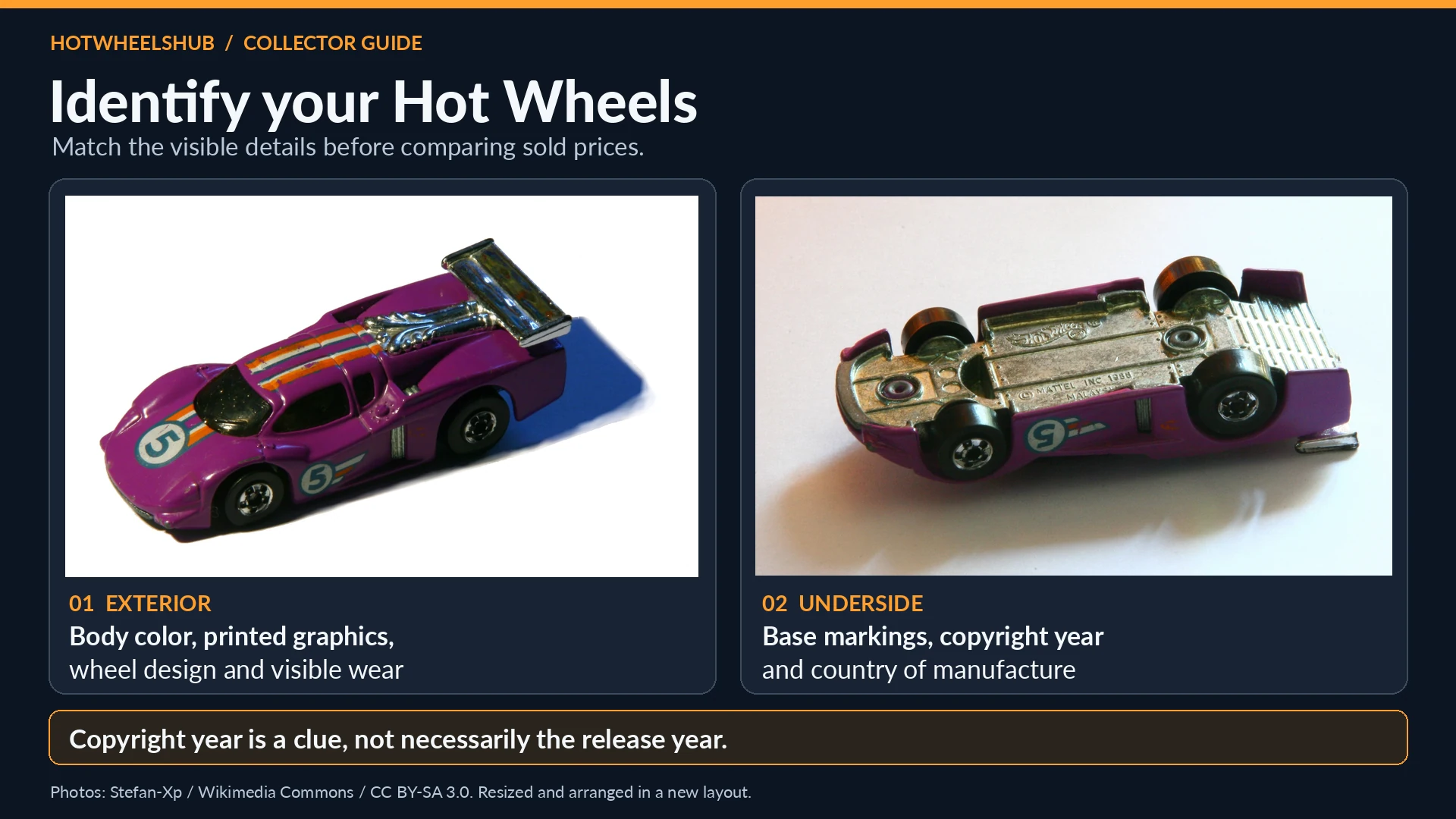
What the base copyright year tells you
The copyright year on the base is one useful identification clue. In discussions on Mattel’s own Creations community forum, moderators have explained that it relates to the design or tooling. The release and manufacturing dates are separate details to establish. A casting designed years ago can carry that older date on a car produced much later, and some bases are shared between models.
Record the toy’s release year separately from the full-size car’s model year. A toy of a 1967 car could have been produced decades later.
Red-striped wheels on vintage and modern releases
Early Hot Wheels from the brand’s first years, starting in 1968, are widely called Redlines because of the red stripe on their tires. Modern collector releases borrow that look on purpose. Mattel’s product description for its 80th Anniversary Original 16 Rally Case Set calls the cars premium replicas of the 1968 originals and lists Redline Neo-Classics wheels. Mattel staff have also described a 2018 Hot Wheels Collectors release of the Custom Eldorado with Neo-Classics Redline wheels and packaging styled after a 1968 blister card.
Use the stripe and retro card styling as clues alongside release documentation and originality checks.

Keep sealed cars sealed
Identify a packaged car through the plastic and from the card. Keep factory-sealed packaging intact. Opening changes its packaging category. Compare opened-package or loose cars with examples in the corresponding category.
For a wider view of how collections are organized and researched, see our Hot Wheels collecting guide.
Step 2: What changes Hot Wheels resale value
Once you know the exact version, use these factors to select comparable sales. Their effects vary by release, so matched sales provide the basis for your estimate.
- Condition of the car: paint chips, bent axles, wheel wear, sun fading or missing parts.
- Condition of the packaging: soft corners, creases, dented or yellowed blisters, tears, price stickers, and signs of opening or resealing. Record the specific condition details.
- Packaging state: compare factory-sealed, opened-package and loose cars separately. Match the original card or box type too.
- Completeness: original inserts, accessories, outer boxes or protective cases that came with the item.
- Grading: a professionally graded or encased item belongs in its own category, compared only with similar graded items.
- Authenticity and alterations: customs, repaints, wheel swaps, restorations and reproduction parts form their own group. They should be disclosed and compared only with items altered in a similar way.
- Demand: some castings and themes attract more buyers than others, and interest changes over time. Recent reported sales show what some buyers have paid. Overall buyer interest and the chance of a future sale require separate evidence.
- Rarity: a limited or chase release deserves closer research. Its price depends on the specific release, condition and actual buyer demand.
Step 3: Find real sold prices
The key to Hot Wheels valuation is reported sold prices. Asking prices reflect sellers’ expectations; reported sales provide evidence of buyer activity. Record any transaction details that need confirmation.
Use the Sold Items filter
On eBay, search for your exact variation and apply the Sold Items filter (also available in Advanced Search). Start with the casting name, then add verified color, wheel type, series or toy number. If results are sparse, remove one search term at a time and manually check the photos. Completed listings cover both sold and unsold items. Select sold results specifically, checking filter names and placement on your device.
In its Product Research help guide, eBay describes the standard completed-listings sold results as covering the previous 90 days. Ordinary eBay search can mix in related results when exact matches are scarce. Open each result and match its photos and description against your car.
A sold listing records a reported sale. Payment settlement and return status require separate confirmation.
Product Research, if you have access
According to eBay, sellers with access to Seller Hub can use a tool called Product Research, which covers up to three years of eBay sales data. It offers filters for date range, item condition, listing format, buyer and seller location and marketplace. eBay says Product Research shows the actual price an item sold for even when a Best Offer was accepted, plus shipping figures such as average shipping cost.
eBay notes that access to individual listings can change after a sale. Treat the tool’s averages as a starting point and check individual matching sales where possible. Use confirmed transaction-specific shipping charges when calculating a buyer-paid total.
Can a Hot Wheels value app or scanner tell you exactly what a car is worth?
Treat any app estimate as a starting point. Confirm the exact variation yourself and compare recent sold listings of the same version and condition before relying on it.
Screening rules for every listing
Record a sale as a comparable only when all of these are true:
- It’s the same variation, with comparable wear, completeness, alterations and packaging state. Verify specific condition details alongside the listing’s broad condition label.
- It’s a single item. Research lots and multipacks in their own comparison groups.
- It sold in your market and currency. For a US estimate, check the relevant marketplace and location details where available, and use US-dollar sales. Confirm market and currency as separate fields.
- The actual sold price is visible. For accepted Best Offers with an undisclosed amount, mark the price Unknown and set the sale aside until the amount is verified.
- The buyer-paid shipping is known. Confirmed free shipping is $0. Use the original transaction charge, since current quotes for your address, marketplace averages and estimated postage can differ. Mark unconfirmed shipping as Unknown and reserve that sale for a separately labeled item-only comparison if its item price is verified.
- Each distinct reported transaction counts once. A shared listing ID may represent multiple units. Retain transactions you can distinguish reliably and set ambiguous records aside.
Retain genuine comparables across the full observed price range. If variation, condition and market match, keep the record even when the price is unusually high or low.
Start with sales from the last 90 days. Only reach further back if you need to, and keep older sales in a separate, clearly dated group.
Step 4: Calculate a realistic value range
With your comparables screened, the math is simple. The example below shows how the decisions work in practice.
Worked example (fictional data)
The figures below are fictional and for illustration only. Picture a hypothetical loose car identified down to its exact variation, compared against hypothetical loose sales of that same variation in comparable condition, all in the US market, in US dollars, within one recent 90-day window.
| Listing | Status | Match check | Item price | Buyer shipping | Buyer-paid total | Decision |
|---|---|---|---|---|---|---|
| A | Sold | Same variation, loose, same condition | $12 | $5 | $17 | Include |
| B | Sold | Same variation, loose, same condition | $14 | $4 | $18 | Include |
| C | Sold | Same variation, loose, same condition | $18 | $0 (free shipping) | $18 | Include |
| D | Sold | Same variation, loose, same condition | $15 | $5 | $20 | Include |
| E | Sold | Carded, different variation | $35 | $5 | $40 | Set aside: different variation and packaging |
| F | Best Offer accepted | Listed at $24, accepted amount undisclosed | Unknown | Unknown | Pending | Set aside: confirm accepted price |
| G | Active | Active asking-price listing | $50 asking | Unknown | Pending | Set aside: active listing |
On smaller screens, scroll horizontally to see every column.
Selecting the four matched sales. In this fictional example, E represents a carded car of a different variation, so it belongs in a separate comparison group. F shows a $24 asking price; the accepted offer amount requires confirmation. G represents a current asking price. A through D supply the matched reported sales for this calculation.
The calculation.
- Included sales: 4 (A, B, C and D)
- Buyer-paid totals sorted from low to high: $17, $18, $18, $20
- Median: ($18 + $18) ÷ 2 = $18
- Observed range: $17 to $20, before sales tax
For this fictional sample, a buyer-paid total of about $18, inside an observed range of $17 to $20, describes the four hypothetical sales. Treat the result as a descriptive sample summary; a certified appraisal, statistical confidence interval or future sale prediction requires separate evidence and methods.

Three measures of value and selling proceeds
- Item-only price: the sale price of the car itself, excluding shipping. In the example, $12 to $18.
- Buyer-paid total: the item price plus the shipping the buyer paid, before tax. The worksheet uses this figure because it lets free-shipping listings compare fairly with paid-shipping ones. In the example, $17 to $20.
- Seller proceeds: what a seller keeps after their own actual costs.
Here’s a fictional proceeds example. Say a car sells for $14 and the buyer pays $4 for shipping, so the hypothetical gross receipts before tax and fees are $18. Subtract $4 of actual postage, an assumed $2.50 in fees and $0.50 of packing materials, and the estimated proceeds come to $11 before any other costs. All amounts, including the assumed fee, are hypothetical. eBay’s own fee information indicates that selling fees vary by category and account and may be calculated on more than the item price, so use the real figures from your seller statement.
Count buyer-paid shipping once as part of receipts and actual postage once as a cost. The $11 represents estimated proceeds after the listed selling costs. Market value and profit after acquisition cost are separate measures.
Assess the strength of your valuation evidence
Before presenting a reasonably supported descriptive range, this guide asks for at least three strong comparables: same variation, comparable condition, known price and shipping, recent, same market. This is a conservative research guideline used by this article; eBay rules and statistical standards are separate.
- Fewer than three strong comps: mark the estimate inconclusive, retain the findings and gather further evidence before assigning a price.
- Identity or condition awaiting confirmation: mark the estimate inconclusive until these details are established, regardless of sample size.
- Older, widely dispersed or market-shifted sales: mark the evidence as limited, even with three or more comparables, and explain the reason. Evaluate sample quality alongside size.
- Extending the date window: keep older sales as a separate, clearly dated group and explain the time windows used.
- One sale: record it as an individual observation and gather additional matches for a range. Keep verified item-only prices separate from buyer-paid totals.
Step 5: Copy the free Hot Wheels valuation worksheet
Copy the three tables below into a spreadsheet or notes app, or print them. The worksheet is freely available on this page.
How to fill it in:
- Leave a cell blank while it awaits research.
- Write Unknown when research leaves a detail unconfirmed.
- Enter $0 for confirmed free shipping and use Unknown for unconfirmed shipping.
- Listing references are private notes for your own research, so the item number or a short description is enough.
On a small screen, scroll each table sideways to see every column.
Part 1: Item details
| Field | Your notes |
|---|---|
| Casting name | |
| Line or series | |
| Release clues (card year, series number, toy number, base text) | |
| Variation identifiers (body color, tampos, wheels, base, packaging) | |
| Loose or carded | |
| Condition and specific damage | |
| Alterations or uncertainty (custom, repaint, possible error, unverified) | |
| Market and currency | |
| Research date (as of) | |
| Sales date window |
Part 2: Sales log
| # | Listing reference | Sale date | Status (sold, unsold, active, offer accepted) | Variation match (yes, no, unsure) | Condition match (yes, no, unsure) | Qty | Item sold price | Buyer-paid shipping | Pre-tax total | Include or exclude | Reason |
|---|---|---|---|---|---|---|---|---|---|---|---|
| 1 | |||||||||||
| 2 | |||||||||||
| 3 | |||||||||||
| 4 | |||||||||||
| 5 |
On smaller screens, scroll horizontally to see every column.
Add rows as needed. Only rows marked “Include” go into the summary.
Part 3: Summary
| Summary field | Result |
|---|---|
| Number of included sales | |
| Included totals, sorted low to high | |
| Median buyer-paid total | |
| Observed range (lowest to highest) | |
| Evidence strength (supported descriptive range, limited or inconclusive) | |
| Why (sample size, recency, spread, unresolved identity) | |
| Next action |
Good “next action” notes are concrete: “search the carded version separately,” “confirm the wheel type from a clearer photo,” “wait for more sales,” or “ask a specialist about the base.”
Redlines, Treasure Hunts, RLC and errors: treat them as research flags
People searching for which Hot Wheels are worth money often land on these categories. Each deserves careful identification and matched sales research to establish its individual value.
- Redlines: cars from the brand’s earliest era. Because modern replicas use the same red-striped look, confirming a true early car is specialist work. Originality also matters, since repaints and replaced wheels or parts change what a car is. Compare only verified like-for-like sales.
- Treasure Hunts and Super Treasure Hunts: chase versions mixed into regular mainline assortments. Confirm the exact chase version separately from the regular release of the same casting. Our article on how rare Super Treasure Hunts really are explains the relationship between rarity and collector value.
- RLC releases: the Red Line Club is Mattel’s Hot Wheels collector membership. Research each member-exclusive release through its specific identity and matched sales. Compare sealed with sealed and complete with complete, including any numbering, case or outer packaging the release came with.
- Factory errors: distinguish genuine production differences from later damage or alterations. Describe the feature precisely, record any uncertainty and assess value through comparable sales. Our guide to Hot Wheels factory errors covers how to tell them apart.
How to value a whole Hot Wheels collection
An inherited box or a lifetime of cars becomes easier to value when you sort it into research groups first.
1. Split everything into three groups.
- Common, clearly identified cars. You can name the variation and condition with confidence.
- Research flags. Redline-era cars, chase versions, collector exclusives, possible errors and anything that looks unusual.
- Items for further research. Cars awaiting identification, damaged or customized cars, and other uncertain items. List them separately with an “Unknown” note where appropriate.
2. Group like with like. Keep carded and loose apart, and group cars of similar condition together.
3. Look for comparable lots for the common group. A realistic bulk estimate comes from sold lots that resemble yours in size, mix and condition, or from a real offer. Keep individual estimates as a separate measure.
4. Run the research flags through the worksheet one at a time. These are the items where careful identification matters most.
5. Keep three numbers separate.
| Estimate | What it describes | Evidence it should come from |
|---|---|---|
| Sum of individual estimates | What the items might bring if each sold on its own, before costs and time | Worksheet ranges for well-evidenced items only |
| Bulk or lot estimate | What a group might bring as one sale | Comparable sold lots or an actual offer, using the observed lot-specific price |
| Seller proceeds | What you might retain after selling costs | Actual receipts minus actual fees, postage, packing and other selling costs |
On smaller screens, scroll horizontally to see every column.
A sorted, documented collection is useful for both keeping and selling cars. If you’re thinking about continuing the collection yourself, our guide to Hot Wheels collecting for beginners covers the basics.
For a high-stakes item or an inconclusive estimate, consider asking a qualified specialist in diecast toys. This worksheet supports research; seek a qualified appraisal when a certified value is required.
Hot Wheels valuation best practices
- Use reported sold prices for valuation.
- Select the Sold Items filter and verify each reported transaction.
- Compare packaging categories separately.
- Match exact variations, including wheels, tampos, line and packaging.
- Record copyright and release dates separately.
- Verify red-striped wheel releases with documented identification evidence.
- Record unconfirmed amounts as Unknown and reserve $0 for confirmed free shipping.
- Retain genuine comparables across the observed price range.
- Use matched lot sales for bulk estimates.
- Track seller proceeds and market value separately.
- Preserve factory-sealed packaging and inspect visible details.
- Use a consistent market and currency.
The takeaway
Hot Wheels value comes from evidence: the exact variation, its real condition, and recent reported sold prices for genuine matches. Identify carefully, screen every listing, calculate the median and range from buyer-paid totals, and mark limited evidence as inconclusive. That approach gives you a documented estimate or a clear plan for further research.