Collector guides · Identification & evidence
An odd-looking Hot Wheels car is worth documenting. It is not automatically a factory error, and it is not automatically rare or valuable. A missing graphic, an unexpected wheel or a card that seems to belong to a different car can each have several causes, and a photo alone usually cannot say which one applies.
The approach that holds up is to separate what you can see from how the car came to look that way. Identify the exact release first. Describe the difference in neutral terms, test the competing explanations, then decide how confidently the car can be described. “Undetermined” is a legitimate result when the evidence cannot separate those explanations.
This guide to Hot Wheels factory errors builds on Mattel’s public explanation of variants and variations and on the production-status categories in the hobbyDB collector catalog. It turns them into a sequence you can use on a loose car, a carded one or a secondhand listing, and it ends with a copyable evidence record.
Identify the exact release, record what differs, check alternative explanations, then choose the level of confidence the evidence supports.
Factory error, variation, damage, or custom: what is the difference?
Mattel’s article on what makes certain Hot Wheels collectible separates two terms that people often swap. A variant, in Mattel’s wording, is a casting released in different versions. A variation is a change within a single release, such as paint color, wheels or graphics. Mattel adds that some variations are planned and some are not. During a long production run, for example, running short of a planned wheel could lead to a similar wheel being used instead, and wheel variations still occur today. Planned colorways and retailer-exclusive color changes exist as well.
hobbyDB, a collector catalog, uses a different system. It treats notable changes such as color as variants and minor differences such as wheel type or packaging style as subvariants. Separately, it has a production status called “Error” for factory production mistakes, with examples such as wrong wheel types, a car on the wrong blister card or a car missing decoration. It keeps other statuses for customs, which are cars significantly modified from their factory state, and for counterfeits. Under hobbyDB’s own data-entry rules, a model classified as an “Error” should be entered as a Variant, not a Subvariant. These are cataloging conventions, not rulings by Mattel, and a catalog label does not prove that any particular car is genuine.
The two vocabularies overlap without lining up. An ordinary wheel-type difference may be cataloged as a subvariant, while a wheel mistake assigned hobbyDB’s “Error” status is cataloged as a variant. Neither classification alone establishes how the wheel difference arose. So name the source whose terms you are using, and do not assume there is one shared official definition.
Every case also involves two separate questions. The first is observation: what can be seen and photographed, such as “left-side decoration absent compared with the reference for this release.” The second is origin: how the car came to look that way. Photos support observation well. Origin usually needs history, such as where the car was found, what the package looked like and whether the same difference is documented for that release.
| Category | Working meaning | Why it is plausible | Why appearance alone does not prove it |
|---|---|---|---|
| Documented release variation | A difference already recorded for that exact release, planned or not | Mattel describes variations within a single release, including paint, wheels and graphics | Your car has to match the documented detail, and the record has to cover the same release |
| Suspected factory production or packaging error | A mistake made before the car left the factory, such as missing decoration, wrong wheels or a wrong card | hobbyDB’s catalog treats these as a distinct error status | A finished car or a sealed-looking pack can look the same whether it left the factory that way or was changed later |
| Damage after manufacture | Wear, loss or breakage that happened later | Handling, storage and play can rub off graphics, bend parts or detach pieces | Wear can look like a missing print, and a lost part can look like an assembly miss |
| Later custom or repaired alteration | A deliberate change or repair made after production | hobbyDB lists custom as its own status, and swapped wheels and resealed packages are known sources of confusion with errors | A careful swap, repaint or reseal can be hard to detect in photos |
On narrow screens, swipe horizontally to view all columns.
HotWheelsHub’s Hot Wheels collecting overview lists the common error types briefly. The rest of this guide is about checking one.
First identify the exact Hot Wheels release
A difference only means something against the right reference. Many castings come out in more than one release, and the same casting can appear with different colors, wheels and graphics. A reference photo of the right casting but the wrong release can make a normal car look odd, so compare against the same release, not just the same casting. Planned colorways and retailer-exclusive color changes are one reason a color that looks off may simply belong to another documented release.

Work through these identifiers:
- Casting name. Read it from the package or, on a loose car, from the base.
- Series and year. Take them from the card, then confirm against a reference listing.
- Packaging details. Note the card art, the series line and the printed numbers. hobbyDB’s Hot Wheels guidance records the collector number, the series number where one applies and the Mattel toy number printed on the packaging, which on recent cards is usually found on the back of the hook section.
- Card type. The same release can sit on different card types. hobbyDB splits mainline releases into subvariants for U.S. long cards, international long cards and international short cards, so an unfamiliar card style may be a regional difference rather than a mismatch.
- Color, wheels and decoration. Check them against the reference entry for that exact release.
For references, use Mattel’s own published material and collector catalogs such as hobbyDB. hobbyDB’s photo guidance favors a front view of the car on its original card, front three-quarter views of the loose car and a close-up that highlights what sets a subvariant apart. That is a good model for the photos you take yourself.
Codes help only so far. The HotWheelsHub guide to reading Hot Wheels case codes explains that a shipping-case code and the date code on the base of a car are different kinds of information, and that the copyright year molded into the base is not necessarily the year that particular car was made. A case letter does not guarantee what a carton contains, and a base date code cannot identify the shipping-case mix, so neither pins down a release by itself. Treat codes as context for identification, not as the identification.
If you cannot match the car to one release with reasonable confidence, stop there. The honest label is “undetermined: release not identified,” and nothing further in this guide can fix that without a better reference.
A nondestructive evidence checklist before calling it an error
Start with what to leave alone. Keep the card intact. Do not pry or remove a wheel, rub or solvent-test a graphic, polish paint, or open and reseal a package to test a theory. Each of those can destroy the evidence you are trying to read, and none is needed to document an observation.
For every photo, use soft, even light, a plain background and no flash glare on the blister. Shoot straight on, keep the car in the same position across shots where possible, and keep the unedited originals.
Seven photo groups
Take what the car allows. Not every group is possible for every car.
- Whole item. Carded: the complete front of the package, edge to edge. Loose: the whole car from a front three-quarter angle.
- Back and card details. Carded: the back of the card, including printed numbers, as far as you can photograph it without opening anything. Loose: not applicable.
- Both sides of the car. Decoration can be present on one side and absent on the other, so photograph each side and compare each with the same release.
- Top, front and rear. Photograph the area where the difference sits and the other decorated areas for comparison.
- Wheels and alignment. Each wheel from the side and, where visible, from the front or rear, plus a shot that shows how the car sits. Carded: only the wheels visible through the blister, from several angles.
- Base and accessible assembly points. Loose: the underside, the base markings and any visible fasteners or axle ends exactly as they are. Carded: the base may be partly or fully hidden, so photograph what is visible and note what is not.
- Anomaly close-up beside a correct reference. A sharp close-up of the difference, then a matching close-up of the same area on a reference example when the rights allow. Reference photos belong to whoever took them, so compare for your own use and link to the source instead of copying it unless you have permission.

Notes that are not photos
- Where and when you got the car, and from whom.
- A screenshot of any listing, with the seller’s description.
- Anything you know about handling, cleaning or storage before you had it.
- Whether other cars from the same source showed the same difference.
Evidence that cannot be recovered
Some evidence disappears once it is disturbed. After a package is opened, its original state cannot be rebuilt from the car alone. A photo cannot show what was in a pack at the factory, and an untouched pack and an altered one can look alike in pictures. If the car has already been opened, cleaned or handled, write that in the record rather than leaving it out. A candid record is worth more than a tidy one.
What common “error” signs can mean
The table pairs six common observations with the explanations that fit them, the evidence that would help and a label that stays accurate until more evidence arrives. Tampo means the printed decoration on a car’s body.
| Observation | Plausible explanations | Evidence that would help | Safe current label |
|---|---|---|---|
| Decoration absent (missing tampo) | Variation recorded for that release, production miss, wear or removal, repaint | Reference for the exact release, sharp close-up of the surrounding paint, history | “Decoration absent versus reference, origin undetermined” |
| Decoration shifted or doubled | Print misalignment in production, a recorded variation, overprinting or decal work later | Reference, crispness of edges in close-up, other examples of the same release | “Decoration position differs from reference, cause undetermined” |
| Unexpected wheel color or type | Planned or unplanned wheel variation, production error, swapped wheels | Wheel type listed for the exact release, photos of all four wheels, signs of disturbance at the axle ends | “Wheel set differs from reference, variation or other cause undetermined” |
| Missing or misassembled part | Assembly miss, later breakage, part removed or swapped | Reference showing the intended assembly, close-up of the mounting point or break surface | “Part absent or placed differently, cause undetermined” |
| Unusual paint shade | Planned colorway, retailer-exclusive color, lighting, aging, repaint | Same-light comparison beside a reference, exact release confirmed | “Shade differs in photos, possible documented colorway or lighting effect” |
| Wrong car, right card (or the reverse) | Packaging mistake, unfamiliar but legitimate card type, card swap or reseal | Photos of seams and edges, card front and back, release records for the card | “Car and card do not match the reference release, origin undetermined” |
On narrow screens, swipe horizontally to view all columns.
None of these rows asserts that the observation is a factory error. A wheel difference in particular can be a documented variation, and Mattel notes that wheel variations occur.
Three hypothetical scenarios
These scenarios are invented for teaching. They are not real, documented Hot Wheels specimens, and they use no specific casting or release.
Hypothetical scenario A: a loose car with a missing side graphic. A loose car matches a release whose reference entry shows a graphic on both sides. The graphic is absent on one side. The observation is clear, but the origin is not. A production miss, a recorded variation, surface wear and a repaint all remain open. A sharp close-up may reveal scuffing, haze or other clues worth recording, but a clean-looking surface does not establish that the graphic was missed at the factory. If the car had been photographed inside its original sealed package before opening, that history would strengthen the case for a plausible factory error. Without it, the outcome stays undetermined.
Hypothetical scenario B: a carded car with an unexpected wheel set. The wheels visible through the blister differ from the wheels the reference lists for the release. Before calling it an error, check whether that release has a recorded wheel variation, since Mattel says a similar wheel could be used when a planned one runs short. Photograph the package from several angles and leave it sealed. If a matching variation is recorded, “documented variation” is supportable. If none is found, the outcome is undetermined, because a sealed-looking pack does not by itself show how the wheels got there.
Hypothetical scenario C: a mismatched package in a secondhand listing. A listing shows a car that does not match the release printed on its card, and the seller’s photos show only the front. A packaging mistake at the factory and a car and card combined later are both possible, and the photos cannot separate them. A buyer can ask for the card back, the edges and seams of the package and any history the seller has. If the seller cannot provide them, the label that fits is “mismatch observed, origin undetermined,” and a price should not rest on the words “error” or “rare” alone.
A decision flow that ends with the right level of confidence
Run the steps in order. Each one can end the process, and “undetermined” is an allowed answer at any point.
- Is the exact release identified? If not, stop with “undetermined: release not identified.” Without the right reference, nothing about the car can be compared.
- Is the difference already documented for that release? Look in Mattel’s published material and in collector catalogs for a recorded variation that matches what you see on the same release. Collector threads can point you toward leads, but a post is not a record. If a documented variation matches your observation, the label is “documented variation.”
- Do the visible signs or history point to later damage or alteration? Look for scuffing or haze where decoration should be, residue, disturbance around the axle ends, disturbed package seams and gaps in the car’s history. If the evidence supports later damage or alteration, the label is “likely post-production damage or alteration.” If later change merely cannot be ruled out, carry that doubt into step 4.
- Is there credible evidence of manufacturing origin? Examples include photos of the car inside an intact original package before any opening, a package that shows no sign of disturbance, an observation that matches a recognized error type such as those hobbyDB lists, and independent reports of the same difference on the same release. An undisturbed-looking package supports a factory origin but does not settle it, because a photo cannot always show whether a pack was altered. If origin is reasonably supported and nothing points to alteration, the label is “plausible factory or packaging error.” If not, the label is “undetermined.”
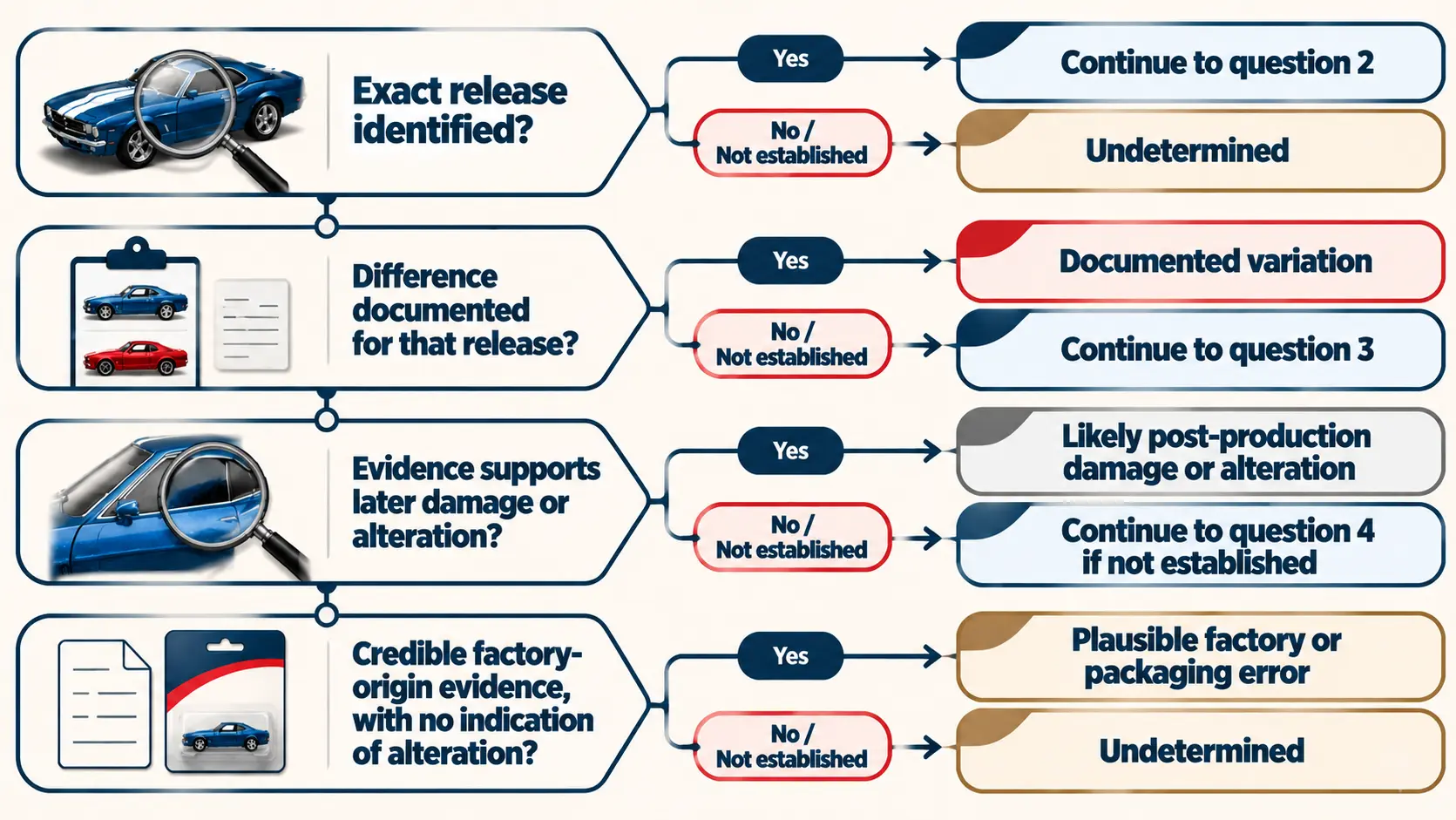
The four outcomes
- Documented variation. Release records show the same difference for that exact release.
- Plausible factory or packaging error. The observation matches a recognized error type, nothing points to later alteration and the evidence reasonably supports a factory origin. “Plausible” is not “certified.”
- Likely post-production damage or alteration. Visible evidence or history points to something that happened after the car left the factory.
- Undetermined. The evidence cannot separate the explanations. This is the safe stopping point, and it is a complete answer. Do not open, pry or modify the car to push it toward a firmer label.
This sequence is a practical way to organize evidence, drawing on Mattel’s public explanation and hobbyDB’s conventions. It is not a Mattel procedure, a certification or proof of authenticity.
When to ask a specialist
Ask an experienced collector or cataloger who knows that specific casting and release when the release is hard to pin down, when the difference is the kind a custom job could imitate, or when a purchase or sale is large enough that a wrong label would matter. Send the evidence record and photos, not the car. Treat the answer as an informed opinion rather than a manufacturer ruling. Collector forums, including the Variations and Errors section of the Mattel Creations community, show active interest in these differences, but a forum post is a lead to check, not proof. Public collector threads about odd cars have turned on which detail actually differs, whether the car was modified and whether the package was resealed. Those are the questions the steps above are built to answer.
Is a Hot Wheels factory error worth more?
Sometimes, but not automatically. What a collector will pay depends on interest in that exact casting and release, condition, how clear and visible the difference is, and how credible the history behind it is. Interest in error cars as a topic is real, but it is not the same as demand for a specific car. An unusual car that nobody can place, or whose label rests on one blurry photo, gives a buyer little to trust.
This guide gives no prices on purpose. A figure detached from the exact release, difference and condition would mislead more than it would help.
If you want a sense of demand, compare completed sales instead of asking prices. A listing shows what a seller hopes to get. A completed sale records a transaction price, although shipping, tax, fees and the exact condition still matter when comparing it with another sale. eBay’s Help center describes a Product research tool that covers up to three years of eBay sales data, including the actual price an item sold for even when a Best Offer was accepted, and it can be filtered by item condition. The same page says it is available to sellers with Seller Hub access, and that ordinary completed-listings results cover a shorter window of about 90 days. Check eBay’s current Help page for who can use it and what it covers.
Then compare like with like: same casting, same release, same kind of difference, similar condition and similar documentation. Product research results are built from your search keywords and filters, which is not the same as matching the car you hold. A sold car that merely looks similar is not an exact match, and a handful of sales does not make a market.
If you are selling, describe the observation and your outcome label, for example “decoration absent compared with the reference, origin undetermined,” rather than “rare error.” If you are buying, ask for the photo groups above and the history before relying on a label.
Collector evidence worksheet: document your findings
Use this blank worksheet for one car. Record observations first, then consider other explanations before choosing an outcome. You can print this page or open the plain-text template below to copy the fields into your notes.
Collector evidence record
A documentation aid, not a factory-error authentication certificate.
Car details
Evidence & observations
Assessment
Open plain-text template to copy
HOT WHEELS EVIDENCE RECORD

Date documented:
Model / casting:
Release, series and year:
How the release was verified (source checked):
Packaging status (carded, opened, loose, unknown):
Anomaly (neutral, observable description only):
Normal reference used (source, and how closely it matches):
Documented known variation? (yes, no or not found, and where you looked):
Photos available (groups 1 to 7, and any missing with the reason):
Condition, history and possible alteration (where found, who handled it, signs of wear or tampering):
Competing explanations (documented variation, factory or packaging error, damage, custom or repair), with a note on each:
Confidence and outcome (documented variation, plausible factory or packaging error, likely post-production damage or alteration, or undetermined):
Reason for the outcome, in one sentence:
What new evidence would change it:
Keep the record in one place and update it when new evidence arrives instead of starting again.
Final takeaway
When a car looks unusual, do four things in order. Identify the exact release. Photograph what is there without disturbing it. Check whether the difference is already documented. Write down the label the evidence supports. If the evidence cannot separate the explanations, “undetermined” is the accurate answer, and a clear record lets you revisit it if new information turns up. Keep the record, and revisit the classification if better release evidence becomes available.
Frequently asked questions about Hot Wheels factory errors
Does a sealed Hot Wheels blister prove a factory error?
No. A package that looks undisturbed supports a factory origin, but a photo cannot always show whether a pack was opened and resealed. A sealed pack also says nothing about whether the difference is already a documented variation. Treat it as one piece of evidence next to the release match and the car’s history.
Can a Hot Wheels car have different wheels without being a factory error?
Yes. Mattel notes that wheel variations occur within a release, and that a similar wheel could be used when a planned one runs short during a long run. You can also swap wheels after purchase. Check the reference for the exact release before calling the difference anything.
Does missing tampo always make a car valuable?
No. Missing decoration can come from wear, a repaint, a recorded variation, or a production miss, and even a well-supported error carries no automatic premium. Demand for that casting and release, condition, and credible history all matter, and asking prices are not sold prices.
Are wrong-card packages always genuine factory errors?
No. A mismatch can come from a factory mistake, but it can also come from a later swap or reseal. Some card differences are legitimate too, since mainline releases are cataloged on U.S. long, international long, and international short cards. Compare the car and card against release records and photograph the seams and edges.
Can two collectors disagree on an error?
Yes. Origin often cannot be settled from photos, and public collector threads show people disagreeing about which detail differs and whether a car was modified. Sources also use different vocabularies, so the same difference can be filed under different labels. A written record with photos and an honest “undetermined” label gives others something concrete to evaluate.