Hot Wheels case codes help collectors identify assortment waves before opening a shipping box. Understanding these codes can help you research which Treasure Hunts belong to a particular case mix. However, a case letter cannot guarantee a chase car or predict exactly when a store will receive an assortment.
Hot Wheels shipping boxes commonly display a printed assortment identifier and a stamped case-mix code. Check the shipping carton for the case letter. When the carton is unavailable, some U.S. mainline blister cards also display the case letter in their printed vehicle-code string. The production code underneath an individual car is different and does not identify its original shipping-case mix.
This guide breaks down every part of the code structure, from the assortment prefix to the version suffix, so you can read any Hot Wheels shipping case like you’ve been doing it for years.
How to Read Hot Wheels Case Codes at a Glance
| Code or Feature | Where to Look | How to Interpret It |
|---|---|---|
| Printed assortment code | Side of the shipping case | Identifies the assortment or packaging format. For example, L2593 is commonly used for U.S. mainline blister-card cases. |
| Stamped case-mix code | Stamped characters beside the printed assortment identifier | In a code such as 976K, the final letter K identifies Case K. Do not confuse the entire stamped block with the case letter. |
| U.S., international and short cards | Assortment identifier on the shipping box and relevant packaging information | Common references include L2593 for U.S. long cards, C4982 for international long cards, and 5785 for short cards. Check the exact packaging format. |
| Version suffix | Additional letters following the stamped case-mix code | For example, PN in L2593-976K PN. Record it as a batch or version reference, not a guaranteed predictor of case contents. |
| Base date code | Underside of the individual car | In the common letter-plus-two-digits format, the letter identifies the production year and the digits identify the production week. For example, N21 and N48 indicate weeks 21 and 48 of 2020. |
| Case mix identification | Case letter in the stamped shipping-box code | Mainline mixes follow A through Q, skipping I and O. The case letter identifies the assortment wave, not a guaranteed retail arrival month. |
How to Read Hot Wheels Case Codes: What Every Letter and Number Actually Means
Hot Wheels shipping cartons use assortment and production markings that help collectors identify the product line and case mix. Placement and format vary between mainline, premium, and other assortments, so first identify which product family the carton belongs to.
On many modern mainline cartons, you can identify a printed assortment code, a stamped case-mix code, and sometimes a two-letter version suffix. A separate packaging-date stamp may also appear. These markings serve different purposes, and not every shipping box uses exactly the same format.
Step 1: The Assortment Code Tells You What Type of Case It Is
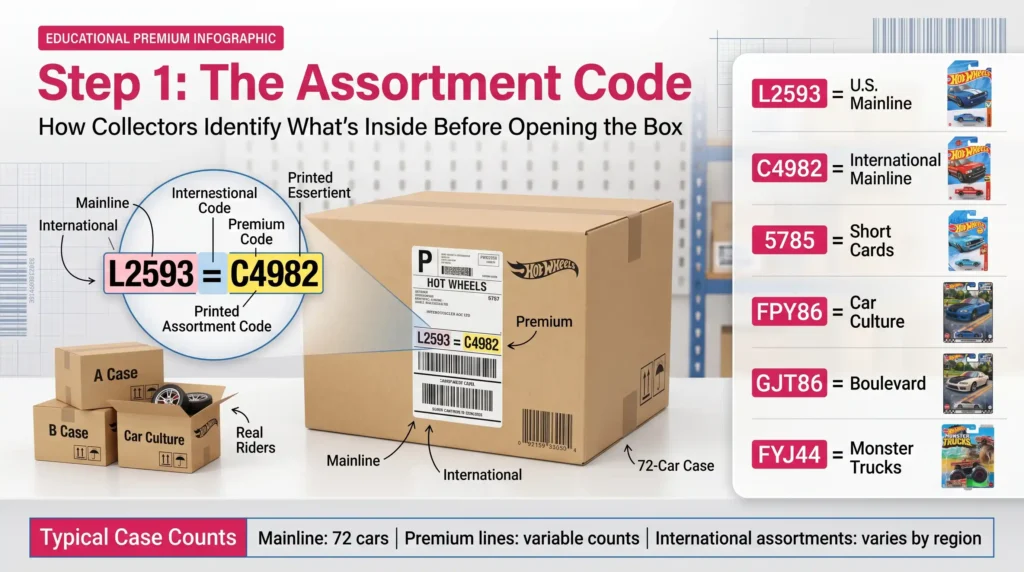
Before you look at anything else, find the printed assortment identifier on the shipping carton. In common mainline carton formats, a dash separates that identifier from the stamped mix code. For example, L2593, C4982, and 5785 are assortment identifiers; the dash belongs to the displayed carton-code format.
This prefix identifies the product line inside. Assortment codes can vary by year and region, but here are the codes collectors have documented most frequently for reference:
- L2593 = Hot Wheels mainline cars on U.S. blister cards
- C4982 = Mainline cars on international blister cards
- 5785 = Mainline on short cards
- FPY86 = Car Culture series
- GJT86 = Hot Wheels Boulevard
- FYJ44 = Monster Trucks
Specialist collector references document these identifiers, but you should still verify the packaging format for the relevant product year. L2593, C4982, and 5785 all identify mainline assortments: U.S. long cards, international long cards, and short cards, respectively. Other codes, such as FPY86 for Car Culture and FYJ44 for Monster Trucks, identify different product families.
Standard U.S. mainline cases typically hold 72 pieces. Premium lines and international assortments vary, so don’t assume that count applies across the board.
Step 2: The Case Mix Letter Is the Code Collectors Actually Care About
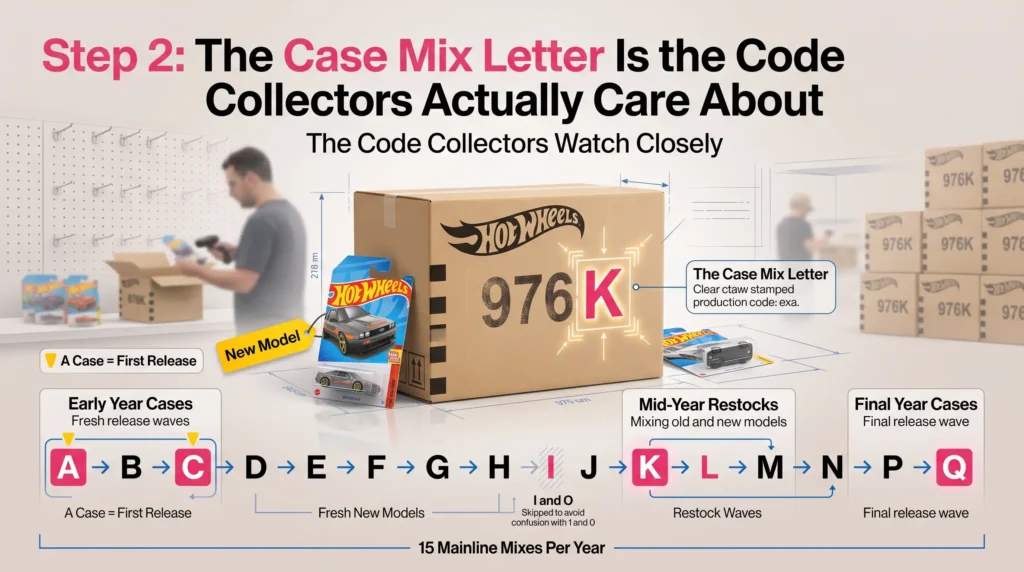
Right next to the assortment code, you’ll find a stamped block of characters. The last letter in that block is your case mix.
For example, if the stamped block reads 976K, the mix is K.
Mattel releases 15 mainline case mixes every year, following this sequence:
| Mix Letter | Position in Year |
| A | 1st release |
| B | 2nd release |
| C | 3rd release |
| D | 4th release |
| E | 5th release |
| F | 6th release |
| G | 7th release |
| H | 8th release |
| J | 9th release |
| K | 10th release |
| L | 11th release |
| M | 12th release |
| N | 13th release |
| P | 14th release |
| Q | 15th release (final) |
Notice that I and O are skipped. They’re too easy to confuse with the numbers 1 and 0. So the sequence goes A through H, then jumps to J, and skips O entirely on the way to Q.
Each mainline mix may include newly introduced castings, recolors, and models carried forward from earlier assortments. New vehicles can also appear in later mixes, including Case Q. Collectors should track actual case arrivals rather than assuming Cases A and B appear in January or February. New model-year assortments can arrive before the calendar year begins, and retail timing varies by region and store.
To follow these case mixes as they roll out through the year, use our 2026 Hot Wheels release tracker for month-by-month case updates and release coverage.
For practical examples, start with our January 2026 Hot Wheels release guide to see the early-year cases. Then compare the later assortments in our September 2026 Hot Wheels release guide and October 2026 Hot Wheels release guide. These articles demonstrate how collectors follow changing case mixes without assuming every retailer receives them in the same month.
For a practical side-by-side example of two consecutive mainline assortments, explore our 2026 Hot Wheels M vs N Case comparison guide. It compares both cases, their regular and Super Treasure Hunts, and key collector differences without treating case letters as fixed calendar-month releases.
If you’re just getting started with the hobby, the Hot Wheels Collecting for Beginners guide is worth reading alongside this one. It puts the case system into full context.
Step 3: The Version Suffix and What It May Indicate
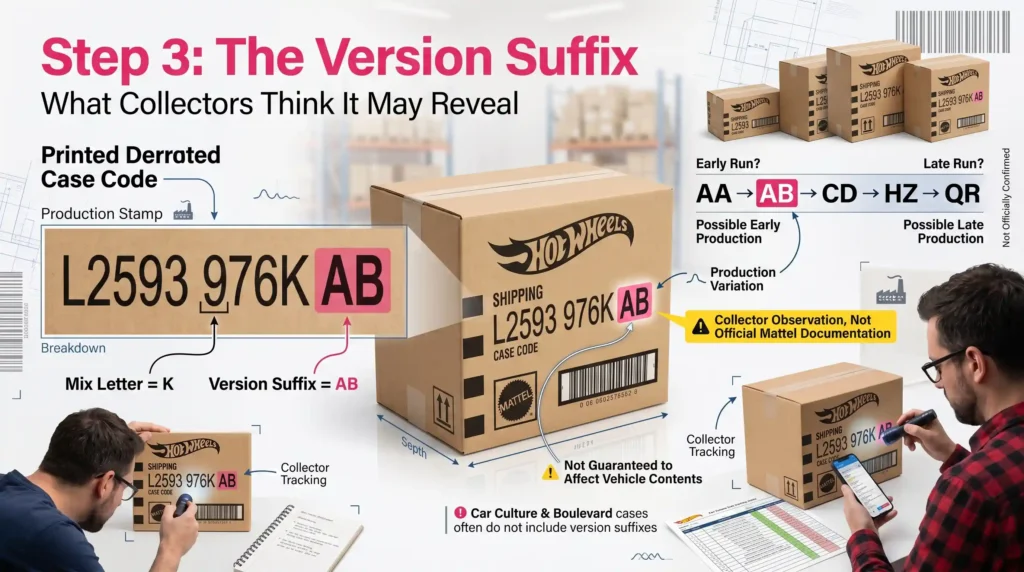
After the mix letter block, you’ll often see a two-letter suffix. Collectors have observed that these letters may reflect internal production variation within the same mix, potentially indicating how far along in the production run the case was packed.
As a rough collector reference:
- Earlier suffix letters (like AA, AB, CD) tend to appear on cases packed earlier in the mix run
- Later suffix letters (like HZ, QR) tend to appear on cases packed later
That said, this suffix system is not comprehensively documented across all lines, and the relationship between suffix and vehicle content isn’t guaranteed. Treat it as a possible indicator rather than a firm decoding rule. For mainline cases, it’s worth noting, but don’t base purchasing decisions on it alone.
Premium and other non-mainline assortments can use different mix-code and suffix conventions. Do not assume that a U.S. mainline suffix-decoding rule applies identically to Car Culture, Boulevard, or Monster Trucks.
Step 4: Cracking the Date Code to Know When It Was Packed
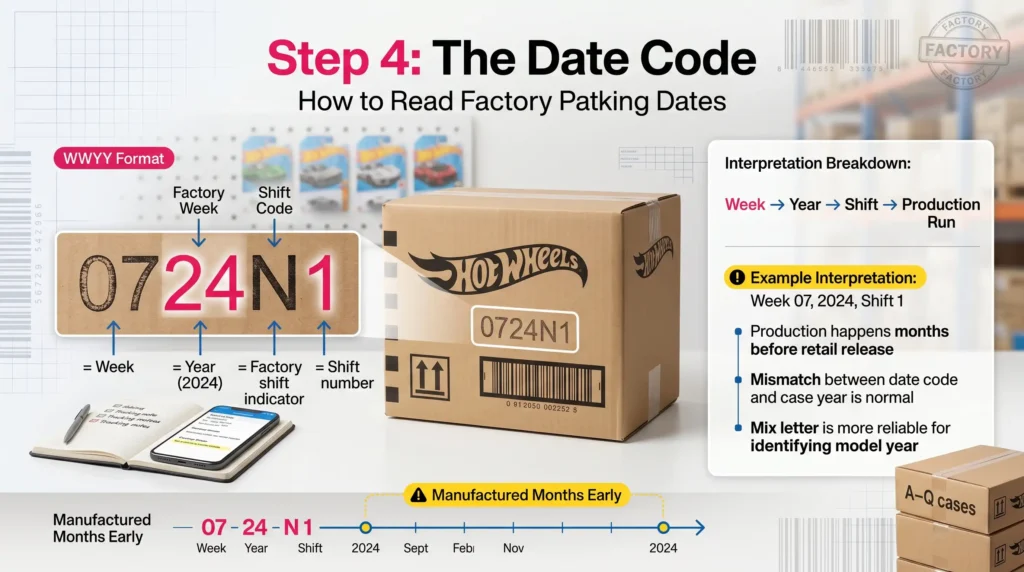
Some mainline shipping cases have a separate packaging date stamp. This should not be confused with the date code stamped underneath an individual vehicle.
A documented example of a shipping-case stamp is 0843N2. In this format:
- 084: The 84th day of the year.
- 3: The final digit of the packaging year. In this example, 2023.
- N2: Additional factory or shift information associated with the packaging operation.
This example indicates a packaging date of March 25, 2023. Use the relevant product year and packaging evidence when interpreting a single-digit year reference.
Manufacturing and packaging dates do not necessarily match the collector release year or the date a case reaches retail. Use the mainline case letter and reliable release records to identify the assortment. Do not use the packaging date alone to determine which vehicles must be inside.
Step 5: The Base Code on the Car Itself
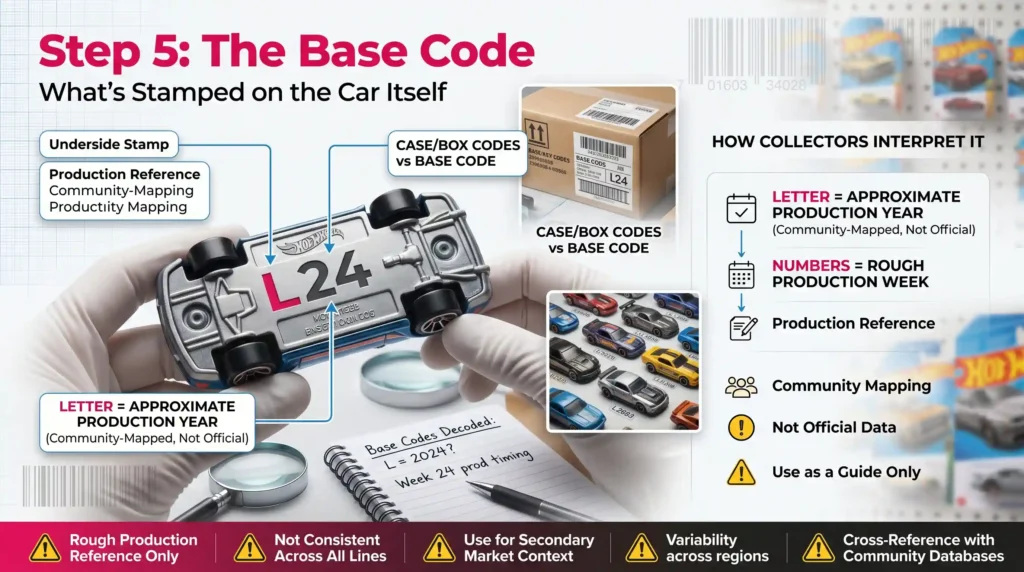
The case box tells you about the shipment. The base code stamped onto the bottom of each individual car is a separate identifier that some collectors use as a rough production reference.
For the commonly used three-character base-code system, the letter identifies the manufacturing year and the two digits identify the production week. This system has been used since 2008, although other code formats also exist.
For example: N21 indicates week 21 of 2020, while N48 indicates week 48 of 2020. For vehicles manufactured under the same code system in 2026, the year letter is V.
Do not confuse this production code with the copyright year molded into the base. The copyright date is not necessarily the year that the individual car was produced. A base date code also cannot identify the exact shipping-case mix by itself.
If you’re trying to date an older model or verify a secondary-market purchase, the base code can serve as a rough starting point. For anything more precise, cross-reference with community databases such as the Hot Wheels Collectors forum or hwheadline.com, where enthusiasts track production details by casting and year.
For a deeper context on what makes certain releases valuable, the guide “Hot Wheels Treasure Hunt Explained” covers the value side in detail.
Putting It All Together: A Real Example
Let’s decode: L2593-976K PN
| Code Part | What It Means |
| L2593 | U.S. mainline blister cards (as commonly documented) |
| 976K | Mix K (10th release of the year) |
| PN | Version suffix may indicate production variation within mix K |
If the same shipping box also carries the packaging stamp 0843N2, that stamp can be read as the 84th day of 2023, or March 25, 2023, using this documented format. The separate 976K code identifies mainline Case K, while PN is the version suffix. The packaging date alone does not prove the exact vehicle contents.
That’s a solid picture of the box without even opening it, though always verify assortment codes against current collector resources.
Collectors tracking the 2026 Hot Wheels Releases are already applying this method to cross-reference which mix letters are arriving at stores right now.
Why Case Codes Matter for Finding Treasure Hunts
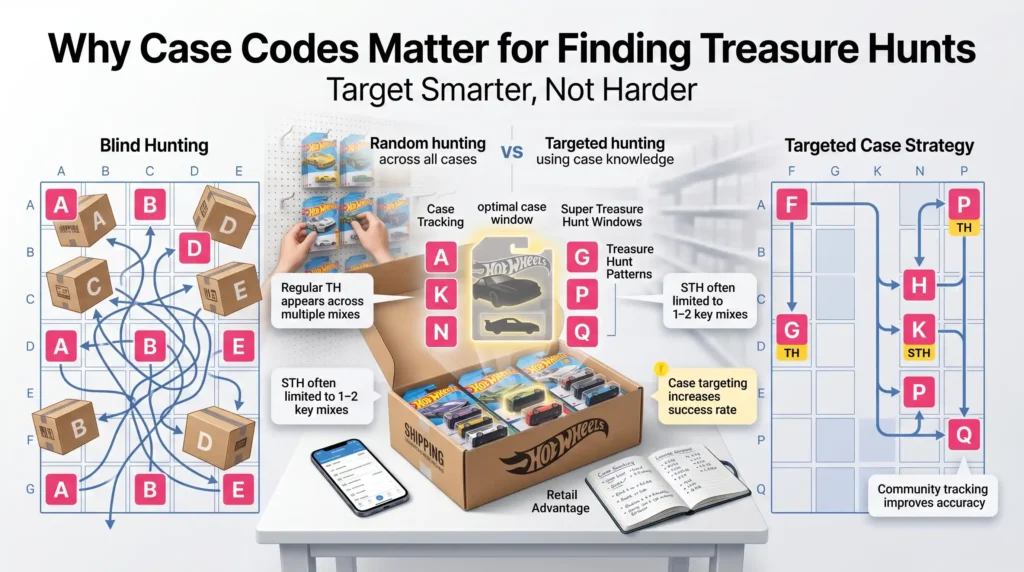
Treasure Hunts and Super Treasure Hunts are important reasons collectors follow mainline case letters. The 2026 specialist-tracked lineup associates a regular Treasure Hunt and a Super Treasure Hunt with each of the 15 used case letters. Knowing the designated chase models for a particular assortment helps collectors identify what to look for. However, the association does not guarantee that any individual sealed carton contains a Treasure Hunt or Super Treasure Hunt.
For identification details beyond the case letter itself, use our complete 2026 Hot Wheels Treasure Hunt guide to compare regular Treasure Hunts, Super Treasure Hunts, symbols, paint, wheels, and case tracking.
That pattern means that if you know which mix is likely to carry the STH for a given model, you can focus your hunting there rather than digging through cases that probably won’t have it.
That’s where the 2026 Hot Wheels Treasure Hunt List becomes a practical tool alongside this decoding knowledge. And if you want to identify one on sight before someone else does, the guide on Spotting a Super Treasure Hunt is essential reading.
Conclusion
Reading Hot Wheels case codes isn’t complicated once you know what you’re looking at. The assortment prefix points you toward the product line, though codes can shift between years, so verify against current community references.
The mix letter tells you where in the year’s release cycle the case falls, and that part is the most reliable piece of the whole system. The version suffix may hint at production variation within a mix, but treat it as a rough guide. The date code gives you the approximate packaging timeline. And the base code on the car itself is a starting point for production reference, not a precise timestamp.
Together, these codes give you more information than most casual buyers ever think to look for. That knowledge gap is exactly why the same collector keeps finding the good stuff while everyone else is left with the carry-forwards.
Start at the assortment code, work your way to the mix letter, and the rest falls into place.
Frequently Asked Questions
How many case mixes does Hot Wheels release each year?
Modern Hot Wheels mainline model years normally use 15 lettered case mixes: A, B, C, D, E, F, G, H, J, K, L, M, N, P, and Q. The letters I and O are skipped to avoid confusion with the numbers 1 and 0.
Case Q is normally the final mix of the model year. Each assortment may contain new models, recolors, and carry-forwards. The case letter indicates assortment order, not a guaranteed calendar-month release date.
Can the same car appear in more than one case mix?
Yes. Many standard Hot Wheels mainline vehicles appear in multiple case mixes, often as carry-forwards alongside newly introduced cars and recolors.
Regular Treasure Hunts and Super Treasure Hunts usually come in a specific case mix. However, that doesn’t guarantee every physical carton contains the designated chase vehicle.
Collectors should consult specialist case checklists and local store sightings to understand which models each assortment includes.
What does the assortment code on a Hot Wheels case actually tell you?
The assortment code identifies the Hot Wheels product family and often the packaging format. Common examples include L2593 for U.S. mainline long cards, C4982 for international mainline long cards, and 5785 for short-card mainlines. FPY86 identifies a Car Culture premium assortment.
On many shipping cartons, the printed assortment identifier is followed by a dash separating it from the stamped mix information.
Not every code other than L2593 identifies a premium product. International and short-card mainlines have their own assortment identifiers.
How do I find the case code if the box has already been opened or discarded?
If you still have the original U.S. mainline long blister card, inspect the printed vehicle-code string on the card. In documented examples, the final letter identifies the associated case mix. For example, a code ending in K indicates Case K.
International long cards and short cards generally do not carry that mix letter in the same card-code position.
If the shipping box and identifying card information are unavailable, use a specialist model-and-case database to determine the likely debut mix.
The production code stamped underneath the car can help estimate its manufacturing year and week, but it cannot identify the original shipping-case mix by itself.
Do international Hot Wheels cases use the same code system?
International Hot Wheels mainline assortments follow the same general case-letter sequence, but their packaging identifiers and printed card codes can differ from U.S. versions.
Common identifiers include L2593 for U.S. long cards, C4982 for international long cards, and 5785 for short cards. The case-mix letter can appear on the shipping carton, while international and short blister cards generally lack the U.S. card-code suffix that identifies the mix.
The 15-letter mainline framework is not exclusive to the United States. However, exact carton contents, packaging information, and retail arrival timing can vary by region. Use specialist case references when the original shipping carton is unavailable.