
Most standard Hot Wheels cars are nominally 1:64 scale, meaning that a full-size dimension divided by 64 gives its target model dimension. Fictional castings may have no full-size prototype to compare. The exact dimensions vary by casting, and some specialty products use other scales such as 1:24, 1:16 or 1:15.
It helps to separate three things: the scale printed on a product listing, the dimensions of a mathematically exact scale model, and the dimensions measured on a specific casting. This guide keeps those three apart, then shows a repeatable way to check a specific car against a storage case, a diorama or a track.
Quick answer: what scale are Hot Wheels cars?
Mattel’s official Hot Wheels FAQ says most of its cars are 1:64, and it notes that some specialty vehicles are larger, at 1:24, 1:16 or 1:15. Mattel also markets its basic car and truck assortment as 1:64 scale.
Nominal scale describes the intended size class, not a guarantee that every casting is a precise 1:64 reduction. As a rough orientation, collector Dave Farquhar describes standard cars as being about 2.5 to 3 inches long (63.5–76.2 mm). Treat that as a starting point with plenty of exceptions, not a rule.
| Term | What it tells you | What it does not tell you |
|---|---|---|
| Nominal scale (1:64) | The intended reduction ratio | The exact length of any one casting |
| Calculated size | What a perfect 1:64 model of a real car would measure | What Mattel actually produced |
| Measured size | What a specific toy measures on your bench | Anything about other castings |
What 1:64 actually means
A scale of 1:64 means one unit on the model stands for 64 units on the real vehicle. The math runs in both directions:
- Model dimension = real dimension ÷ 64, using the same units for both.
- Estimated scale denominator = real dimension ÷ measured model dimension, again in matching units.
One inch is exactly 25.4 millimeters, so converting between the two is straightforward.
One catch matters more than the formula. A car has several dimensions, and each can produce a different scale ratio. A toy might be close to 1:64 in length but noticeably different in wheelbase or height. Averaging those ratios into one “true scale” would hide exactly the variation worth noticing, so it is better to report each dimension separately.
Diecast scale calculator
Convert a real vehicle dimension into a theoretical model size, or estimate the scale ratio of a measured casting. Calculate length, width, height or wheelbase separately.
Calculated dimensions are theoretical, not actual Hot Wheels measurements. Use the same real-world prototype and matching dimension in reverse mode. A ratio alone does not guarantee storage or track fit. If a fictional casting has no documented full-size prototype, report its measurements without estimating a scale ratio.
Worked example: 4,500 mm ÷ 64 = 70.31 mm (2.77 in). Divide the real dimension by the scale denominator to calculate model size. For estimated scale, divide the matching real dimension by the measured model dimension, using matching units. One inch is exactly 25.4 mm.
The calculator controls require JavaScript. The same calculations can be performed manually.
Calculated sizes: what a perfect 1:64 model would measure
To make the math concrete, here are two real cars with published manufacturer dimensions, divided by 64. These are calculations, not measurements of Hot Wheels toys. This page does not claim that a Hot Wheels version of either car exists with these numbers.
| Real vehicle | Length | Width | Height | Wheelbase |
|---|---|---|---|---|
| 2025 Mazda MX-5 soft top (US/Canada, 16-inch wheels) | 61.2 mm (2.41 in) | 27.1 mm | 19.3 mm | 36.1 mm |
| Porsche 911 Carrera (Porsche press-kit version) | 71.0 mm (2.79 in) | 28.9 mm (excluding mirrors) | varies by version, so omitted | 38.3 mm |
The real-car inputs come from Mazda USA’s 2025 MX-5 owner’s manual dimensions page and Porsche’s newsroom press kit for the 911. The Mazda figures apply to that one configuration, since other wheel sizes and the hardtop have different heights. Porsche’s height varies by version, which is why it is left out. The Porsche width does not include mirrors.
These two full-size sports cars would be about 2.41 and 2.79 inches long at exact 1:64 scale. Other cars will have different calculated lengths. A toy that is longer or shorter than its theoretical size is not automatically defective.
Why castings vary: two collector-reported examples
Farquhar published wheelbase measurements from a small collection, on a page last updated September 17, 2023. Two examples from that one collection illustrate how wheelbase-based scale estimates can differ from 1:64.
| Car (as reported) | Full-size wheelbase | Reported model wheelbase | Calculated ratio | Rounded |
|---|---|---|---|---|
| 1940 Ford Woodie Wagon | 2,845 mm | 44 mm | 2,845 ÷ 44 ≈ 64.7 | about 1:65 |
| 1935 Duesenberg | 3,899 mm | 49 mm | 3,899 ÷ 49 ≈ 79.6 | about 1:80 |
We recalculated the ratios from his reported numbers. These come with limits worth stating plainly. They are one collector’s reports, and the exact toy versions and measurement uncertainty are not documented. The full-size figures are as reported rather than cross-checked against manufacturer specifications. They cover wheelbase only, and two cars cannot represent the whole lineup. No first-hand testing of these models is claimed here.
Even so, the contrast is useful. One car sits close to 1:64 and the other is far from it. These two reported measurements cannot establish a representative range for the brand, but they illustrate why the nominal scale alone is not enough.
As for why castings differ at all, a 2018 Car and Driver interview with Mattel designers, written by David Muller, discusses how design is shaped by physical constraints. Designer Jun Imai talks about factors including wheelbase, weight distribution and track performance. That is helpful context, but it is a historical interview and not a specification for any current casting. It does not show that a particular car was altered to suit the track.
Scale comparison: 1:43, 1:64 and 1:87
Scale numbers are easier to feel when you see one car shrunk three ways. Here is a hypothetical 4,500 mm car, a made-up example and not a real product, at three different scale ratios.
| Scale | Calculation | Model length |
|---|---|---|
| 1:43 | 4,500 ÷ 43 | 104.7 mm (4.12 in) |
| 1:64 | 4,500 ÷ 64 | 70.3 mm (2.77 in) |
| 1:87 | 4,500 ÷ 87 | 51.7 mm (2.04 in) |
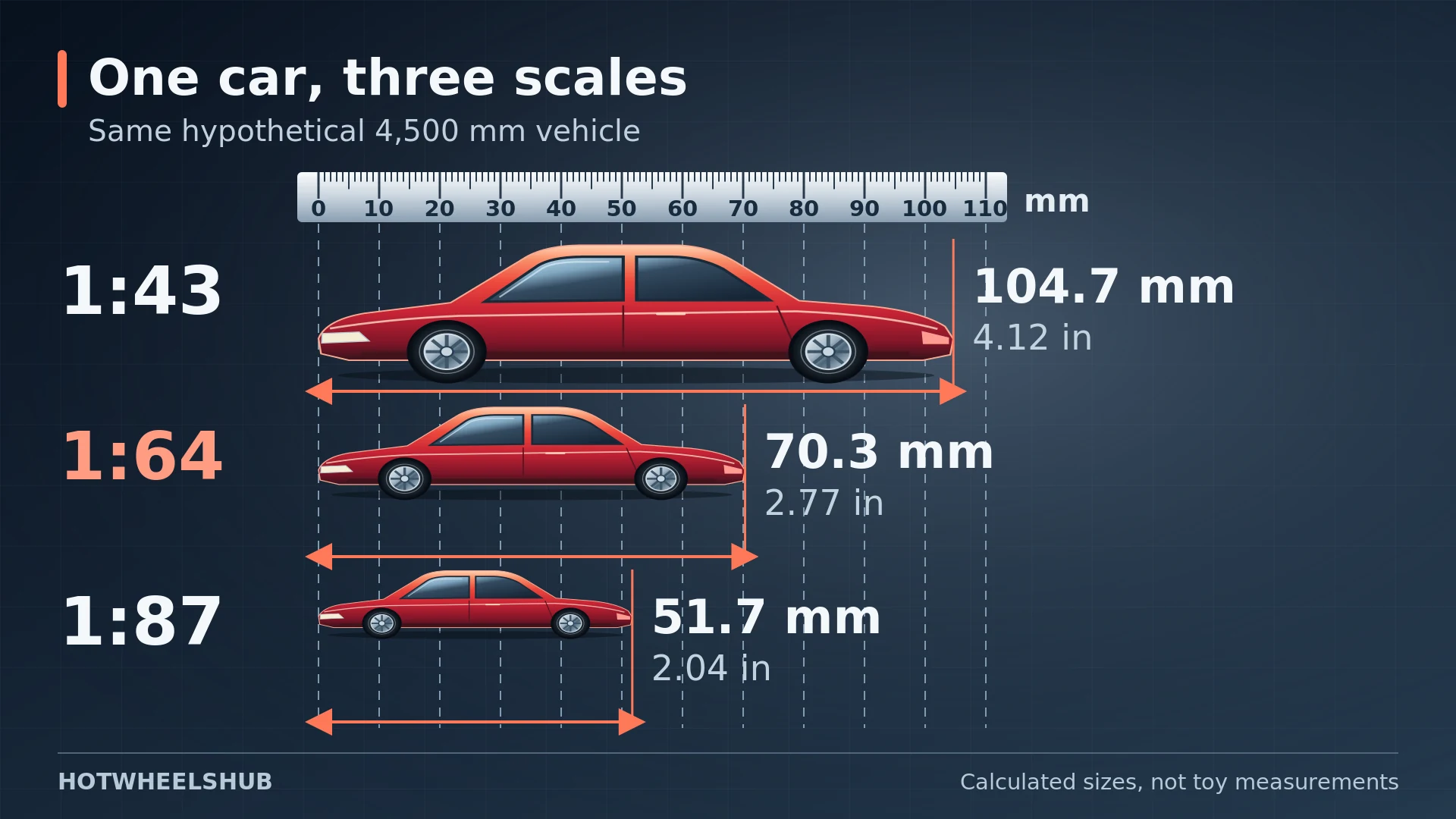
A bigger denominator means a smaller model. It is a plain relationship, but it is the part that most often gets flipped when people shop across scales.
Other scales in the Hot Wheels lineup
Mattel’s FAQ says specialty vehicles can be 1:24, 1:16 or 1:15. Mattel’s own product pages show how mixed things get, even within one theme.
| Mattel product page | Listed scale |
|---|---|
| Monster Trucks die-cast truck (FYJ44) | 1:64 |
| Monster Trucks oversized assortment (FYJ83) | 1:24 |
| RC Aston Martin Vantage (JHW59) | 1:64 |
| Monster Trucks RC truck (HTP15) | 1:15 |
Two cautions follow from this. Not all Monster Trucks are 1:24, and not all RC vehicles share a single scale. Product listings also change over time, so check the current page for any specific item before buying or planning around it.
How to measure a loose car
You need a flat surface and either digital calipers or a ruler marked in millimeters. Calipers are easier to read, but a ruler works if you are careful.
- Length: measure between the furthest front and rear points, including fixed protrusions, with the car sitting normally on its wheels.
- Width: measure the widest point. Note whether that includes mirrors, fenders or wheels, because real-car specs often exclude mirrors.
- Height: measure from the flat surface to the highest point of the car, including any fixed roof accessories or other protrusions.
- Wheelbase: measure from the center of the front axle to the center of the rear axle on the same side.
- Compare: divide the matching full-size dimension by your measurement, using the same units. Using Farquhar’s Woodie Wagon figures, 2,845 ÷ 44 gives about 64.7.
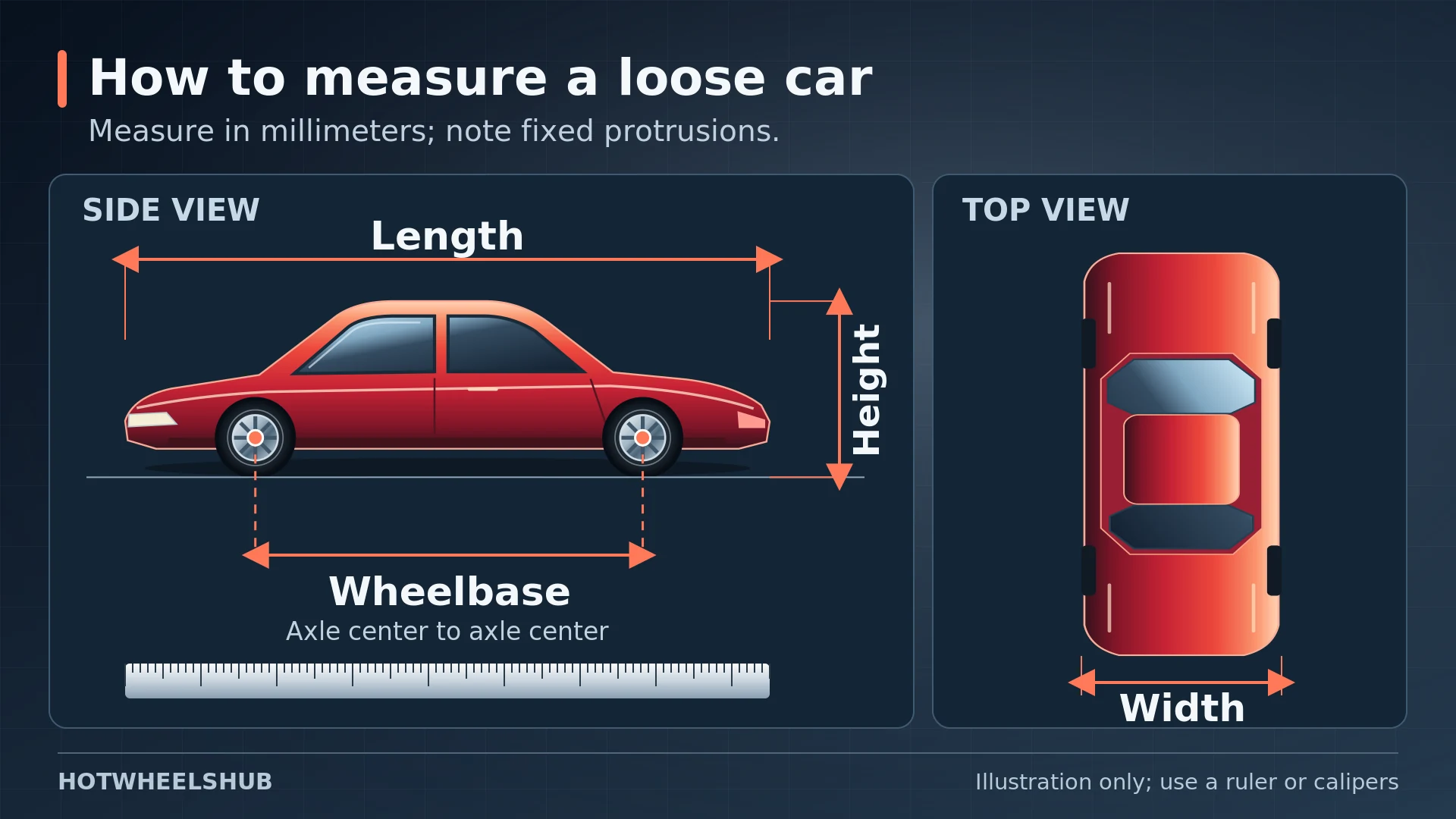
Keep two things in mind. Take each measurement a couple of times and record it in millimeters, since small errors loom large on a car this small. And make sure the full-size figure belongs to the same prototype, meaning the same model, year and body style, or the comparison may be misleading. For a fictional design without a documented full-size prototype, record the toy dimensions without claiming an exact real-world scale. Report length, width, height and wheelbase ratios separately instead of blending them.
How to measure a carded or packaged car
If the car is still sealed, the card or blister is a separate object with its own dimensions. Measure the width, height and thickness of the package, including any header or hook, and use those numbers for storage planning. Do not substitute the toy dimensions for the package dimensions, because the package has its own shape and clearance requirements. If you can’t open it, treat the car’s own size as unknown instead of guessing through the plastic.
Checking fit: cases, dioramas and tracks
Knowing the scale doesn’t tell you whether a specific car fits a specific space. Measuring does.
Storage cases and dioramas
Here is an illustration with made-up numbers. Say a loose model measures 76 × 31 × 24 mm (length, width, height), and the clear interior of a compartment measures 80 × 34 × 28 mm. The total dimensional clearance is 4 mm in length, 3 mm in width and 4 mm in height, not clearance on each side. By the bounding dimensions the car plausibly fits, but that is not a confirmed fit. Before trusting it, check these:

- the door or opening, which can be smaller than the interior
- rounded inner corners that cut into usable space
- protrusions such as mirrors, wings or roof accessories
- padding or dividers that reduce the interior
- enough room to get the car in and out without scraping
For case options, see our guide to Hot Wheels storage cases. If you are planning a display built around this scale, our guide to 1:64 diorama garages and display options covers the setups.
Tracks
Track fit depends on more than scale. Check wheel clearance, body width, wheelbase, weight and ground clearance, and read the manufacturer’s compatibility notes for the specific set. Oversized wheels on trucks are a good example, since they can change how a vehicle sits and runs even when the listed scale matches. Mattel says most standard tracks are designed for standard 1:64 die-cast vehicles, but a 1:64 label alone is not a promise of track compatibility. See our guide to Hot Wheels track sets and drag strips for more context.
The bottom line
Most standard Hot Wheels cars are nominally 1:64, but castings are designed objects, not precise reductions, and some products use entirely different scales. Use 1:64 as a starting point, use a ruler or calipers for anything that has to fit, and expect exceptions. If you are building a collection around that logic, our Hot Wheels collecting guide is a natural next read.
Editorial note: HotWheelsHub is an independent collector publication. Manufacturer specifications and attributed collector reports are distinguished from theoretical calculations. The illustrations are original diagrams, not product photographs or first-hand measurement evidence.
Freqently Asked Question
Are all Hot Wheels cars 1:64 scale?
No. Mattel says most of its cars are nominally 1:64, but some specialty vehicles are 1:24, 1:16, or 1:15. Mattel's Monster Trucks and RC product pages show 1:64, 1:24, and 1:15 listings, so check the specific item.
How long is a Hot Wheels car?
There is no single length, because it varies by casting. A hypothetical 4,500 mm car at exactly 1:64 would be about 70.3 mm, or 2.77 inches. Collector Dave Farquhar gives a rough range of about 2.5 to 3 inches (63.5–76.2 mm), with exceptions.
Are Hot Wheels cars exactly to scale?
Not necessarily. Farquhar's reported wheelbase measurements work out to about 1:65 for a 1940 Ford Woodie Wagon and about 1:80 for a 1935 Duesenberg. Both measurements were reported by the same collector, and the exact toy versions and measurement uncertainty are not documented. They do not represent the whole lineup.
What scale are Hot Wheels Monster Trucks?
It depends on the product. Mattel lists one Monster Trucks die-cast truck at 1:64 and an oversized assortment at 1:24. Some RC Monster Trucks are listed at 1:15, so check the specific item's page.
How do I find the scale of my own Hot Wheels car?
Measure the car's wheelbase, from axle center to axle center on the same side, in millimeters. Divide the real car's wheelbase by your measurement to find the matching prototype scale. Calculate length, width, and height separately, because the ratios can differ. Fictional castings without a documented full-size counterpart cannot be assigned a reliable prototype-based ratio.
Will any 1:64 car fit a Hot Wheels track or display case?
Not automatically. Scale does not guarantee fit. For a case, measure the car against the compartment, including the opening, corners, and protrusions. For a track, check wheel clearance, body width, wheelbase, weight, ground clearance, and the manufacturer's compatibility notes.