Most people think Hot Wheels collecting is just buying toy cars. That mindset is exactly what keeps beginners stuck with duplicates, wasted money, and zero idea what anything is actually worth. If you start without a starter guide, you’ll spend months catching up to what experienced collectors figured out in week one.
A practical collecting strategy starts with understanding standard mainline cars, regular Treasure Hunts, Super Treasure Hunts, Premium assortments, and Red Line Club (RLC) exclusives. Beginners can then choose a collecting theme, set a budget, use reliable model databases, and learn how stock availability varies between local retailers.
This guide walks you through every essential: how to spot valuable finds, where to hunt, how to store properly, and which beginner mistakes quietly kill a collection’s value before it starts.
Hot Wheels Collecting for Beginners at a Glance
Start with these six practical steps to build a collection around your interests, recognize special releases, and avoid common mistakes.
| Step | What to Do | Beginner Takeaway |
|---|---|---|
| 1. Understand the product lines | Learn about Mainlines, regular Treasure Hunts, Super Treasure Hunts, Premium cars and RLC releases. | Understand what you’re buying before comparing different products. |
| 2. Learn Treasure Hunt identification | Check vehicle markings, paint, wheel types and packaging indicators. | Use multiple clues rather than relying on one symbol. |
| 3. Choose a collecting focus | Select a theme, casting, series or brand that interests you. | Set a budget and avoid buying everything you find. |
| 4. Develop a peg-hunting routine | Learn case codes, compare local restocking patterns and track your finds. | Retail arrival times vary. No store visit guarantees a chase car. |
| 5. Protect and display your collection | Decide which cars to keep packaged and which to display loose. | Use suitable storage and avoid excessive heat, moisture and sunlight. |
| 6. Avoid common beginner mistakes | Check seller details, compare completed sales and avoid impulsive purchases. | Collect for enjoyment rather than assuming every purchase will appreciate. |
Hot Wheels Collecting for Beginners: What Nobody Actually Tells You First
If you’ve done any research at all, you’ve probably found lists of “rare” cars with no context for how to find them. That’s not helpful. This section covers the real foundation, the stuff that makes everything else click.
Since 1968, Hot Wheels has introduced thousands of different castings and many more individual releases and color variations. As a beginner, narrowing your focus is the most important decision you’ll make.
Step 1: Understand Mainlines, Treasure Hunts, and Premium Cars
Start by comparing standard mainline releases with the two main types of mainline chase cars: regular Treasure Hunts and Super Treasure Hunts. Hot Wheels also offers separate Premium assortments, including Car Culture and Boulevard, as well as RLC collector exclusives. These product groups differ in features, availability, and pricing.
Understanding these differences helps you identify cars correctly and choose purchases that fit your interests. Rarity and resale value still depend on the particular model, its condition, collector demand, and availability.
| Category | Main Characteristics | Beginner Advice |
|---|---|---|
| Standard Mainline | Regular releases within mainline assortments | Collect the models you like and learn their case context. |
| Regular Treasure Hunt | Special mainline releases with a circle-flame marking | Check both the vehicle and its packaging. |
| Super Treasure Hunt | Harder-to-find variations with special paint and wheels | Verify multiple identifiers before paying above retail. |
- Modern Hot Wheels mainline years commonly contain 250 numbered collector entries, including standard models and regular Treasure Hunts. Recolors and other variations can share the same collector number, so 250 numbered entries do not mean 250 entirely new castings. Mainlines are widely distributed and are a practical starting point for collecting by theme.
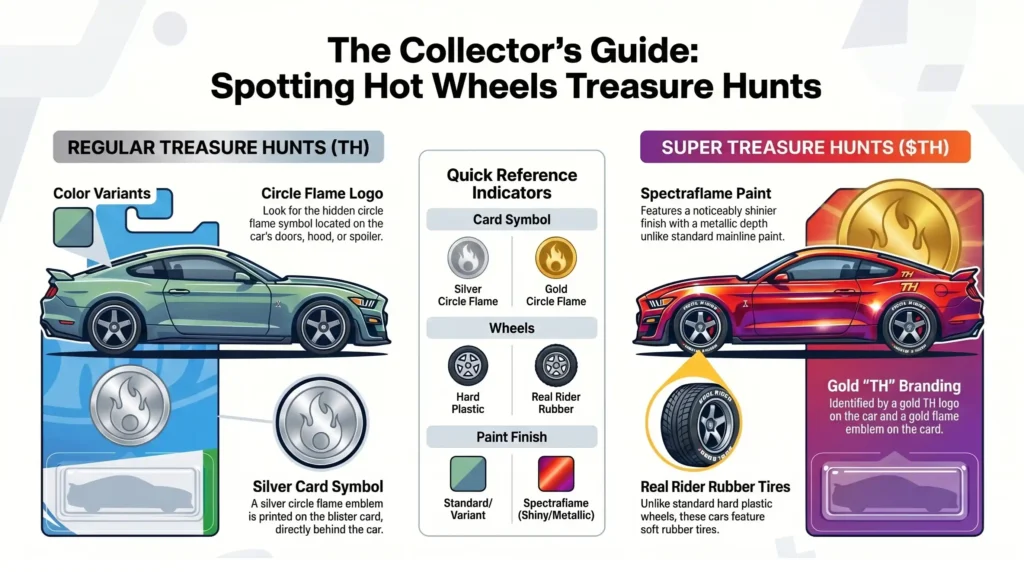
- Regular Treasure Hunts are harder-to-find mainline releases. On modern examples, look for the circle-flame Treasure Hunt marking on the vehicle itself. A silver circle-flame symbol may also appear behind the car on applicable packaging. Availability varies, and exact production totals are not publicly confirmed for individual modern castings.
- Super Treasure Hunts are harder-to-find variations of selected mainline castings. They generally feature Spectraflame paint, Real Riders wheels, a small “TH” marking on the vehicle and a gold circle-flame indicator on applicable modern packaging. A designated Super Treasure Hunt is not guaranteed in every 72-car case.
Understanding this before you walk into any store means you already know more than most new collectors.
Step 2: How to Spot a Treasure Hunt in the Wild
This is where beginners lose the most time. You need to be able to identify these cars in seconds, not after standing in the aisle for five minutes.
A Treasure Hunt hides in plain sight among regular mainlines. Train your eye before your first store visit.
Regular Treasure Hunt identifiers:
- Circle flame logo somewhere on the car body (check doors, hood, spoiler)
- Silver circle flame symbol on the blister card, behind the car
- A designated Treasure Hunt casting confirmed against a reliable checklist; a different paint color alone does not establish that a car is a Treasure Hunt
Super Treasure Hunt identifiers:
- Spectraflame paint — noticeably shinier, with an almost metallic depth compared to standard paint
- Real Riders wheels with rubber tires. Compare visually with reference images rather than pressing or opening a packaged car.
- “TH” marking on the vehicle, often integrated into its graphics; it is not necessarily gold.
- Gold circle-flame indicator behind the car on applicable modern packaging.
Practice these checks on cars you already own. The difference between Spectraflame and standard paint becomes obvious once you’ve seen both side by side.
For a complete explanation, read our 2026 Hot Wheels Treasure Hunt guide. You can also follow our Super Treasure Hunt identification guide for a closer look at paint, tires, vehicle markings and packaging.
Step 3: Choose a Collecting Focus That Actually Holds Your Interest
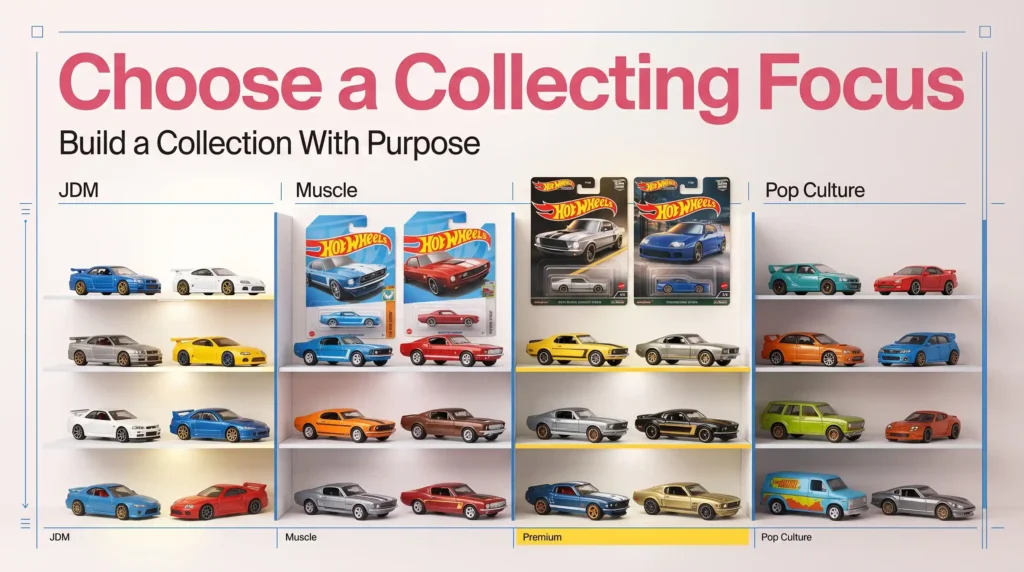
Random accumulation is hoarding. Focused collecting is a hobby worth building.
Picking a theme early does three things: it keeps your budget manageable, makes your collection display coherent, and helps you build real expertise in a specific area.
Popular beginner themes:
- JDM Japanese cars — Nissan Skylines, Toyota Supras, Honda Civics, Mazda RX-7s. If Honda is your focus, explore our guide to collectible Hot Wheels Honda Civic castings for casting identification, Premium releases and documented Super Treasure Hunts. These are popular collecting themes, but secondary-market prices vary considerably by casting, condition, demand and timing.
- Classic American muscle — Camaros, Mustangs, Chargers. Huge casting variety across decades, easy to find at retail.
- Licensed premiums — The Car Culture and Boulevard series offer more detailed castings, Real Rider wheels, and higher-quality paint, targeting adult collectors.
- Pop culture cars — Movie and TV replicas. Batman, Fast & Furious, Knight Rider. These appeal across collector and non-collector audiences.
If you have no strong preference yet, start with a theme or series that genuinely interests you. Mainlines offer an inexpensive introduction, while Premium collections such as Car Culture provide another option for collectors who prefer detailed models. Explore our Hot Wheels Collector Guides hub for additional collecting advice.
Step 4: Where to Hunt and When to Show Up
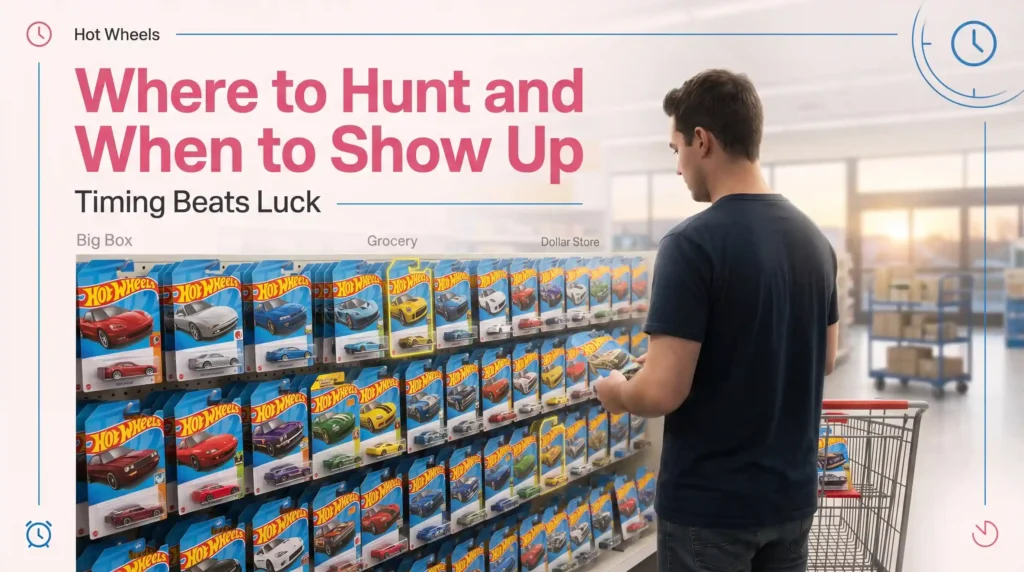
Location matters. Timing matters more. Most beginners show up at random hours and find empty or picked-over pegs.
Best retail hunting spots:
- Walmart and Target are useful places to search for Hot Wheels, but shipment dates and shelf-restocking times vary by store. Some locations restock overnight, while others replenish during different shifts. Track your local stores instead of assuming a universal schedule.
- Grocery chains like Kroger are often overlooked by serious hunters, but they’re worth checking.
- Dollar Tree and Family Dollar are also worth checking where available. Specialist collector records document exclusive 2026 Hot Wheels color variations for these retailers, though availability varies by location.
Timing strategy:
- Restocking schedules vary between stores. Track your local retailers’ actual stock patterns instead of assuming weekday mornings always offer better opportunities.
- Weekend stock conditions vary by store. Compare several visits before deciding which days and times work best for your local hunting routine.
- Building a relationship with a stocker who can tell you restock days is genuinely valuable.
Super Treasure Hunt finds are unpredictable. There is no reliable annual find count or universal best restocking time. Learn how assortment letters work in our Hot Wheels case-code guide. Track the retailers you visit, respect store policies, and compare completed sales before purchasing a particular car online.
Step 5: Condition and Storage That Protects Your Investment
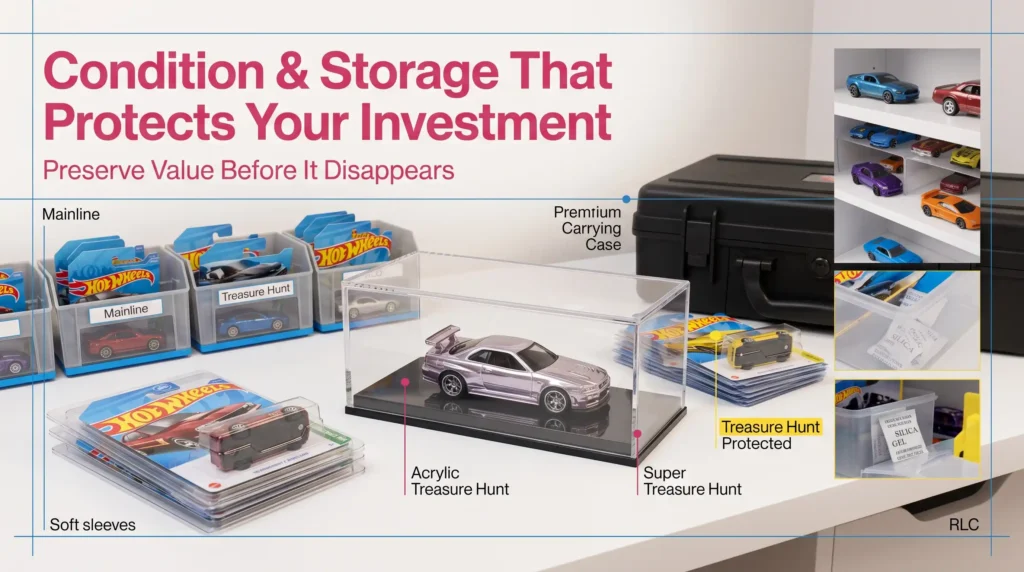
This is the step most beginners skip, and it’s the one that silently destroys value.
Mint-on-card (MOC) matters. Packaging condition can influence collector demand and resale prices, particularly for sought-after releases. However, the difference between carded and loose values varies by individual model and market.
Storage rules that actually matter:
- Store Hot Wheels in a cool, stable indoor environment. Avoid hot attics, direct sunlight, radiators, and repeated temperature changes. Excessive heat can accelerate the deterioration of cardboard and packaging materials; staying below 30°C alone does not guarantee protection.
- Aim for moderate, stable humidity and avoid damp storage areas. Around 40-50% relative humidity can be a practical target for carded collections when achievable, but the main priorities are preventing moisture exposure and avoiding large fluctuations. Use suitable storage enclosures, and monitor humidity if your environment is particularly damp.
- Keep collections away from smoke, dust, and direct sunlight, as these can damage paint, cardboard, and packaging over time.
Protective Storage by Collection Type:
| Collection Type | Protection Options |
|---|---|
| Common loose Mainlines | Compartment organizers or suitable storage cases |
| Carded Treasure Hunts | Correctly sized card protectors |
| Carded Super Treasure Hunts | Rigid protectors sized for the exact packaging |
| RLC Exclusives | Protective cases appropriate for the packaging and display format |
Choose protection based on the car’s dimensions, packaging and how you intend to store it. Our best Hot Wheels storage cases guide compares options for loose and carded cars. For collections you want to showcase, explore our Hot Wheels display shelves and cabinets guide. Measure your cars before choosing individual compartments or display slots. For loose cars that you take on the go, see our recommendations for the best carrying cases for loose cars.
Step 6: Avoid the Mistakes That Cost Beginners Real Money
Learning from others’ mistakes is cheaper than making your own.
Mistake 1: Buying at scalper prices during hype peaks. New STH releases hit eBay immediately at inflated prices. Avoid buying impulsively at inflated asking prices. Compare recent completed sales and monitor prices over time, since resale prices can increase or decrease unpredictably.
Mistake 2: Ignoring fakes. As values increase, so do counterfeit cards and repackaged loose cards. Buy from established sellers, request videos of high-value purchases from multiple angles, and join authentication groups on Facebook.
Mistake 3: No focus. Buying everything that looks cool leads to an unfocused pile rather than a collection. Decide on a theme within your first month.
Mistake 4: Chasing every RLC drop. Red Line Club (RLC) Exclusives are premium, limited models sold directly to members. They’re of exceptional quality, but jumping on every drop without research can quickly overextend your budget.
The Hot Wheels Community: Join Early, Learn Faster
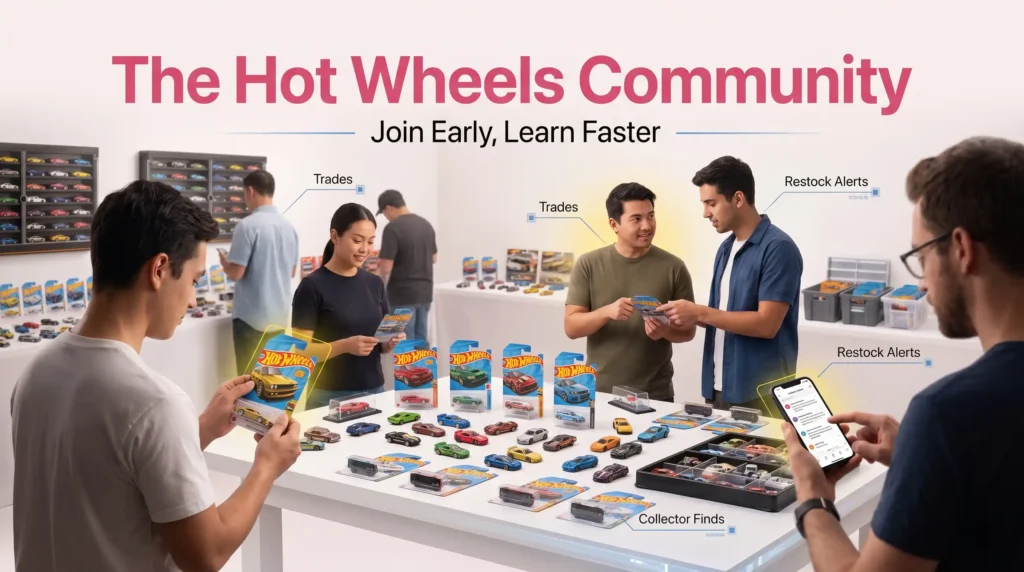
One of the genuinely underrated parts of this hobby is how much knowledge circulates in collector communities.
Reddit’s r/HotWheels is particularly active, with a strong anti-scalping culture and regular trading. Facebook has theme-specific groups for JDM collectors, muscle car hunters, and premium series completionists. Local toy shows and swap meets offer in-person trading without marketplace fees.
In Hot Wheels collecting, community knowledge can significantly accelerate your learning. Collectors share local stock observations, alert one another to new finds, and trade duplicates—benefits that can be harder to access when collecting alone.
If you come across a card with a circle flame while hunting and aren’t sure what you’re looking at, what is a Hot Wheels Treasure Hunt? It’s the first question worth getting a solid answer to before your next store visit.
Quick Reference: Hot Wheels Collecting Tiers at a Glance
| Feature | Mainline | Regular TH | Super TH |
|---|---|---|---|
| Paint | Standard | Usually standard-style | Spectraflame-style |
| Wheels | Usually plastic | Usually plastic | Real Riders |
| Vehicle marking | Standard graphics | Circle-flame | TH |
| Modern card indicator | Standard packaging | Silver circle-flame, where applicable | Gold circle-flame, where applicable |
| Guaranteed per case? | Contents vary | No | No |
Conclusion
Hot Wheels collecting doesn’t have to be overwhelming when you start with a practical plan. Understand the differences between mainlines, Treasure Hunts, Premium releases and RLC exclusives; learn how to identify special models; choose a collecting theme; set a budget; and protect your collection with suitable storage.
The biggest advantage beginners have right now is access to more community knowledge than any previous generation of collectors. Use it. Join groups, ask questions, and don’t let scalper prices panic you into overpaying.
Start small, stay focused, and the collection builds itself over time.
Frequently Asked Questions
What is the best way for a beginner to start a Hot Wheels collection?
Start with a few standard Hot Wheels mainline cars that genuinely interest you. Choose a theme such as Japanese performance cars, American muscle, racing cars, or movie vehicles. You don’t need to chase rare models or buy Premium cars right away.
Learn how regular Treasure Hunts and Super Treasure Hunts differ, and explore Premium lines like Car Culture for more detailed models. Set a budget you can comfortably afford; for example, US $20-30 can be a modest starting budget, but local prices and personal circumstances vary.
Visit retailers when convenient, track local stock patterns, and use trusted collector guides to identify releases. Focus on enjoyment and learning rather than expecting every purchase to gain value.
How do you tell the difference between a regular and a Super Treasure Hunt?
Modern regular Treasure Hunts typically use standard mainline-style paint and wheels and can be identified by the circle-flame Treasure Hunt marking on the vehicle. A silver circle-flame indicator may also appear on applicable packaging.
Modern Super Treasure Hunts are harder-to-find upgraded variations of selected mainline models. They generally feature Spectraflame paint, Real Riders wheels with rubber tires, and a small “TH” graphic incorporated into the vehicle decoration.
Applicable modern packaging may show a gold circle-flame indicator behind the car.
Always compare the specific model against a reliable Treasure Hunt checklist. Paint color or packaging alone is not enough to confirm authenticity.
Are Hot Wheels worth investing in for beginners?
Hot Wheels resale values vary by casting, condition, demand, market and timing. Some collectible releases command higher secondary-market prices, but appreciation is never guaranteed. Beginners should collect primarily for enjoyment, set a budget and compare recent completed sales rather than treating asking prices as established market values.
Which Hot Wheels series should a beginner collect first?
Standard Hot Wheels mainlines are usually the easiest starting point because they offer a wide range of castings and collecting themes at comparatively accessible retail prices.
If you prefer more detailed models, consider Premium collections like Car Culture or Boulevard, which feature enhanced detailing and often use Real Riders wheels.
Beginners who enjoy searching for special releases can also learn about regular Treasure Hunts and Super Treasure Hunts. Use a current-year tracker to check individual models rather than relying on older release lists. The best series to collect is the one that matches your interests, available space, and budget.
Is it better to keep Hot Wheels in the package or open them?
Keeping a collectible car in its original packaging may help preserve its condition, but the best choice depends on your collecting goals. The price difference between packaged and loose examples varies by model and market. Opening common Mainlines is also a reasonable choice if you prefer handling or displaying your cars loose.
If maintaining packaging condition matters to you, use a properly sized protector for collectible carded cars, including valuable Treasure Hunts and RLC releases. If you prefer handling or displaying loose cars, opening them is a valid collecting choice. There is no need to buy duplicates unless you genuinely want both a carded and a loose example.
For either approach, store cars away from direct sunlight, excessive heat, damp conditions, dust, and major temperature or humidity fluctuations.
Which Hot Wheels should a new collector buy first?
Start with one to three affordable Hot Wheels mainline cars featuring models or themes you already enjoy. Popular starting points include sports cars, Japanese imports, muscle cars, and movie vehicles. Learn the model names and packaging, then expand gradually. You don’t need a Treasure Hunt, Super Treasure Hunt, or RLC exclusive to start a worthwhile collection.