Hot Wheels Premium and Mainline cars look similar on store shelves, but picking the wrong one for your collection is a costly mistake most new collectors make. The gap between these two lines is bigger than the price tag suggests.
Quick Answer: Mainline Hot Wheels usually pair a die-cast metal body with a plastic base and wheels, and a basic car can cost about $1.25 in the U.S. Premium Car Culture cars typically feature Metal/Metal construction, Real Riders rubber tires, and richer decoration, with many singles priced around $6.50. Prices vary by retailer and release.
In this guide, you’ll get a clear breakdown of both lines, including build quality, pricing, collectibility, and which one actually fits your goals. For broader collecting advice, explore our Hot Wheels collector guides.
Premium vs Mainline Hot Wheels Comparison at a Glance
| Feature | Mainline Hot Wheels | Premium Hot Wheels |
|---|---|---|
| Construction | Usually a diecast metal body with a plastic base | Typically Metal/Metal construction in lines such as Car Culture, with a metal body and chassis |
| Wheels | Usually standard plastic wheels | Real Riders rubber tires on Car Culture and many other Premium releases |
| Paint and Tampos | Generally simpler graphics and decoration | Typically more detailed tampos, realistic liveries and additional decoration |
| Packaging | Standard Hot Wheels blister card | Themed collector cards or presentation packaging, depending on the series |
| U.S. Price Reference | $1.25 for a standard basic car listed by Mattel | $6.50 and up for selected Premium Car Culture singles, with other formats priced differently |
| Collector Profile | Budget-conscious collectors, beginners, broad collections and track enthusiasts | Collectors prioritizing realistic detail, display presentation, licensed vehicles and themed sets |
Note: These are typical differences, not universal specifications. Some special mainline releases, including Super Treasure Hunts, feature upgraded wheels and finishes. Prices are illustrative U.S. references and vary by retailer, region and release.
Most people assume “premium” just means more expensive. It doesn’t. These two lines serve completely different collectors, built around different priorities from the factory floor up. Understanding that separation is what separates casual buyers from smart collectors.
Here’s the full picture.
Build Quality: Metal/Metal vs Plastic Base
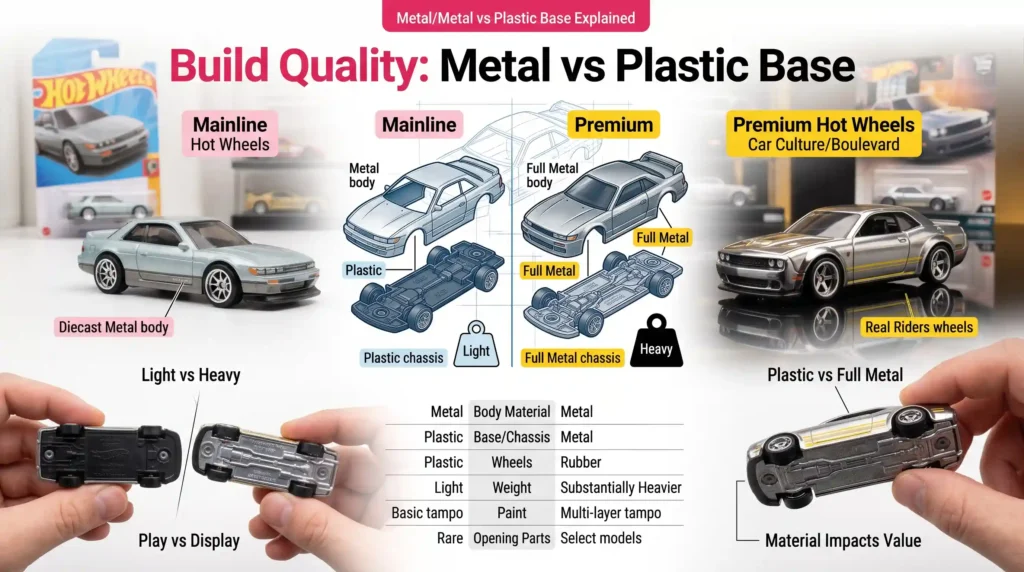
The most immediate difference shows up the second you hold both cars.
Mainline Hot Wheels feature a diecast metal body on a plastic base. That keeps production costs low and retail prices at roughly $1.25–$2 per car, though pricing can vary by retailer and region. The cars feel light. They’re built for play and track racing, which is exactly what they’re designed for.
Premium Hot Wheels go further. They use a Metal/Metal construction, meaning both the body and the chassis are diecast. The weight is noticeably different in hand. Premium cars in lines such as Car Culture and Boulevard typically feature Metal/Metal construction, although specifications can vary by individual release.
Key build differences at a glance:
| Feature | Mainline | Premium |
| Body Material | Diecast metal | Diecast metal |
| Base/Chassis | Plastic | Diecast metal |
| Wheels | Plastic 5-spoke | Real Riders rubber |
| Weight | Light | Substantially heavier |
| Paint Layers | 1-2 tampo layers | Multi-layer tampo printing |
| Opening Parts | Rare | Available on select models |
That weight difference isn’t just tactile satisfaction. The heavier metal construction adds to the premium feel, but resale value depends on the specific release, collector demand, rarity, and condition.
If you’re new to the hobby, the Hot Wheels Collecting for Beginners starter guide provides a solid foundation for what to look for when starting a collection.
Real Riders Wheels: The Single Biggest Upgrade
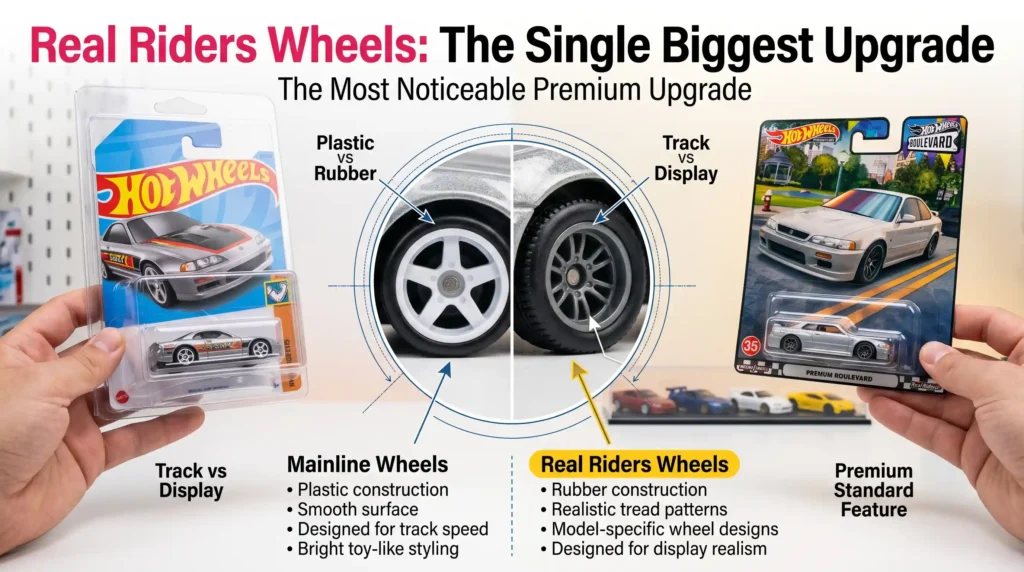
Ask any serious collector what separates these two lines most visibly, and the answer is almost always Real Riders.
Mainline cars roll on plastic wheels. They’re functional, colorful, and fast on orange track. But they don’t look realistic on a display shelf.
Real Riders are rubber tires with proper tread patterns, molded to replicate the specific wheel style of the actual vehicle. Car Culture uses them. Boulevard uses them. Most premium lines use Real Riders as a defining feature, though it’s worth checking individual releases since not every premium product is identical.
Real Riders are a significant factor in the price difference. They add visual realism that plastic wheels simply can’t replicate, and they’re one of the first things experienced collectors check when evaluating a new premium release.
This is why premium cars display so much better. The rubber tires, combined with the heavier metal base, give them a presence that plastic-wheeled mainline cars simply don’t have on a shelf.
Tampo Printing and Paint Detail
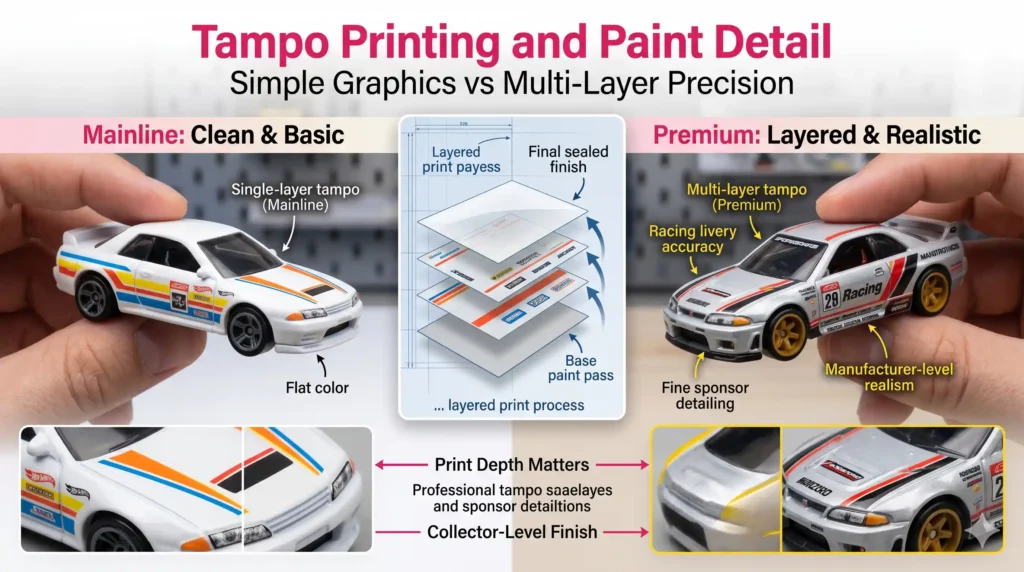
Mainline Hot Wheels have clean, fun graphics. The tampo quality is fine for the price. You’ll see bright colors, basic sponsor logos, and simple liveries. Nothing wrong with that at $2.
Premium models run multi-layer tampo printing. This means the car goes through more print passes to build up sponsor decals, racing stripes, brake caliper details, and manufacturer badging. The result looks far closer to the real vehicle.
On series like Fast and Furious sets or Japan Historics, the print work often rivals brands that charge three to four times more per model. This attention to detail is part of what justifies the collector pricing.
Licensing and Vehicle Selection
There’s another layer here that often gets overlooked.
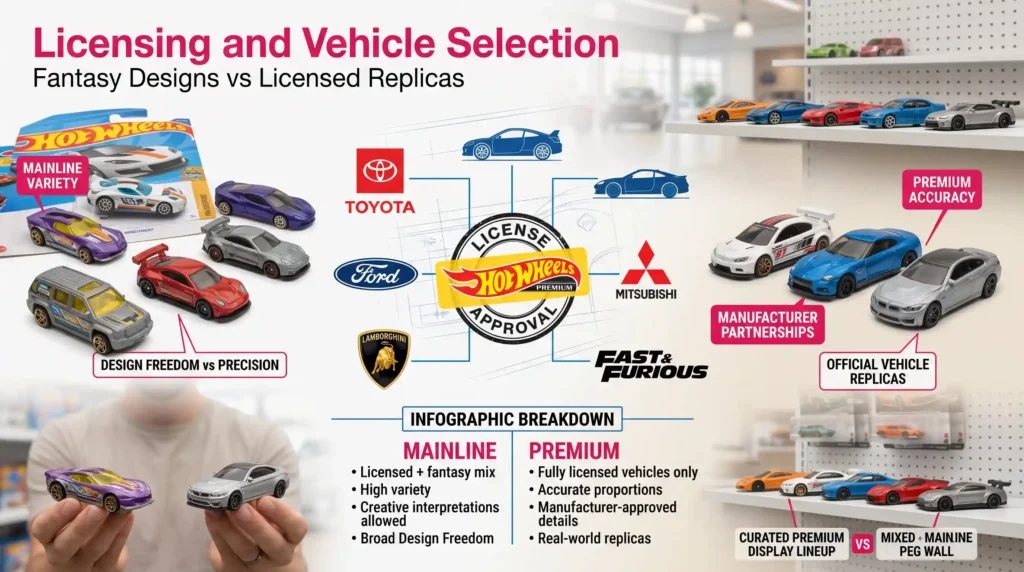
Mainline Hot Wheels include licensed vehicles as well as many original fantasy castings and simplified versions of real cars. The selection is massive, with over 250 new models released each year.
Premium lines operate with stricter licensing agreements. Every car in a Car Culture or Boulevard set is an officially licensed vehicle. Mattel has agreements with manufacturers such as Toyota, Ford, Lamborghini, and Mitsubishi, as well as with entertainment properties for the Fast and Furious and Pop Culture series.
These licenses cost money. That cost flows through to the retail price, but it also means every model is an accurate replica, not a loose interpretation.
For collectors tracking specific releases and case assortments, understanding how to read Hot Wheels case codes is genuinely useful before you start hunting premium sets.
Packaging and Presentation
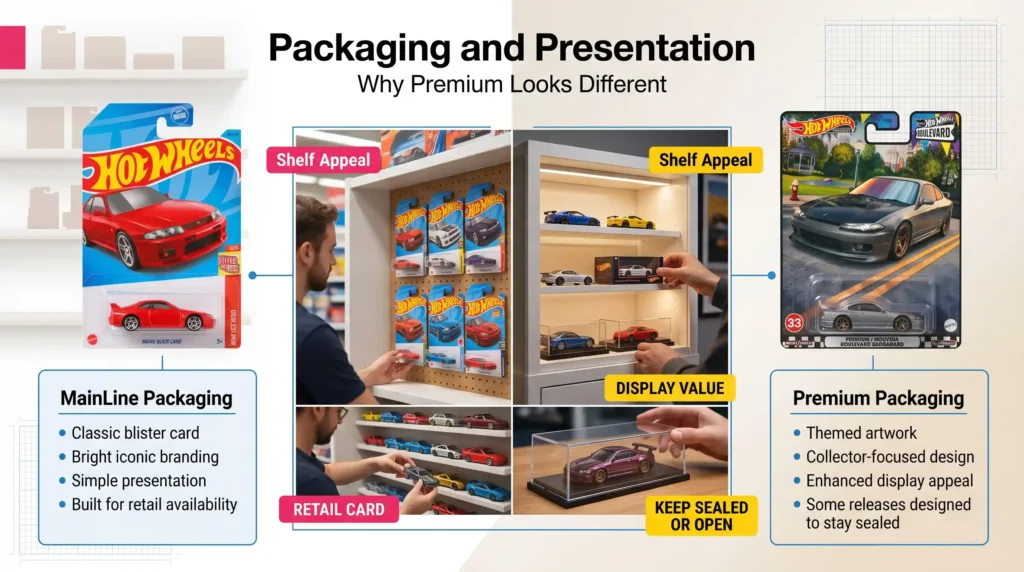
This is an underrated factor for display collectors.
Mainline cars come in the classic blister card. Simple, bright, iconic Hot Wheels packaging. Functional and familiar.
Premium cars, especially in the Car Culture and Boulevard lines, come in themed collector packaging. The card art is noticeably richer than a standard blister card. Some releases use numbered packaging, and certain series use windowed boxes designed specifically for shelf display without opening. Packaging format varies across lines and years.
If you’re building a shelf display, the premium packaging adds aesthetic value. Some collectors keep their premium cars sealed specifically because the packaging enhances display quality.
Protecting and presenting your collection is another consideration. Our Hot Wheels storage case guide covers storage options, while our Hot Wheels display shelves and cabinets guide covers display solutions for different collection sizes.
Pricing and Value Comparison
Here’s where collectors have to think strategically.
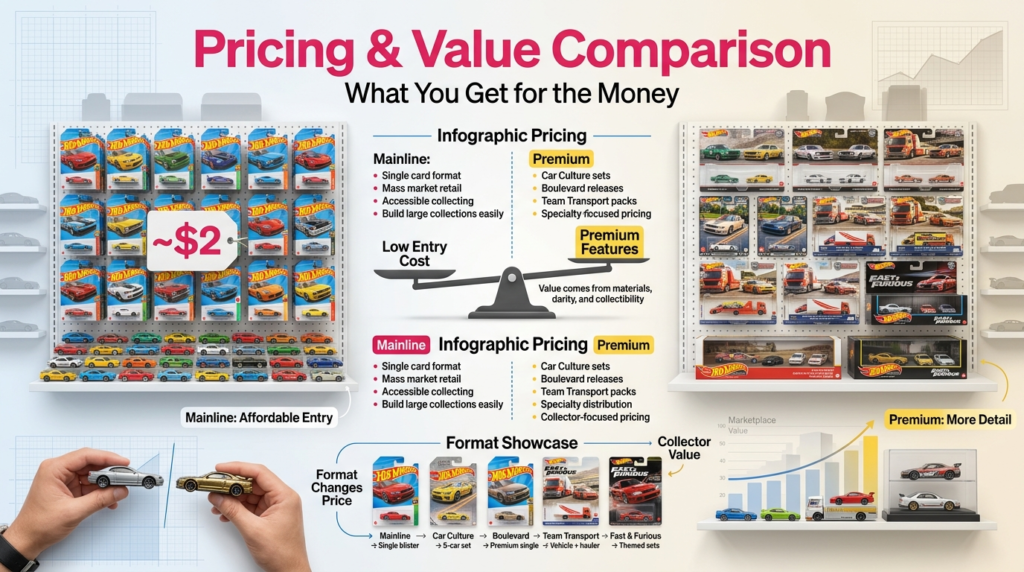
Mainline Hot Wheels retail for roughly $1.25–$2 per car, though exact pricing varies by store and country. They’re accessible, easy to find in any major retail chain, and perfect for building volume collections or completing annual sets.
Premium lines come in several formats. Standard Car Culture 5-car sets, single-car Boulevard releases, two-packs, transport sets, and multi-car assortments vary in price. Looking for the best premium releases to collect? Explore our best Hot Wheels Car Culture sets guide to compare popular options before buying. There’s no single premium price. As a rough guide, individual premium cars tend to fall between $5 and $12, depending on the format and retailer, but that range can shift.
| Series | Format | Availability |
| Mainline | Single card, roughly $2 | Mass market retail worldwide |
| Car Culture | Typically 5-car sets | Specialty stores, online |
| Boulevard | Single cards, various mixes | Primarily Walmart in the US |
| Fast and Furious | Multi-car sets, format varies | Specialty, online |
| Japan Historics | Car Culture subline, set format | Specialty, online |
| Team Transport | Truck and car packs | Specialty, online |
For comparison, competing brands like Greenlight and Auto World sell individual 1:64 models in a similar tier at $14.99 each. Premium Hot Wheels, depending on format, can represent solid value relative to those alternatives.
Some Japan Historics sets have sold for significantly above original retail on the secondary market, though resale prices shift depending on condition, completeness, and market timing.
Who Should Buy Which Line
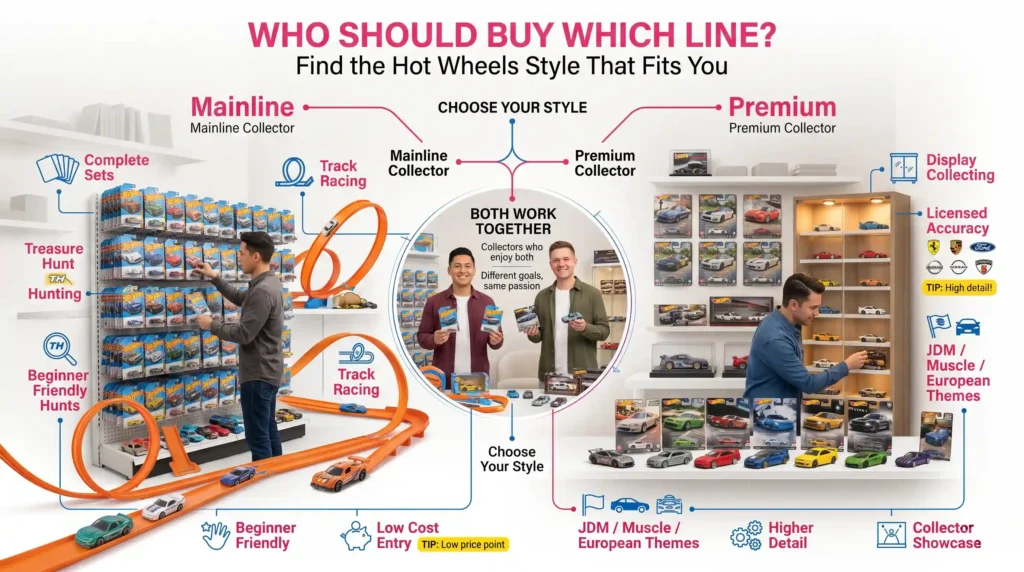
This comes down to what you’re actually doing with the cars.
Mainline Hot Wheels are the right choice if you:
- Are building a broad collection or completing annual sets
- Enjoy track racing and play
- Want to hunt Treasure Hunts and Super Treasure Hunts for value at low initial cost
- Are new to the hobby and want to learn without heavy investment
Premium Hot Wheels are the right choice if you:
- Focus on display collecting
- Want vehicles tied to specific automotive cultures like JDM, European, or American muscle
- Want vehicles that often see stronger secondary-market demand over time
- Need licensed accuracy for a franchise collection like Fast and Furious
Many collectors do both. Mainline cars fill out the numbers and provide the treasure hunt excitement. Premium cars serve as showpieces, displayed prominently rather than stored in cases.
For a broader look at what collecting strategies work for different goals, Hot Wheels Collecting covers the hobby in depth.
If you’re keeping up with current releases, the 2026 Hot Wheels Releases guide and the 2026 Treasure Hunt list are worth bookmarking.
Follow our 2026 Hot Wheels release tracker for current mainline and Premium release coverage. If you enjoy searching for chase cars, explore our 2026 Treasure Hunt identification and hunting guide for practical collecting information.
Major Premium Lines Worth Knowing
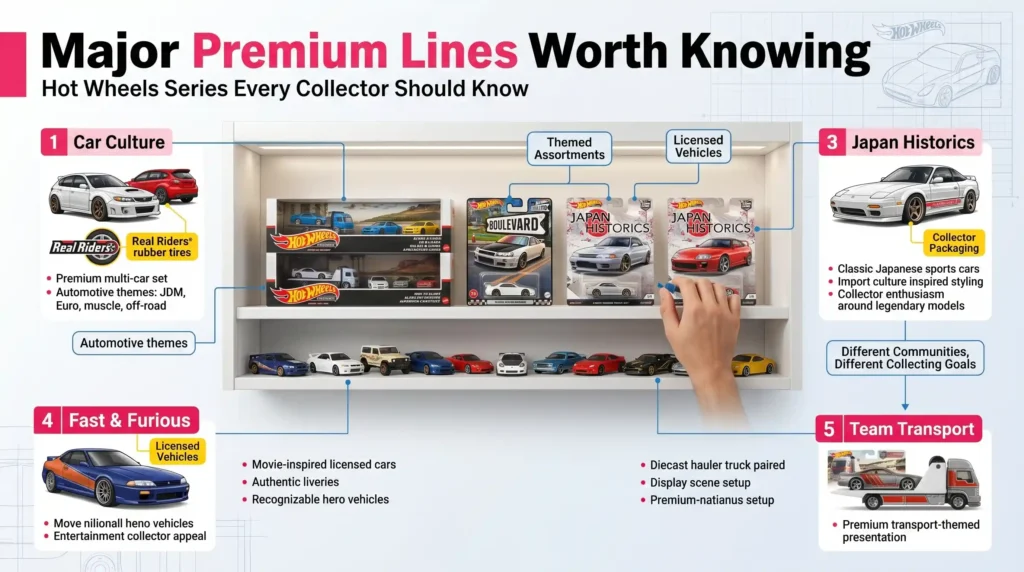
Not all premium Hot Wheels are the same. Here’s a quick breakdown of the main series:
Car Culture (2016-present): Adult collector-focused. Themed around automotive subcultures like JDM, Euro, muscle, and off-road. Most cars feature Real Riders and metal-on-metal construction, though formats and specs have varied across years. Releases are generally multi-car thematic assortments.
Boulevard (2012-2013, revived 2020): Originally launched as a premium single-card line, Boulevard has been distributed primarily through Walmart in the US in its revived form, though availability has varied by region and year. Focuses on street machines, vintage icons, and modern performance cars.
Japan Historics: A themed subline within Car Culture dedicated to legendary JDM vehicles. Popular with collectors who follow the import car scene. Some releases have shown strong secondary-market interest, though results vary by set and market.
Fast and Furious: Licensed movie replicas with authentic liveries. Comes in multi-car set formats that differ from standard Car Culture packaging. Appeals to franchise fans and die-cast collectors who want accurate versions of the hero cars.
Team Transport: Features hauler trucks paired with the cars they carry. Packaging and format differ from standard Car Culture sets. Popular with collectors building display scenes rather than just shelf rows. Explore our Hot Wheels Team Transport buying guide for a closer look at individual sets.
Each of these lines has different distribution patterns, packaging formats, and collector followings.
Beyond these retail premium lines, collectors can also explore Red Line Club (RLC) exclusive releases through Mattel’s membership program. This guide covers RLC membership, exclusive drops, and Overdrive buying options.
Conclusion
The difference between premium and mainline Hot Wheels isn’t just price. It’s a fundamentally different product built for different purposes.
Mainline offers volume, accessibility, and the thrill of the hunt for $2 per car. It’s the heart of the hobby for casual collectors and track enthusiasts.
Premium gives you metal/metal construction, Real Riders rubber tires, official licensing, detailed tampo printing, and collector-grade packaging. Pricing varies by format, but the quality gap over mainline is clear regardless of which premium line you’re looking at. It’s built for display, serious collecting, and the kind of shelf presence that basic mainline cars don’t deliver.
Most experienced collectors use both lines strategically. The key is knowing what each line actually delivers before you spend.
Commonly Asked Questions About Premium vs Mainline Hot Wheels
Are Hot Wheels Premium cars better for investment than Mainline cars?
Generally, some premium releases do show stronger secondary-market demand than mainline cars. Certain Japan Historics and Car Culture sets have sold above their original retail price after being discontinued, though resale prices depend heavily on the specific set, condition, and timing.
Mainline cars can appreciate too, particularly Super Treasure Hunts, but the ceiling is typically lower for standard releases. For collectors seeking stronger resale potential, limited-run premium series tend to attract more attention on the secondary market.
That said, no die-cast purchase is a guaranteed investment, and buying what you genuinely enjoy collecting always matters more than chasing market value alone.
Can you mix Mainline and Premium Hot Wheels on the same display shelf?
You can, but the visual difference is noticeable. Premium cars sit lower and feel more substantial thanks to their metal base, and Real Riders tires look far more realistic than plastic wheels.
Many collectors separate the two lines into different display sections so the premium pieces aren’t visually diluted.
If mixing is unavoidable, grouping by theme rather than line tends to work better aesthetically. Some collectors actually enjoy the contrast as a way to show the brand’s evolution across different product tiers.
Do Hot Wheels Premium cars work on standard Hot Wheels track?
They can be placed on track, but they’re not optimized for it. Premium cars use Real Riders rubber tires, which create more rolling resistance than the smooth plastic wheels on mainline cars. The metal/metal construction also adds weight, which affects track speed.
Most premium collectors treat these cars as display pieces rather than track racers. If track performance matters to you, mainline cars are the better choice. The premium line is built for shelf presence and realistic detail, not speed runs on orange plastic.
Why are some Hot Wheels Premium series sold exclusively at Walmart?
Boulevard has been distributed primarily through Walmart in the US in its revived form, a distribution arrangement that gives Walmart a dedicated collector product.
Availability has varied over time and by region, so collectors outside the US sometimes find it harder to source at retail and instead rely on online marketplaces or community resellers. This distribution setup doesn’t affect build quality.
Boulevard cars carry the same Metal/Metal construction and Real Riders tires as other premium lines, just with a different retail footprint than Car Culture sets sold through specialty channels.
How do I know if a Hot Wheels car is Premium without opening the package?
Look at the packaging design first. Premium series have noticeably richer card art compared to the standard mainline blister card. The series name, such as Car Culture, Boulevard, or Japan Historics, will be clearly printed.
You can also check the wheels through the packaging. Real Riders rubber tires have a visible tread pattern and a matte finish, while plastic wheels look smoother and shinier. The back of the card also typically lists Metal/Metal construction and Real Riders as features.
Price point is another indicator since premium releases retail at a noticeably higher price than standard mainline single-packs.