The bottom line: match the garage to your display goal
The right 1:64 diorama garage depends on what you want it to do. A covered horizontal garage suits a short illuminated lineup, an open workshop gives photographers more staging room, and a larger two-level display prioritizes car count over a compact footprint. A plain unlit acrylic case remains the simplest option for showcasing one car. None of the current recommendations supplies independently measured usable bay clearance or a front-opening measurement, so measure your largest casting before you shop. This guide is based on researched listings and conservation references, not hands-on product testing.
Quick picks by collector goal
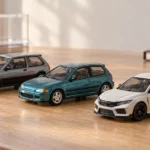
Several ordinary loose cars, lit and lined up
Bivitre red brick six-slot, listed at 11.8 x 5.2 x 3.9 inches exterior.
Read the analysis →Photographing cars in a setting
NUEIOVRW Moriyama Workshop. A deeper square scene gives more foreground room and more camera angles than a shallow six-bay cabinet.
Read the analysis →More cars in a larger multi-level display
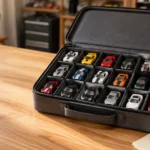
NUEIOVRW Two-Tier LED Garage, advertised for 20+ standard 1:64 cars. Allow for its roughly 11.81 x 11.81-inch base and verify your cars' fit.
Read the analysis →One car, kept simple
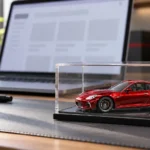
A plain unlit acrylic case such as GreenLight's 55025. No lighting, no power lead, no switch.
Read the analysis →We examine four Amazon-identified product candidates and two reference examples without verified Amazon destinations. Check the selected variation and current seller before ordering.
If you collect carded cars, this is the wrong page. Sealed blisters need a Hot Wheels card protector, and a whole-collection display is a different purchase again, covered in our guide to Hot Wheels display shelves and cabinets. This guide focuses on loose cars displayed in miniature buildings or individual cases.
How we researched this guide
We have not bought, assembled, measured or photographed any product on this page, so nothing here describes how anything feels or holds up over time.
What we did do:
- Matched product identities to Amazon US records or specialist retailer descriptions, keeping variant names and package-contents claims separate from promotional photographs.
- Distinguished advertised exterior dimensions and capacity from measured interior fit. The selected models lack independent bay-clearance and front-opening measurements; advertised capacity is not a guarantee that all castings fit.
- Recorded conflicts rather than picking a side. Where two sellers of the same item disagree on size or power supply, that disagreement appears in the write-up.
- Used published conservation research from the Canadian Conservation Institute for the general behaviour of acrylic, dust, static and display lighting. Those sources describe materials and light in museum contexts. They have not examined any product named here, any diecast finish, or any consumer LED strip.
We do not publish exact prices or promise live availability. Amazon product records can change between checks, and different-looking variants can share listing families. Confirm the selected model, seller, current offer and included accessories before paying.
A product receives an individual section when its identity and useful published details can be traced. The G-Fans station and GreenLight single-car case remain reference examples rather than invented Amazon recommendations.
At a glance: compare the display formats
Sizes below are seller-advertised exterior measurements unless marked otherwise. None of these products has independently measured usable parking-bay clearance or front-opening measurements in the sources reviewed.
Amazon-identified products. Product identities are matched. Amazon listings are identified by ASIN, but the selected variation, seller and buyer-specific availability still need confirmation.
| Model | Choose it for | Capacity | Exterior size | Interior figure | Material and structure | Lighting and power | Main limitation |
|---|---|---|---|---|---|---|---|
| Bivitre red brick (B0CPLLMBWJ) | Lit horizontal lineup | 6 spaces | 11.8 x 5.2 x 3.9 in | Not published | Acrylic cover and plastic base per listing; brand copy describes a printed PVC structure | LED kit included; adapter vs cable only not stated | Many near-identical colourways under separate listings |
| NUEIOVRW Moriyama (B0G3GB1GQD) | Photography | Not stated | 11.81 x 11.81 x 5.51 in | Not published | Assembled printed panel scene; open front | LED confirmed; power source not verified | Deep footprint, open front, no dust barrier |
| NUEIOVRW Two-Tier (B0F9PSTYJ3) | High-capacity multi-level desktop display | Seller claims 20+ standard 1:64 cars across 2 levels | Seller states each module is 11.81 x 11.81 in; double-level unit described as 7.48 in tall | Usable bay and front-opening clearance not published | Modular garage with 2 mm sliding acrylic door, per seller | Separate USB lighting groups with three color modes and 10-step dimming advertised | Requires a large desktop footprint; capacity and casting fit untested |
| Waivvy Silent Scream (B0F6SYB87Q) | Distinctive printed backdrop | Seller states 6 spaces per level | 4.1 x 5.1 x 11.8 in, orientation unclear | Not published | PVC foam board panels with acrylic cover; flat-pack assembly | LED roof; USB cable listed; no adapter identified | Size, orientation and per-level capacity need confirmation |
On a phone, scroll the table sideways to compare all columns.
Reference examples. Not affiliate picks, and no Amazon destination established.
| Model | Choose it for | Capacity | Exterior size | Material and structure | Lighting and power | Main limitation |
|---|---|---|---|---|---|---|
| G-Fans 710035 gas station | A roadside scene | Open forecourt | 285 x 300 x 123 mm | PVC and acrylic, flat-packed, snap-together | Interior and sign LEDs, USB with switch | No verified Amazon US offer; specialist stock only |
| GreenLight 55025 acrylic case | One car, no electronics | 1 car | Sellers differ: case 4.75 x 2.25 x 1.75 in, or 5 x 2.5 x 3 in | Clear acrylic cover on plastic base | None | Unlit; seller measurements and UPCs conflict |
On a phone, scroll the table sideways to compare all columns.
Neither table guarantees that your specific car fits. Seller-advertised car counts do not replace usable bay and front-opening measurements.
Bivitre red brick six-slot LED garage
Best for: six ordinary loose cars lit and lined up on a shelf, where the lighting is decoration rather than photographic equipment.
Skip it if: you want depth for photography, or your cars are tall enough that roof clearance is a live question.
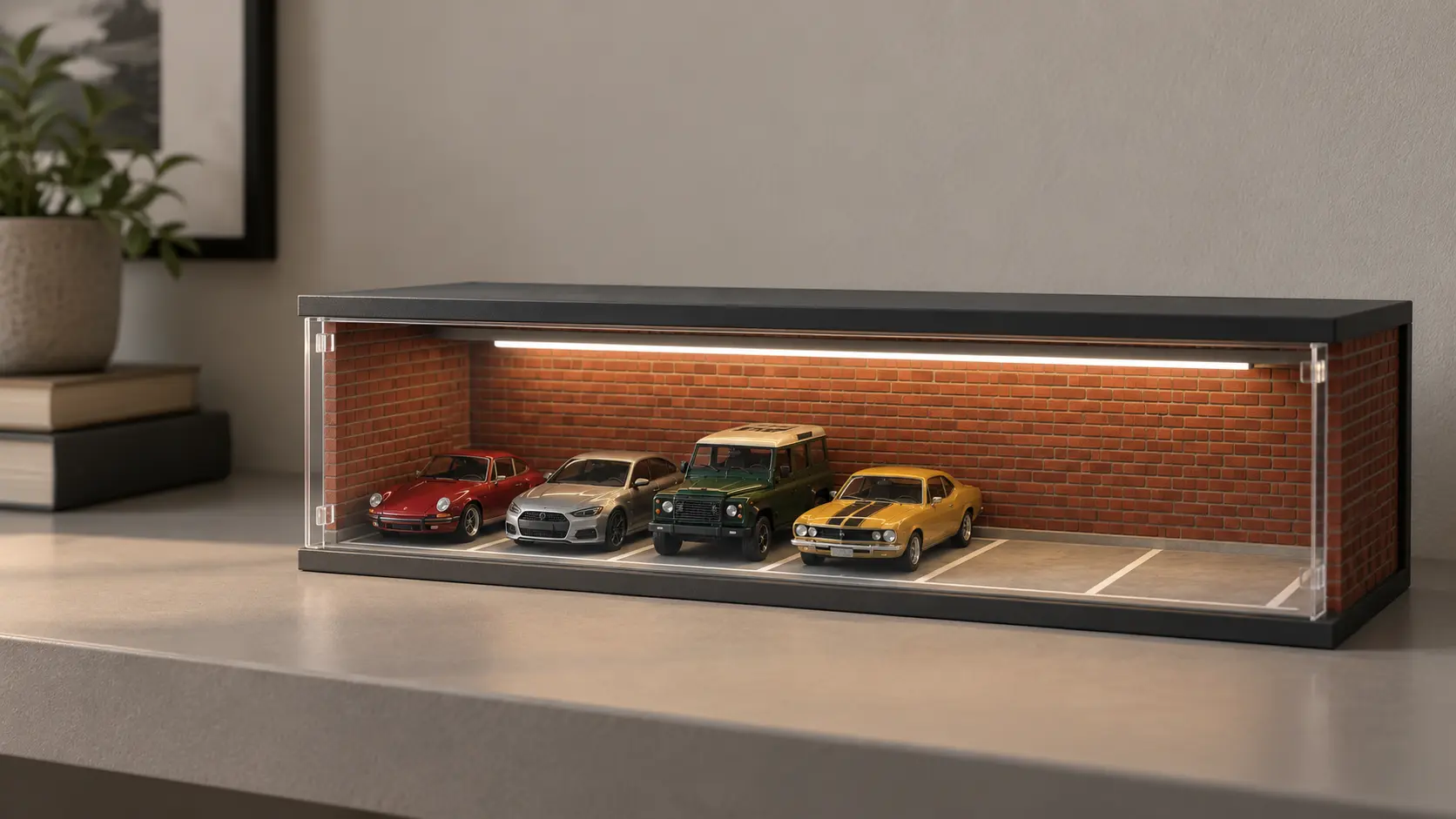
ASIN B0CPLLMBWJ resolves to the Red Brick colourway. Amazon lists it at 11.8 x 5.2 x 3.9 inches, and the listing labels that figure as the exterior size. Frame material is given as acrylic with a plastic base, while Bivitre’s descriptive copy for this product family describes a PVC structure carrying a laser-printed scene beneath an acrylic cover. Those are different components of the same object rather than competing claims, but if the structural material matters to you, ask before ordering.
Six marked bays, a printed brick backdrop, an overhead LED strip and a clear cover. The format is plain and predictable, which is its main virtue.
What works. Six discrete bays keep cars from touching each other, which matters for paint and chrome. Stacking is advertised across this product family, so a shelf plan can grow. The cover interrupts the path dust takes to your cars, which an open scene does not.
What to weigh. The 3.9-inch exterior height is not headroom. Subtract the base, the roof panel and the LED housing and the clear space above a parked car is smaller, by an amount nobody publishes. For a casting with a roof rack, a light bar or a raised wing, that gap is the whole question, and the listing will not answer it.
Bivitre also sells a large number of closely related six-slot scenes under separate listings, including Grey, Warehouse, Off Road, Green, Factory and several container-style variants at different sizes. Photographs and questions blur across them, so a detail you read about one colourway may not describe the one you receive. Check the selected option at checkout.
The listing copy calls the acrylic cover dustproof and says it protects collectibles from dust and corrosion. We found no gasket, latch or dust-ingress testing supporting that. Read it as a barrier that slows dust rather than a seal.
Fit check before ordering: ask the seller for interior bay height, front opening height, and bay width between dividers. Confirm whether the box contains a power adapter or only a cable, since the listing does not say.
Verdict. Start here if you display ordinary loose castings and want an illuminated, covered row rather than a photographic stage. Verify your largest car’s fit, exact colourway and power accessories.
NUEIOVRW Moriyama Workshop
Best for: collectors who photograph their cars. This is a scene, not a storage rack, and judging it as storage will mark it down for the wrong reasons.
Skip it if: you want cars protected from dust, or your shelf cannot give up nearly a foot of depth.
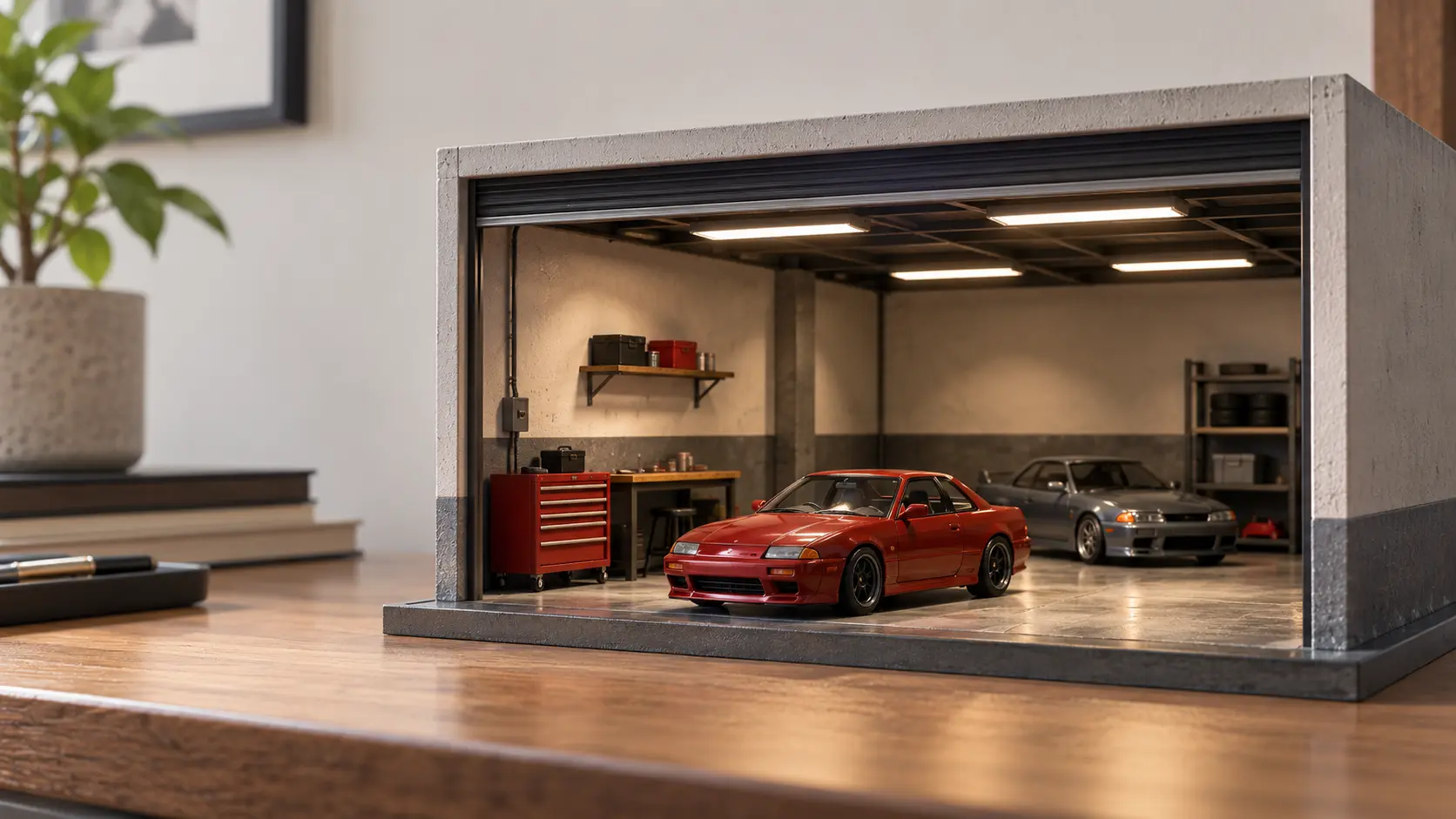
ASIN B0G3GB1GQD resolves to the Moriyama Workshop variant, a Japanese-style garage scene with LED lighting. It is a separate listing from the brand’s Repair Shop (B0DJ8PT1Q2) and from the Factory Building variant sold under similar titles. Amazon lists it at 11.81 x 11.81 x 5.51 inches.
What works. That square footprint is the point. Depth is what a photographer needs: room to place a car in the foreground, room for the building behind it, and room for a lens to find an angle that is not flattened against a back wall. A shallow six-slot cabinet cannot offer that. In exchange it occupies more shelf than anything else here and holds fewer cars than a cabinet half its size.
Power is unresolved for this exact variant. NUEIOVRW’s range is mixed. Some of the brand’s scenes are listed as USB Type-C with adjustable brightness. At least one sibling listing describes a battery box taking AA and AAA cells. A specialist retailer sells an apparently similar Moriyama scene under the MoreArt label with a USB-C cable and the option of two AA batteries. We could not find exact-variant documentation for B0G3GB1GQD, and features from one variant should not be assumed for another. Ask the seller before ordering, particularly if the shelf has no USB port nearby.
What comes in the box. The listing’s contents line names the garage diorama model. On that basis, do not assume the cars, figures, tools or optional props arranged in the product photography are included. The brand sells workshop accessory sets separately. Assembly is required.
Scenes resembling this one are also sold under other brand names. Similar appearance does not prove shared tooling or a shared manufacturer, but it does mean a review you read elsewhere may describe a differently specified unit.
Fit check before ordering: ask for the clear height under the workshop roof if you intend to park a tall casting inside rather than in front, and confirm the power supply.
Verdict. Consider the Moriyama when you want foreground room and a workshop backdrop for car photography. It is less appropriate when your priority is dust reduction or compact storage. Confirm the exact power arrangement and included props before buying.
NUEIOVRW Two-Tier LED Garage
Best for: collectors who want to stage a larger loose-car collection in one illuminated, multi-level setting and can accommodate a relatively broad square footprint.
Skip it if: you need a genuinely narrow tower, have a shallow shelf, or want independently verified clearance for oversized castings.
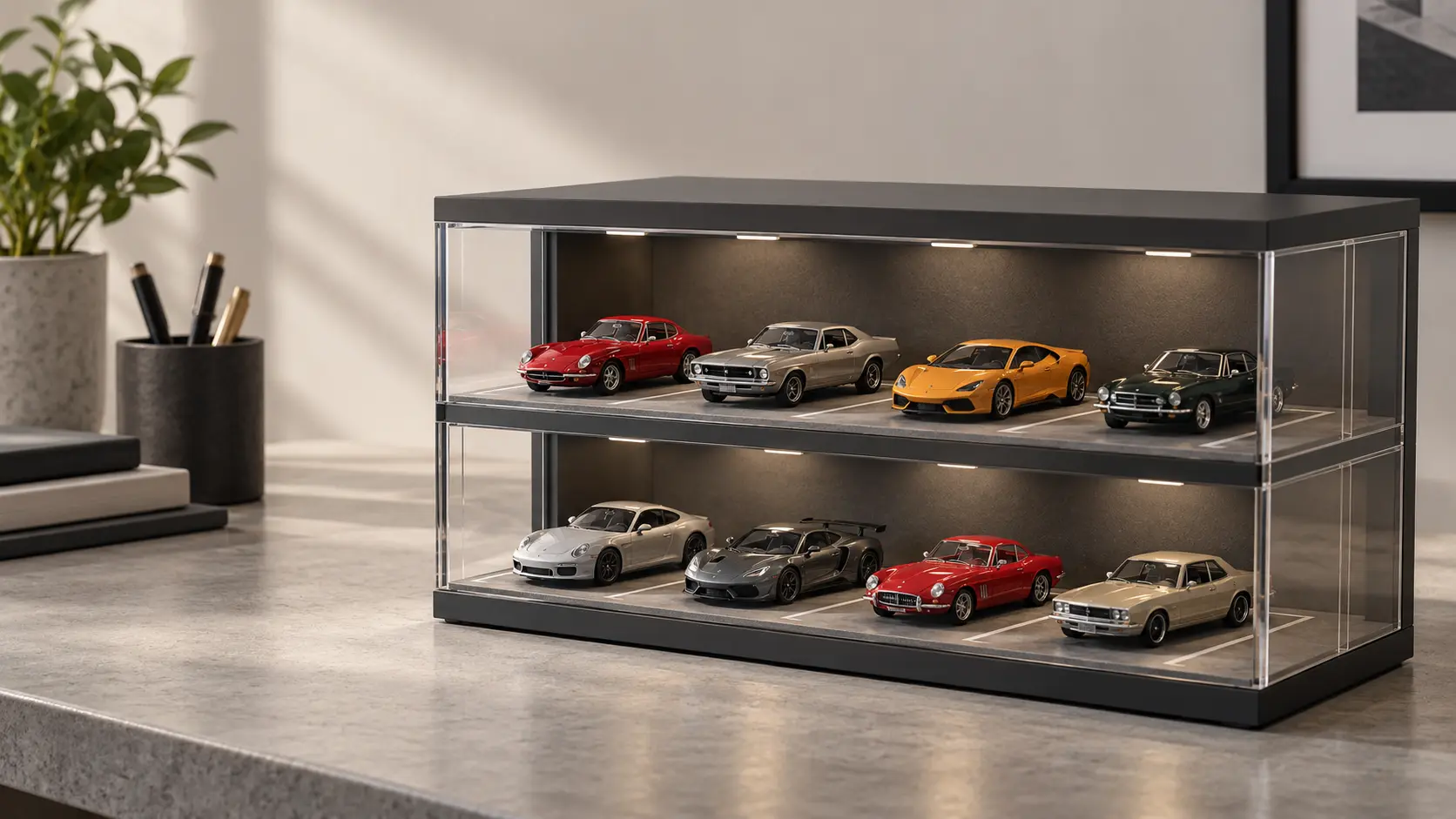
Amazon US identifies ASIN B0F9PSTYJ3 as the NUEIOVRW 1:64 Two-Tier Garage Display Case. The exact selected variant, seller and buyer-specific availability can change, so confirm the current offer before ordering.
The capacity comes with a larger footprint. The seller advertises space for more than 20 standard 1:64 cars in a two-level layout. It describes an individual module as 11.81 x 11.81 inches and the double-level space as 7.48 inches tall. These are seller figures, not our measurements, and the listing does not supply usable internal parking-stall dimensions. This is an option for a desk or deeper shelving, not a space-saving tower for a narrow ledge.
Lighting is a practical advantage on paper. Unlike some small garages with unspecified power accessories, this listing describes independent USB power for its two lighting groups, three selectable lighting colors and ten brightness levels. Individual upper and lower lighting control could help stage different cars or reduce glare, though we have not tested the output, color accuracy or heat inside the unit.
What arrives and what fits. The seller describes a modular plug-in structure, removable fences, a sliding acrylic door advertised as 2 mm thick and assembly that it estimates at 20 to 30 minutes. Treat its dust-protection language as a seller claim, not evidence of an airtight seal. A 20-plus-car capacity claim assumes suitable castings and a particular arrangement. A roof rack, wide mirrors or a tall spoiler may change the number that fits comfortably. Do not infer Team Transport compatibility from the headline car count.
Fit and offer check before ordering: confirm the current two-level variant and seller, usable parking-deck dimensions, clear door opening, total external height and whether the advertised USB cables or power adapters are included. Verify that Amazon presents a purchasable offer for your delivery location.
Verdict. Choose this if your priority is staging more loose cars with flexible decorative lighting and you have the desk space to support it. It is not a compact shelf-width solution, and its advertised 20-plus capacity should not be treated as independently measured performance.
Waivvy Silent Scream
Best for: collectors who want a visually distinctive printed backdrop with a clearly described flat-pack panel set.
Skip it if: you need a confirmed footprint before committing shelf space, since the published dimensions and the stated capacity need clarifying with the seller.
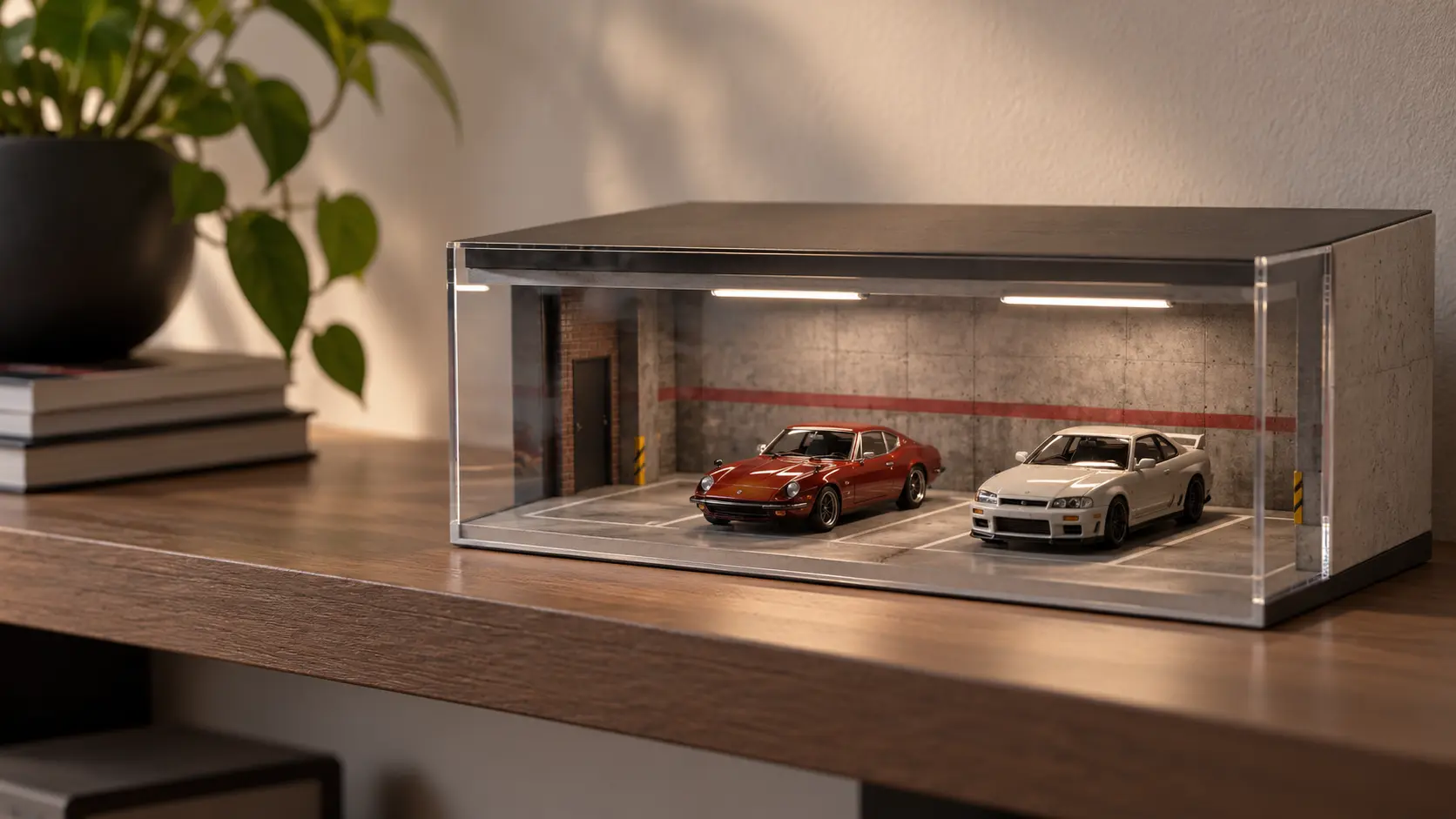
ASIN B0F6SYB87Q resolves to the Silent Scream, which is both the colourway and the model number. The listing is unusually specific about contents: one acrylic cover, four foamboard body panels, one foamboard roof with LED lights, and one USB cable. That is a useful contents breakdown because it names the panels, roof and power cable separately.
Note what is absent from that list: a power adapter. A USB cable alone does not guarantee a wall power source. Confirm the voltage and connector requirements before using a separate compatible adapter.
The size and capacity figures need clarifying with the seller. Amazon lists 4.1 x 5.1 x 11.8 inches and separately states six parking spaces on each level. We could not reconcile those two statements from the listing alone. A level measuring 4.1 by 5.1 inches is small for six castings of roughly three inches each, so either the dimension labels run in a different order than the L x W x H heading suggests, or the capacity is distributed across levels in a way the listing does not spell out. We are not going to assert which, and we are not claiming six cars will not fit. Ask the seller which figure is the width and how the six spaces per level are laid out.
On the construction. The listing gives the base type as PVC foam board and the frame material as plastic, and the product description says it is built from PVC foam board under a clear acrylic cover. That is worth stating plainly because the word foamboard in the product title invites the wrong comparison: this is not craft foamcore, and it is not a non-PVC alternative to the PVC-bodied units elsewhere on this page. What differs is the form the PVC takes and the flat-pack panel assembly, not the base material. We have no panel thickness, no density figure and no comparative testing for any product here, so we are not ranking these products for rigidity or durability. If the display will be handled, moved or stacked often, ask the seller about panel thickness.
On the UV printing. The listing describes vibrant UV-printed scenes. UV printing is a manufacturing process that cures ink with ultraviolet light. It is unrelated to UV filtering, and it gives the cars inside no protection from sunlight. These two meanings get conflated constantly in this category.
Fit check before ordering: confirm which dimension is the width, how many levels ship, and the clear height of each level.
Verdict. Consider it for a distinctive printed setting and a comparatively detailed advertised contents list. Its size/orientation uncertainty prevents a confident recommendation for collectors working with a tightly measured shelf. Do not assume a wall adapter is included or treat it as a verified budget winner.
G-Fans gas station 710035
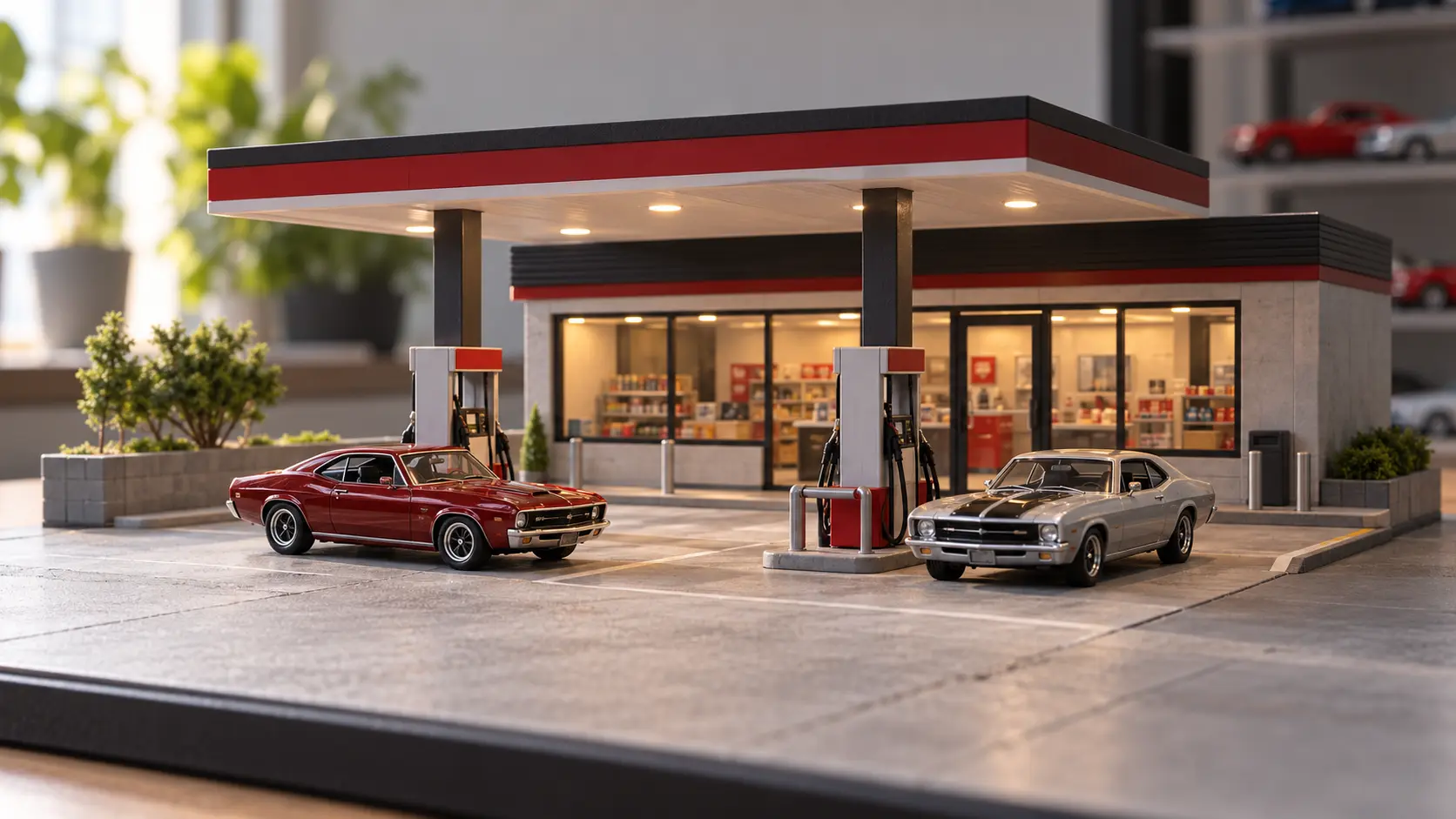
Reference example. No verified Amazon US offer was established in this research, and there is no affiliate link here. It appears because it covers a job the enclosed garages cannot, and because its published specifications are unusually consistent across sellers.
SKU 710035 is a forecourt scene rather than an enclosure. Several specialist diecast retailers publish matching details: overall 285 x 300 x 123 mm with the building at 245 x 200 x 123 mm, PVC and acrylic construction, interior and signboard LED lighting powered over USB with an on/off switch, sliding doors, and scenery consisting of two fuel dispensers, two trash cans and one fire hydrant. It ships flat-packed and snaps together, and at least one retailer notes a paper detail sheet may need cutting and gluing. Cars, figures and tools in the product photography are not included.
Their published details largely agree, but agreement may reflect shared manufacturer copy rather than independent measurement. Nobody has published a physical check.
Availability is the practical obstacle. Specialist hobby retailers carry this type of scene, and availability can vary considerably. Confirm the precise SKU, included scenery and shipment status with the retailer before buying.
Why a forecourt is a different purchase. An enclosed garage frames a car from the front and hides three sides. An open forecourt lets you shoot from any angle with a building behind, and lets you combine it with road sections or other scenes. For narrative photography it is a more flexible base than any cabinet here. It is also the one surface here with room to stage something larger than a parking bay allows, a Team Transport hauler among them, if the model and the forecourt both measure up. It is not an enclosed storage system and provides no cover over staged cars.
We make no claim about licensing or historical accuracy of the branding on this scene. Retailers describe it as a branded station; we have not verified what that means contractually.
Research example only. No verified Amazon affiliate offer is linked for this reference product.
Plain acrylic single-car cases
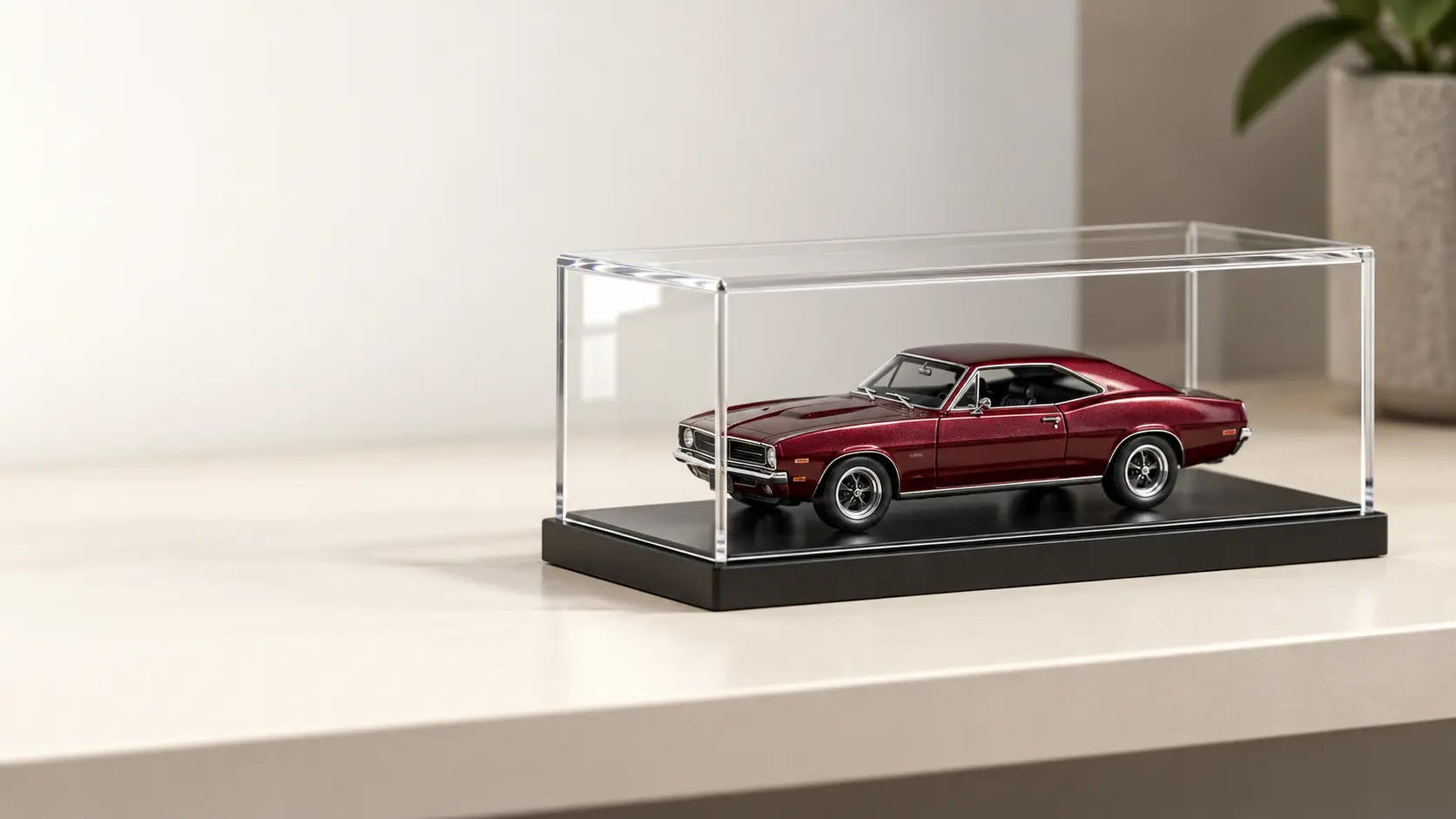
Reference category. No affiliate link here. Our researched shortlist did not establish a sufficiently documented single-car or two-car LED case to recommend. For an individually displayed loose car, an unlit acrylic case is a simpler alternative.
For one car, the straightforward option is a plain unlit acrylic case. GreenLight’s 55025 is the common example, and its published size depends on who is selling it. ToyWonders lists the showcase at 4.75 x 2.25 x 1.75 inches with a 5 x 2.25 x 2 inch box, and distinguishes the two clearly. ModelToyCars lists 5 x 2.5 x 3 inches without separating product from packaging. The two retailers also show different UPCs for the same item number. That could reflect a revision, a packaging difference or retailer-record errors; we did not locate manufacturer documentation that resolves it.
That spread matters at this size. The difference between a 1.75-inch and a 3-inch case is the difference between fitting and not fitting a casting with any height to it. Measure your car and ask the seller which figure describes the case itself.
What this format gives you and what it does not. It removes the lighting and the power lead, and with them the cable routing, the switch and anything to leave running. The cover and small base simplify dust management compared with an open-front stage. We did not locate credible seal documentation or comparative dust-ingress tests for these products, so this is a format distinction rather than a verified performance ranking.
If you want one car lit, the workable approach is a plain case with separate lighting positioned outside it. We have not tested any light against any case, cannot say whether a given strip would warm an enclosed space, and will not tell you a combination is safe left running. External lighting avoids placing another electrical component inside the enclosure, but its safety and suitability still depend on the actual light, case and setup.
An acrylic case for a loose car is not a card protector. If the car is still sealed on its blister you need a different product, sized to the card. Our Hot Wheels card protector guide covers that, and our Hot Wheels storage case guide covers bulk storage for cars you are not displaying.
Research example only. No verified Amazon affiliate offer is linked for this reference product.
The collector’s buying guide
Measure the actual casting, not the scale label
1:64 is a nominal ratio applied to cars that were not the same size in real life. A 1:64 Fiat and a 1:64 crew-cab dually are both 1:64 and they are nowhere near the same object. Most mainline castings sit near three inches long, but the number that gets collectors into trouble is almost never length.
Measure the specific car you intend to display, and measure four things:
- Length, including any rear wing, spoiler, tow hitch or exhaust that projects past the bodywork.
- Maximum width, which is usually at the mirrors, not the body. Mirrors are what catch on a bay divider.
- Maximum height, measured to the highest point: roof rack, light bar, snorkel, scoop, rollcage or raised spoiler.
- Overall footprint on the base, for lifted or wide-track vehicles whose wheels sit outside the body line.
Write those four numbers down before you shop. Every decision below depends on them.
Ask for usable interior clearance, because external dimensions tell you nothing
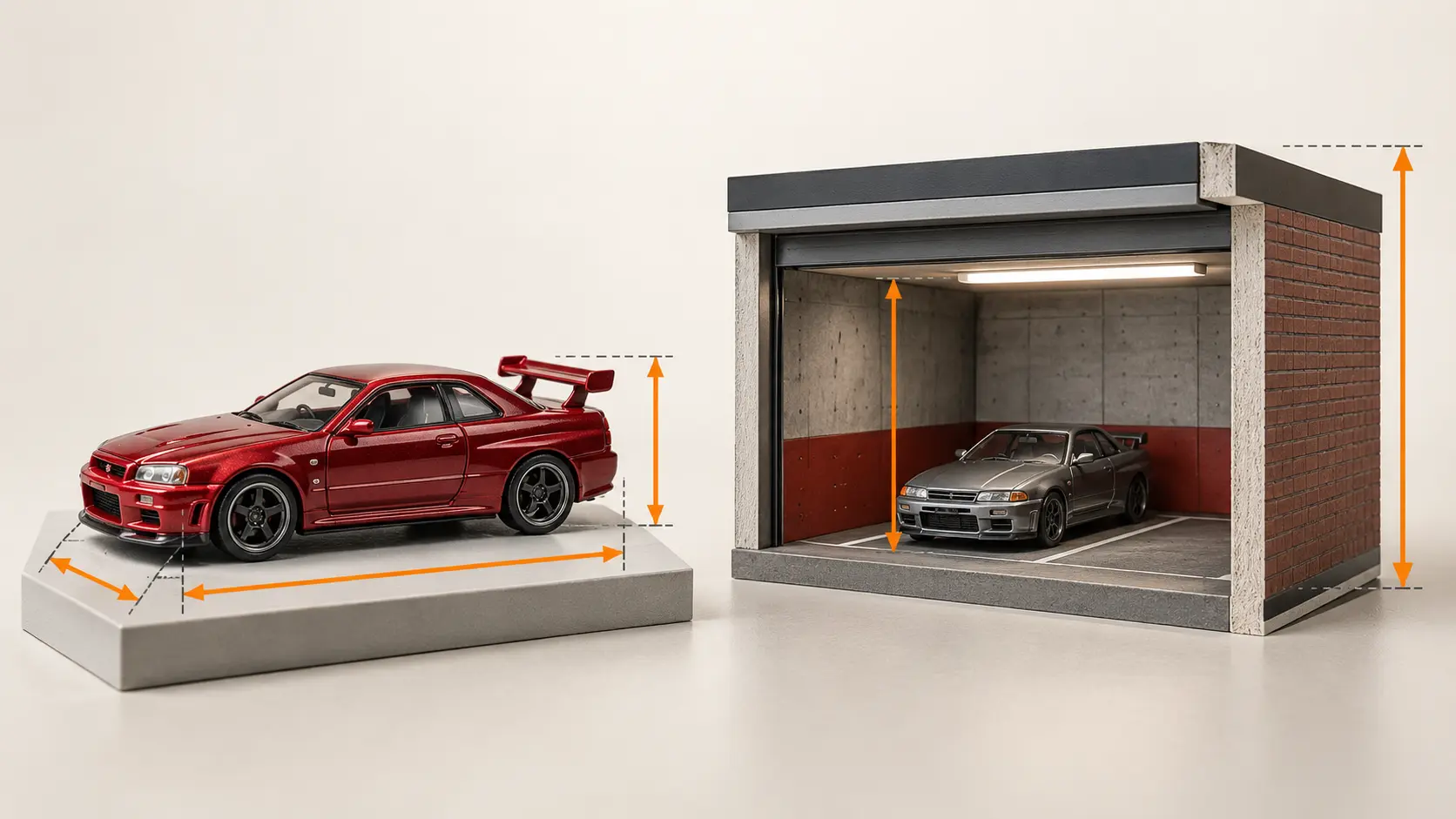
This is the central idea on this page. Listings tend to emphasize outside cabinet dimensions and advertised car counts. The measurement that decides whether your car fits is usable bay clearance and the size of the access opening, neither of which was independently documented for our chosen products.
An 11.8 x 5.2 x 3.9 inch cabinet does not give you 3.9 inches of headroom. Subtract the base, the deck, the roof panel and whatever housing the LED strip sits in, and the clear space above a parked car is smaller. No listing here publishes how much smaller. Similarly, the larger NUEIOVRW unit’s claimed capacity of 20-plus cars does not establish its individual bay dimensions. And a bay can be tall enough to hold a car while the opening you post it through is not.
So ask the seller directly, before ordering, and ask in these words:
- What is the interior height from the parking deck to the underside of the roof?
- What is the clear height of the front opening?
- What is the usable width of a single parking bay, divider to divider?
- What is the usable depth of a bay from the front edge to the back wall?
A seller who cannot answer has told you something. On an oversized casting, an unanswerable fit question is a reason to buy elsewhere.
Premium, RLC, Kaido House and Team Transport break the assumptions
The gap between Premium and mainline Hot Wheels is not only materials and tyres. Premium lines include castings with proportions that generic 1:64 storage was not designed around. None of the points below holds for every mould, which is exactly why the measurement comes first.
- Premium and Car Culture castings carry Real Riders rubber tyres. Tyre and track dimensions vary by casting, so check width on the specific car rather than assuming a line-wide difference.
- RLC pieces vary in body style. Alongside fit, think about whether you want a valuable or hard-to-replace car in an open scene at all. If you plan displays around upcoming drops, our 2026 RLC release calendar tracks what is coming, though a release date says nothing about whether a casting fits a given cabinet.
- Kaido House builds often carry roof racks and accessories that add height. Whether a particular one clears a particular bay depends on both measurements, and we did not locate independently measured clearance for the reviewed options.
- Team Transport sets are the clearest mismatch with an enclosed bay. None of the covered parking-bay options here is verified to hold a complete hauler and its car, and a hauler requires a substantially different length allowance than an ordinary loose car. An open forecourt such as the G-Fans scene could stage a transporter for photography if the model and the available surface both measure up, but that is scenery rather than protected storage. If Team Transport is a significant part of your collection, read our Team Transport buying guide and plan a separate display.
Length, width and height can each turn out to be the limiting dimension. Compare all three against the seller’s usable bay and opening figures rather than assuming one of them is the one that matters.
Decide between a stage and a cupboard before you compare products
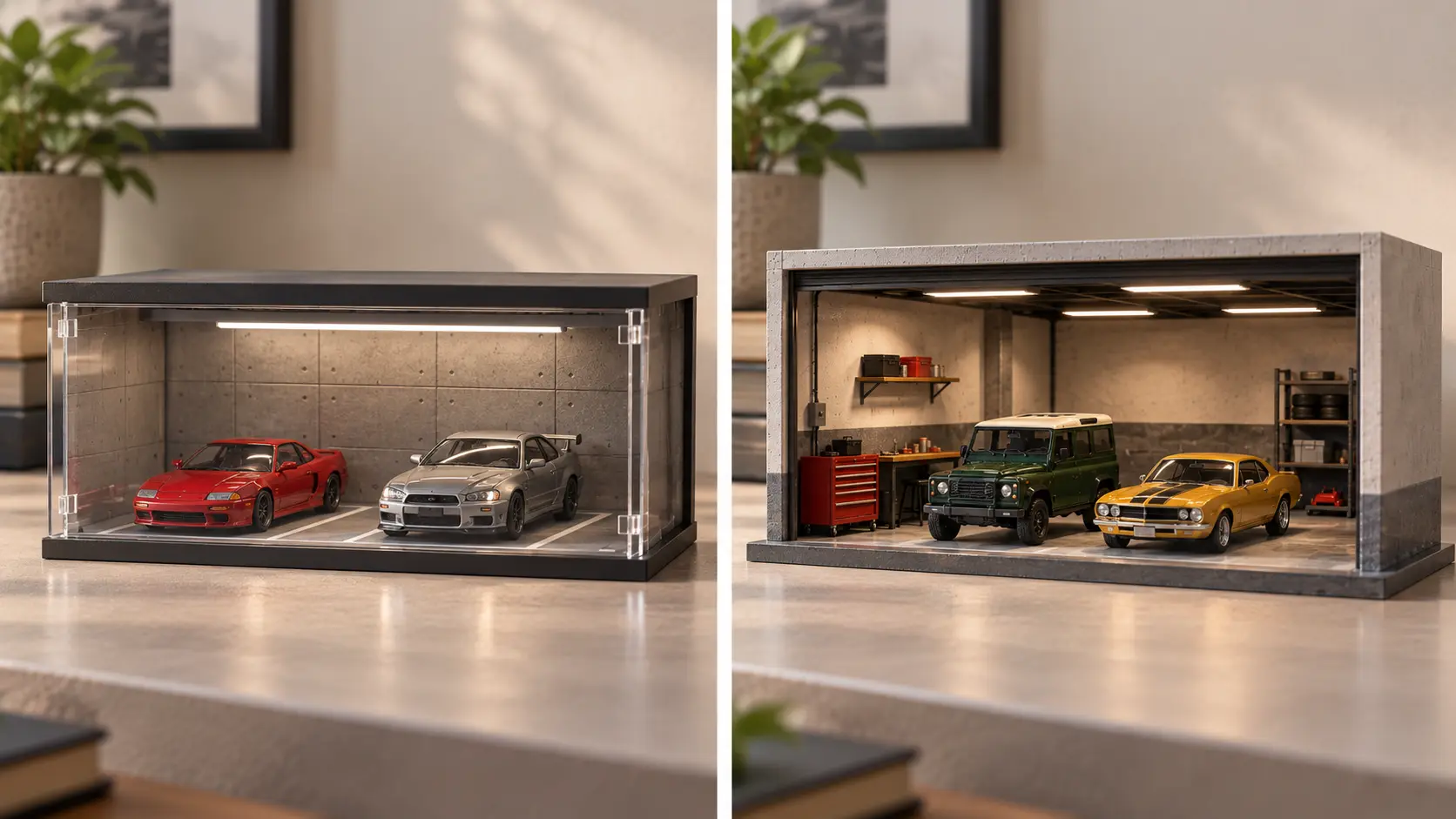
These are two different purchases and comparing them on price is a mistake.
A photographic stage needs open frontage, depth in front of the subject, and a background that reads well at a shallow depth of field. It will collect dust, and that is the cost of the format.
Protected staging needs a cover, minimal gaps, and enough clearance to get cars in and out without knocking them. It will fight you every time you want a clean photograph, because you will be shooting through acrylic or lifting the cover off.
Almost everyone wants both. Nobody on this page sells both in one product. Pick the one that matches what you actually do with your cars each week, not the one that matches how you imagine displaying them.
Power, switching and glare
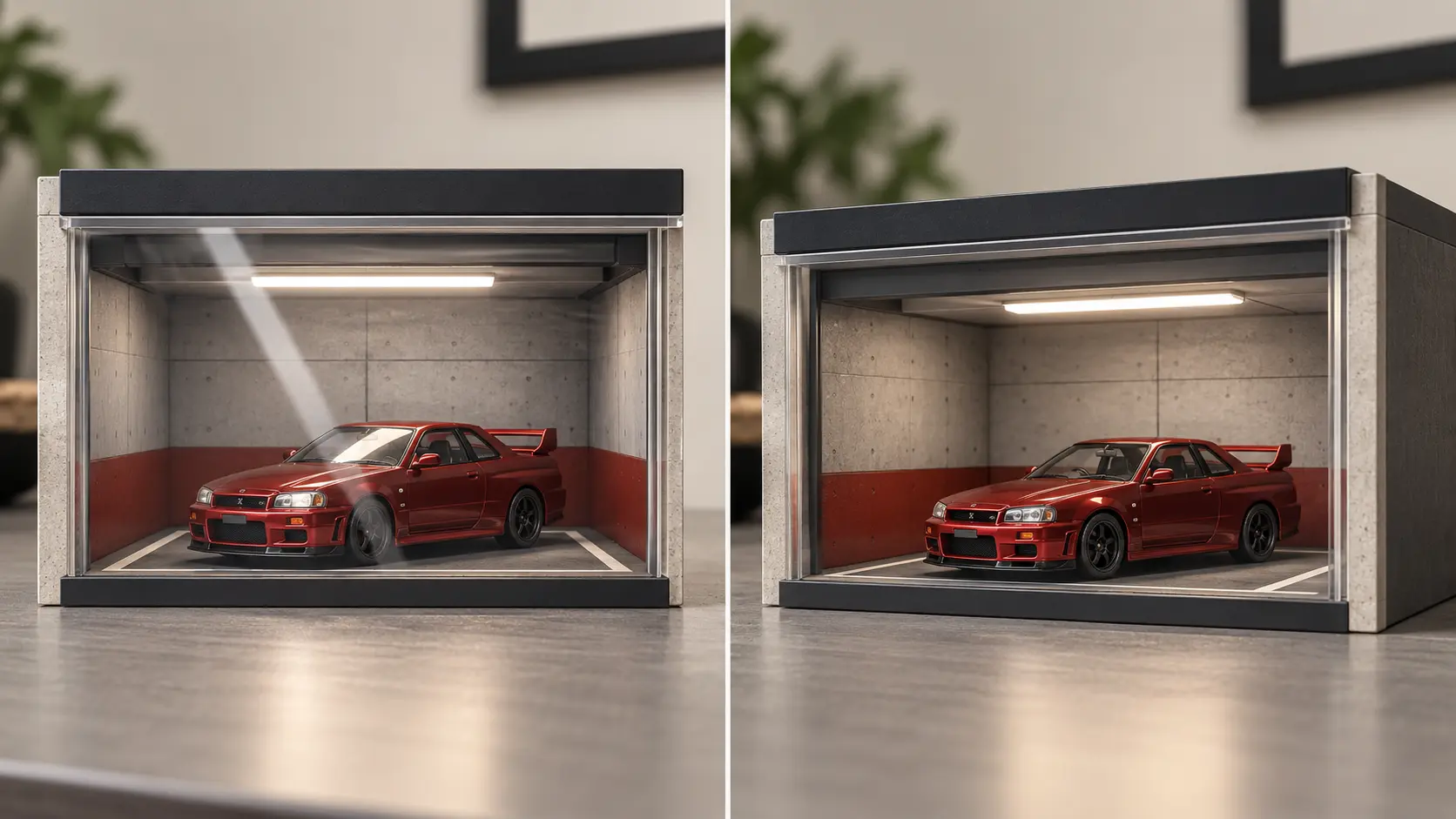
Confirm three things before buying anything lit:
- What powers it. USB and battery boxes are both common in this category, sometimes within the same brand’s catalogue. A battery unit on a high shelf is an annoyance you discover slowly.
- Whether an adapter is included. A USB cable in the box is not a power supply. Several listings here include the cable and say nothing about a plug.
- Whether there is a switch, and where it sits. A switch you cannot reach once the unit is on a shelf is a switch you stop using.
Glare deserves more attention than it usually gets. The Canadian Conservation Institute’s technical bulletin on LED lighting, written for museum installations, reports that glare can be worse with LED lamp designs that place the diodes at the front of the housing without a reflector or diffuser, and that controlling glare is fundamentally about controlling the line of sight between viewer and source [1]. The same bulletin notes that reflected glare from shiny surfaces, including protective glazing, has to be designed around, and describes the distracting effect of many small LED lenses mirrored in a glossy surface [1]. That bulletin describes museum lighting hardware rather than the LED strips fitted to these dioramas, and its most recent revision predates the products on this page.
Translated to a desk, the principle still travels: a roof-mounted LED strip will reflect in an acrylic cover and in the paint of your cars, and whether that spoils a photograph depends largely on where you and the camera sit relative to it. It is a geometry problem you solve by moving. If you plan to shoot through the cover, plan on taking the cover off instead.
Acrylic, dust and static
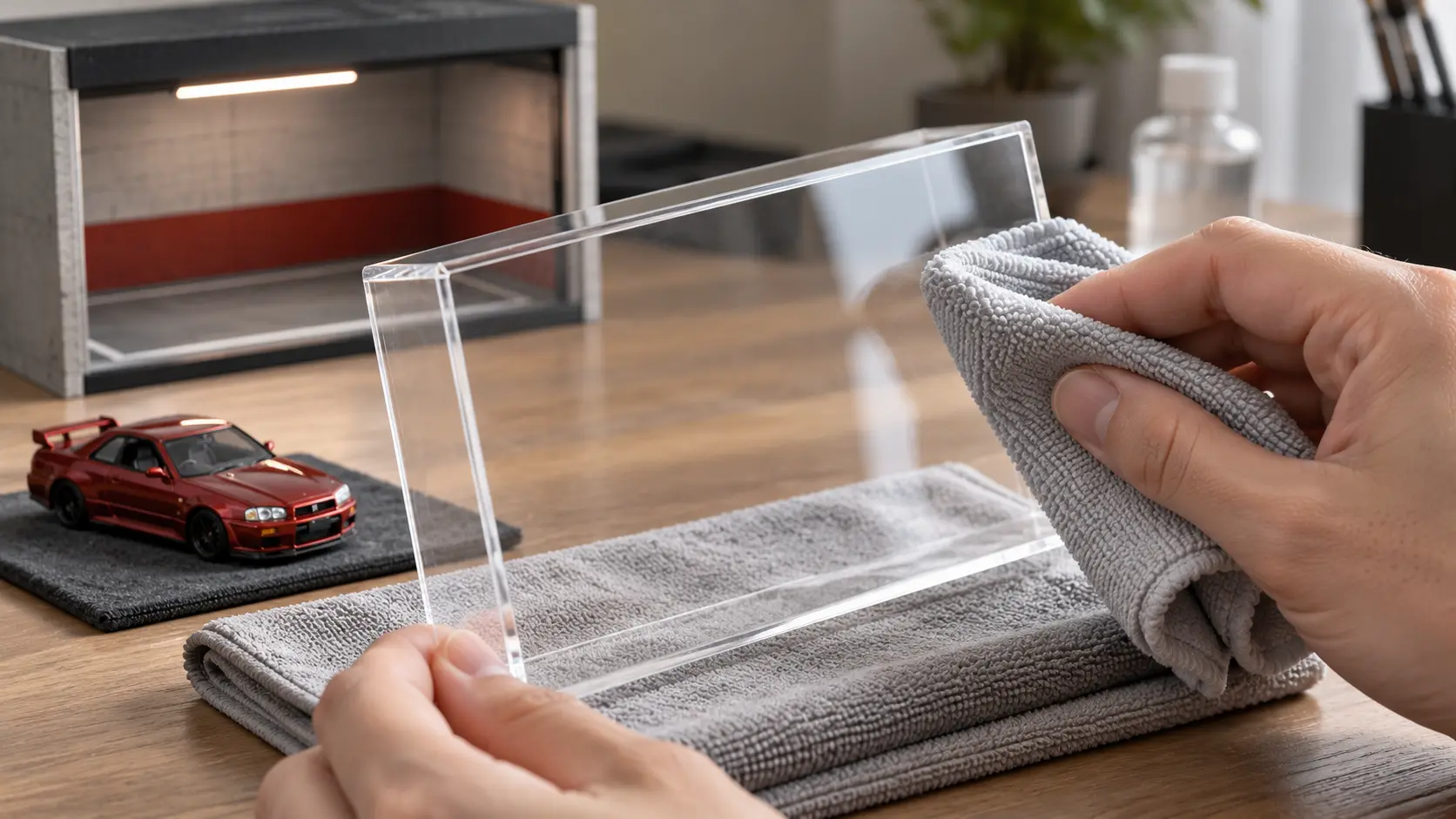
The most useful fact in this category comes from conservation practice and it runs against intuition. The Canadian Conservation Institute notes that acrylics tend to generate static electricity during cleaning and use, and that this static causes dust to accumulate by electrostatic attraction [2].
An acrylic cover is not a neutral barrier. Handling and wiping build static, and static pulls dust toward the surface. That is why a case can look dustier a week after cleaning than it did before you started.
The same source warns that many household cleaners contain abrasives that can scratch acrylic, and that some contain solvents which cause crazing, meaning fine surface cracks. It notes that manufacturers sell cleaners formulated to minimise static without scratching or crazing [2]. Practical translation: skip the kitchen glass spray. Use a cleaner made for acrylic with a soft lint-free cloth, and accept that scratches are hard to undo once there. CCI notes that only very shallow scratches can be removed with fine abrasives, and that the work is laborious [2].
On the dustproof claims: several sellers describe acrylic covers as dustproof and as protecting collectibles from dust and corrosion. We did not find documentation of gaskets or latches, nor any independent dust-ingress testing, for any product here. A cover slows dust. Nothing on this page has been shown to seal.
Sunlight and the UV confusion
Two separate things get called UV in this category and they have nothing to do with each other. UV printing is an ink-curing manufacturing process. UV filtering is a separately specified protective property of glazing. The presence of a UV-printed scene does not establish that the display cover filters sunlight.
On light exposure generally, CCI’s position is that white light from any source causes discolouration, usually fading, of vulnerable surfaces, and that ultraviolet from any source causes gradual disintegration of vulnerable surfaces [1]. The bulletin also concludes that for the materials it studied, the time taken to reach a given level of damage is set primarily by the material’s sensitivity, the light’s intensity and the duration of exposure, with the spectrum of the source mattering less than those three [1].
That research covers museum materials such as dyes, pigments and paper. It does not cover diecast paint, tampo printing or the printed backdrops in these dioramas, and we found no fade testing for any of them. So we cannot tell you how a particular finish will behave, and we are not going to rank diecast durability against anything else.
What the principle does support is cheap and sensible: avoid direct sun, keep unnecessary light exposure down, and switch built-in lighting off when you are not looking at the display. Those habits cost nothing and do not depend on knowing which LED is inside.
We also cannot tell you these LEDs run cool enough to leave on indefinitely. CCI’s heat discussion concerns properly specified museum installations at controlled light levels, where measured temperature rises inside display cases were around one to two degrees Celsius [1]. We did not locate dependable temperature measurements of the consumer lighting fitted to these products. Switch them off when you leave the room.
Assembly and what is actually in the box
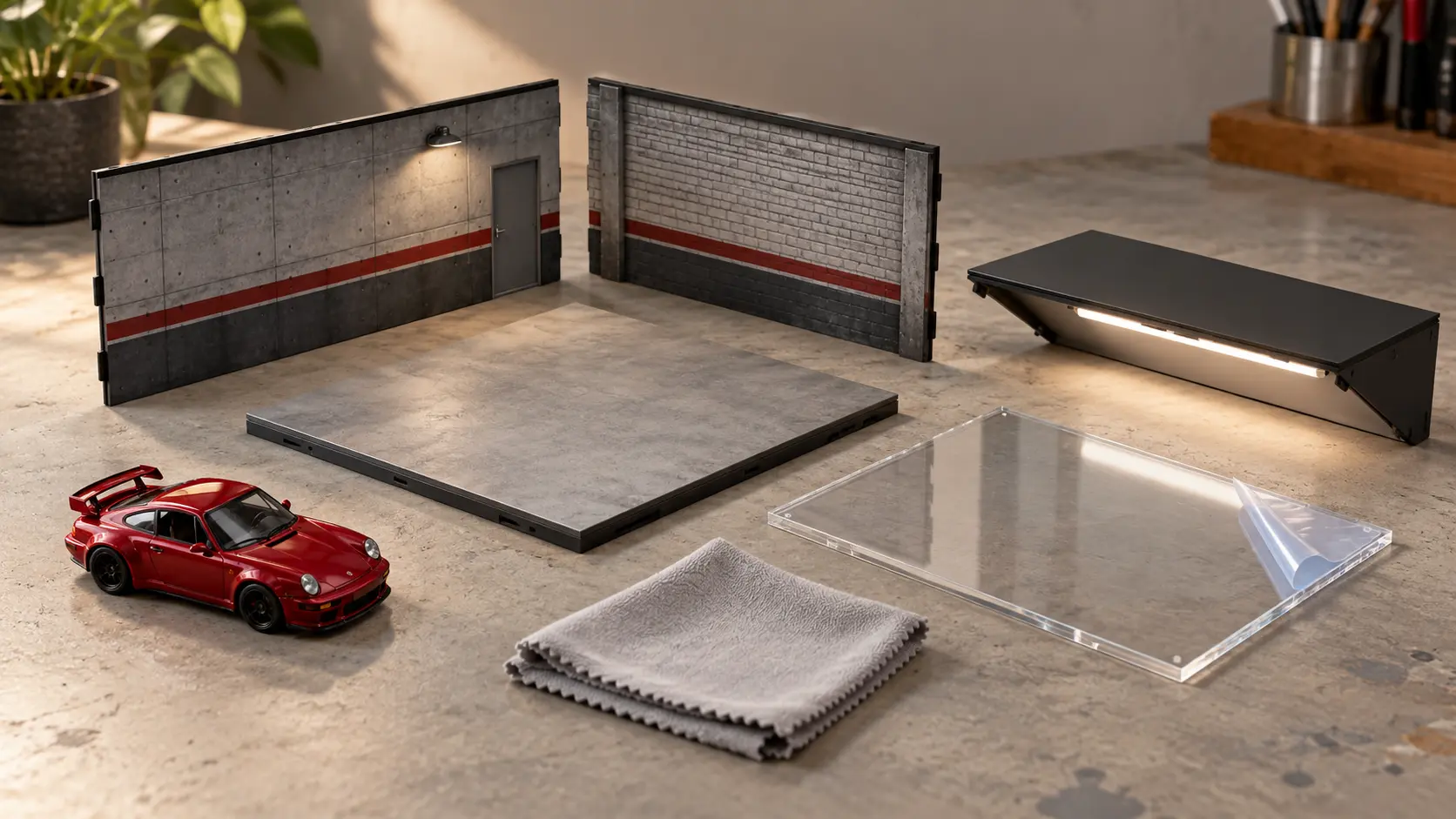
Most products in this category arrive as flat panels. The Waivvy lists four foamboard body panels plus a roof. The G-Fans station ships flat-packed. NUEIOVRW scenes are listed as requiring assembly. This is normal and it is not a defect, but it does mean the thing you unpack is not the thing in the photograph.
Another mistake is assuming every prop in a product photo is included. Tools, lifts, signage, figures and especially cars may be sold separately; inclusion varies by model. The G-Fans package, for example, does list some pumps and other scenery. Read the contents line, not the hero image. Where a listing says the package contains one diorama model, it means one diorama model.
Finally, check whether protective film needs peeling off the acrylic. Several listings in this category mention it. Shipping film can make a clear panel appear cloudy until it is removed according to the seller’s assembly instructions.
Before you order: the short checklist
- Measured the tallest and widest car going inside, including mirrors and roof accessories
- Asked the seller for interior bay height and front-opening clearance, and got an answer
- Confirmed the exact variant or colourway selected, not just the listing title
- Confirmed the power source, and whether a wall adapter is included or only a cable
- Confirmed whether cars, figures, tools and scenery in the photographs are included
- Checked the external footprint against the actual shelf, including depth
- Decided whether this is a photographic stage or protected storage, and bought accordingly
- Chosen a spot out of direct sunlight
Which one should you choose?
We are not naming a single best product. The four jobs on this page have different winners, and the evidence does not support ranking them against each other on price or build quality.
First one, ordinary mainline castings. The Bivitre red brick six-slot. Its exterior size is the best documented of the four, the format is well understood, and the acrylic cover gives you something an open scene does not. Confirm the variant at checkout.
One car, no electronics. A plain unlit acrylic case. It is the simplest format here, and simplicity is the whole proposition. Check which dimension the seller is quoting, since listings differ.
You own a camera and this is about photographs. The NUEIOVRW Moriyama Workshop. Its deep square scene gives more foreground room and more workable camera angles than the shallow six-bay cabinets. Settle the power supply with the seller first, and accept dust as the cost of an open front. The G-Fans forecourt is the other scenic option if you would rather shoot outdoors than in a workshop.
You want to stage more cars and have a large desk. The NUEIOVRW Two-Tier model advertises 20-plus-car capacity and separate adjustable USB lighting for each level. Its square base needs plenty of room, and you should verify both the current offer and the dimensions of your largest models before buying.
You collect Team Transport. No enclosed bay here is verified to hold a complete hauler and its car. An open forecourt might stage one for photographs if the measurements work. Plan a separate display for storage.
One caveat covering all of it. Documentation in this category is inconsistent and specifications drift between sellers. We matched identities and headline specifications for the four Amazon candidates, which is not the same as confirming a current purchasable offer. We found no independent testing or long-term reliability data for any of them, and no verified price comparison, so we are not ranking them on build quality or value. Buy from a seller whose return policy you have read.
Questions collectors actually ask
Are these display cases actually dustproof?
None has been shown to be. Several sellers use the word dustproof in their listing copy, but we did not find documentation of gaskets or latches, or any independent dust-ingress testing, for any product here. An acrylic cover does slow dust accumulation, which is worth having. We found no evidence that it forms a seal, and acrylic can also attract dust electrostatically, particularly during handling and cleaning [2].
Can I run these from a USB phone charger?
For a USB-powered unit, usually yes, but confirm the unit is USB before assuming. Power arrangements vary within a single brand’s catalogue in this category, and several listings here supply a cable without a plug. If the listing does not say, ask before ordering.
Will a Hot Wheels Premium car fit in a standard six-slot diorama garage?
Length, width and height can each be the limiting factor, and which one bites depends on the casting. Premium cars sit on Real Riders rubber tyres, and both track width and body height vary by mould. Measure all three on your specific car, add the mirrors and any roof accessory, and compare them against the seller’s usable bay and opening figures. Advertised product capacity is not a substitute for measured usable clearance.
Do the LEDs damage the paint on my cars?
We did not locate reliable product-specific exposure testing for these models. Conservation research on museum materials finds that light damage depends mainly on how sensitive the material is, how bright the light is and how long it stays on [1]. That research does not cover diecast finishes, and we will not guess how yours compares. The sensible precautions are cheap either way: keep the display out of direct sun and switch the lights off when you are not looking at it.
Is a diorama garage a good way to protect a valuable car?
A diorama is built for display and photography. A plain acrylic case removes the lighting, the power lead and the printed scenery, which is less to go wrong, though we did not find credible seal documentation or independent dust-ingress testing for any reviewed model. If preservation rather than display is the goal, you are paying for features that do not serve it.
Why do similar dioramas appear under different brand names?
Some of these scenes reach the market through more than one brand. Similar appearance does not prove shared tooling or a shared factory, but it does mean specifications can differ between sellers for products that look alike, and a review of one may not describe the one you receive. It is the main reason this guide keeps pointing you back to the listing in front of you.
Can I stack these to build a larger display?
Some sellers advertise stackability or connected units, but do not assume that applies to every colourway or construction. Follow the exact manufacturer’s assembly and stacking instructions, check any stated load limits, and secure the display against tipping. We did not locate comparative load testing for the reviewed models.
Research references
These independent sources support the general material and lighting claims on this page. Neither has tested, reviewed or evaluated any product named here, any diecast finish or any consumer LED strip, and we do not present them as having done so. Both were checked on 4 October 2026.
- Stefan Michalski and Jim Druzik, Canadian Conservation Institute, LED Lighting in Museums and Art Galleries, Technical Bulletin 36. Supports the claims about LED glare and lamp geometry, reflected glare from glazing, light damage depending primarily on material sensitivity, intensity and duration, and measured temperature rise inside properly specified museum display cases. The bulletin states that its guidelines will not necessarily provide complete protection in all situations.
- Canadian Conservation Institute, Cleaning Glass and Acrylic Display Cases, CCI Notes 1/2. Supports the claims about acrylic generating static and attracting dust electrostatically, abrasive and solvent damage from household cleaners, crazing, and the difficulty of scratch removal.
Product specifications on this page come from current retailer listings for the models named. Those are commercial sources rather than independent testing, and are treated as such throughout.
Research updated October 4, 2026. This is a research-based buying guide, not hands-on testing. Product listings and offers can change; check the exact selected variant, its measurements and current seller terms before ordering.
More collector buying guides: HotWheelsHub Buying Guides | Collector Guides