We may earn an affiliate commission if you buy through links on this page, at no extra cost to you.
As an Amazon Associate I earn from qualifying purchases. See our full affiliate disclosure.
The bottom line: match the case to your card
To choose among the best Hot Wheels card protectors, match the case to your packaging format and check blister depth separately.
For standard US long cards, Sterling Mainline 17201 publishes both card and blister allowances; Acfunique may be a bulk alternative if its current price and fit make sense. Platinum targets European short cards, while Sterling Premium 17403 suits common wider premium singles provided the blister fits its stated 1.5-inch depth.
EVORETRO’s rigid acrylic case serves a few prized standard long-card pieces, while its oversized clamshell is designed for Team Transport. Always confirm the exact Amazon variation and measure unusual packaging before ordering.
Sterling Mainline
Stated card and blister dimensions make compatibility easier to evaluate.
Read the mainline analysis →Platinum Short Card
Purpose-sized for short cards, with Amazon pack variation to check.
Read the short-card analysis →Sterling Premium
Wider 5.25-inch cards, provided your specific blister fits.
Read the premium analysis →How this guide was put together
This is a documentary comparison, not a hands-on test. Product dimensions are attributed to the featured makers, with retailer-only data identified as provisional. The preservation advice draws on government and library conservation guidance. The limited primary specifications available for some products are discussed openly in their reviews. Research compiled October 3, 2026.
Six products were assessed against five criteria:
- Packaging compatibility. Does a named source publish a card footprint, and is the interior blister cavity documented separately from the exterior shell?
- Protection design. Material, stated thickness, closure type, corner clearance and how the case behaves in storage.
- Usability. Opening and reclosing without stressing the card, and how the case stacks or stands.
- Value. Pack quantity and the price per protector, which depends on the live offer and has to be calculated at purchase.
- Strength of evidence. Whether a figure comes from the manufacturer, a secondary retailer record, a single collector account, or nothing at all.
That last criterion does a lot of work in this category. Evidence quality is uneven across these six, so the write-ups below say where each number comes from rather than presenting everything with equal confidence. Manufacturer claims appear as manufacturer claims. Collector reports appear as individual, dated accounts rather than as findings.
What this guide does not contain. No live Amazon prices, star ratings or stock levels are quoted because they could not be verified against every exact US listing. Where a dated manufacturer-site review is discussed, it is identified as a historical observation, not current Amazon review data. No live value-per-protector calculation is presented for the same reason. No UV performance figure for any product, because no independently measured transmission data was found for any of the six.
These six are a selected research set, not a market survey. Other specialist protectors exist, and their fit and construction can vary. This article compares these six documented options without claiming that brands outside the set are inferior or unavailable.
For how these guides are structured, see the HotWheelsHub Buying Guides hub.
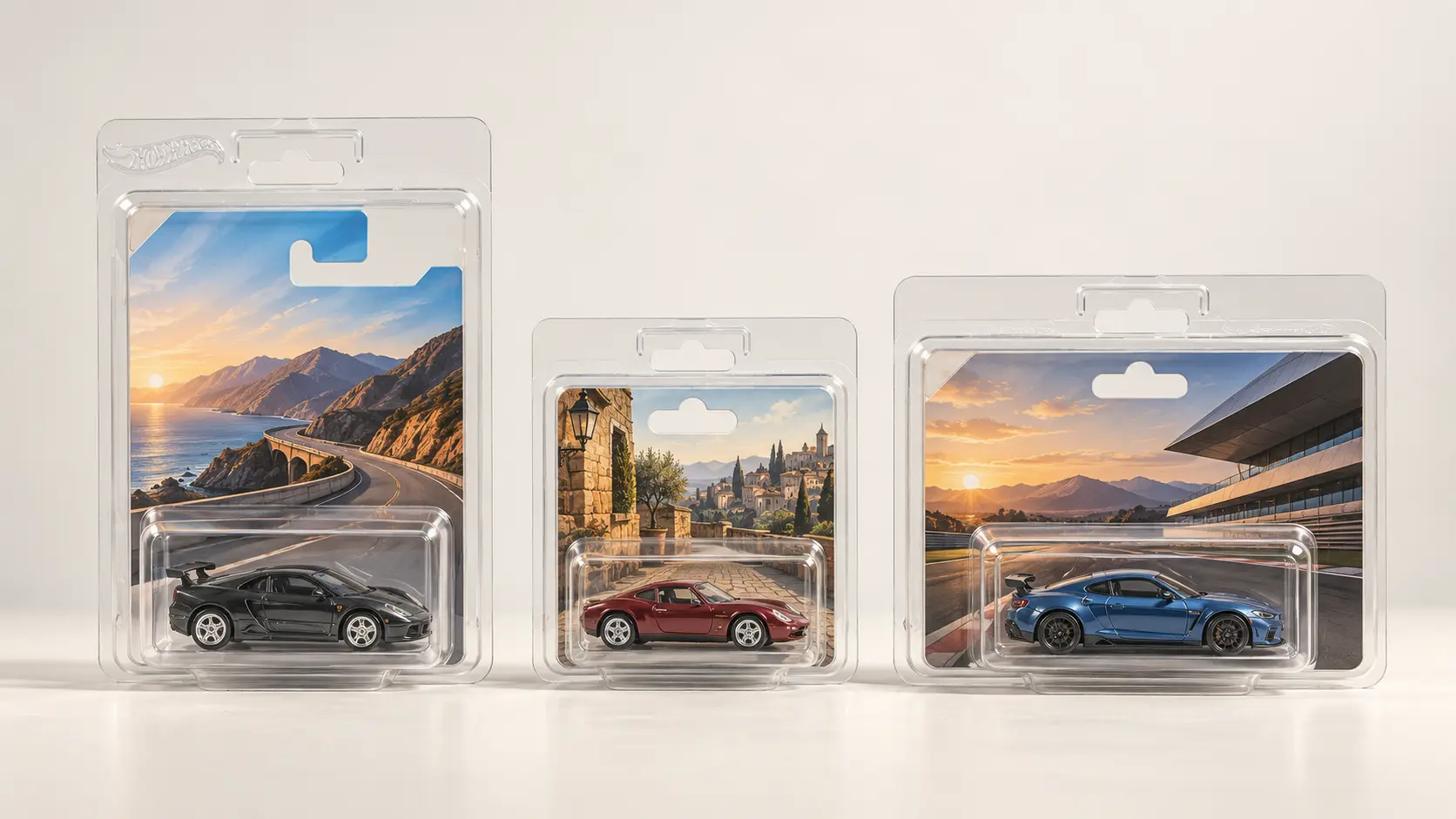
Compare the six selected protectors
Stated measurements are manufacturer or retailer claims, not independent physical fit tests. Exact Amazon offers may vary.
“Stated” below means the maker or retailer claims it will fit, not that anyone measured a card into the case.
| Product | Pack | Intended card format | Stated card allowance | Stated interior blister clearance | Stated exterior / product dimensions | Material and closure | Intended buyer |
|---|---|---|---|---|---|---|---|
| Sterling Mainline 17201 | 48 | Standard US long card | 6.5 x 4.25 in | 3.25 x 2 x 1.7 in | Not published | Described by the maker as acid-free; exact polymer not specified. One-piece hinged clamshell with extra corner room | Bulk protection for mainlines and regular Treasure Hunts |
| Acfunique PC-50 | 50 in the listing researched | Standard US long card | 6.5 x 4.25 in (retailer-advertised) | Not published (unverified) | Not published | Retailer copy describes plastic/PET; snap closure. Gauge not documented | Budget bulk, subject to current price and a quality check on arrival |
| Platinum Short Card Clamshell | 25 in the listing researched; a 10-pack variant appears elsewhere, so confirm the Amazon variation | European and other short cards only | 4.25 x 4.25 in | Not published (unverified) | Not published | Acid-free PET; horizontal hinge | Short card collections |
| Sterling Premium 17403 | 10 (maker also lists 20, 30 and 60) | Modern premium single card | 6.5 x 5.25 in | 4.75 x 2.75 x 1.5 in | Not published | Described by the maker as acid-free; exact polymer not specified. Hinged clamshell | Car Culture, Boulevard and Pop Culture singles |
| EVORETRO Mainline Acrylic | 2 | Standard US long card | Not published as a card allowance | Not published (unverified) | 17.5 x 11.5 x 4.7 cm, listed as product dimensions | 3 mm rigid acrylic | A few prized long-card pieces on display |
| EVORETRO Team Transport PET | 10 | Hot Wheels Premium Team Transport | Not published as a card allowance | Not published (unverified) | 22.5 x 6 x 20.3 cm, listed as product dimensions | 0.80 mm PET | Team Transport car-and-hauler packages |
Read the two middle columns together, because they are not the same measurement and only two products publish both halves of the picture.
- Interior blister clearance published: two products, both Sterlings.
- Product or exterior dimensions published, interior clearance not: two products, both EVORETROs. An exterior figure tells you how much shelf the case occupies, not what fits inside it.
- Card footprint published but no blister figure at all: two products, Acfunique and Platinum.
That gap decides more purchases than card width does, and it is the main reason the recommendations below are conditional rather than absolute.
↔ Swipe or scroll the comparison table horizontally on smaller screens.
Detailed protector reviews
Sterling Protector Case Mainline 17201 (48 Pack)
US standard long card 6.5 × 4.25 in
Why it leads this set
Sterling earns the lead position on documentation, not on tested performance. Its 48-pack mainline listing publishes a 6.5 x 4.25 inch card size and a separate blister allowance of 3.25 x 2 x 1.7 inches, along with a one-piece hinged design, extra corner room, stand and hang options, an acid-free material claim and US manufacture. Most competing bulk listings publish a card size and stop there. Being able to check a bubble against a published depth before ordering is the practical difference.
The 1.7 inch blister allowance is the most generous among the long-card products in this set. That matters for taller castings: vans, lifted trucks and anything with a roof rack or a raised spoiler are the releases most likely to foul a shallow case.
On materials, Sterling describes the case as acid-free but does not name the polymer in the sources reviewed. This guide says acid-free plastic rather than PET for that reason. Acid-free describes the chemistry of the plastic in contact with the card. It is not a statement about light filtering, and it does not make the case archival in the conservation sense.
Practical check. Corner room is useful, but dimensions still matter. Confirm the case closes without pressing the blister, especially for taller castings. Multiply the current cost per case by the number of cards you plan to protect before choosing a bulk pack.
Stated specifications
- Card allowance: 6.5 in H x 4.25 in W
- Interior blister allowance: 3.25 in x 2 in x 1.7 in
- Material: described by the maker as acid-free; polymer not specified in the sources reviewed
- Construction: one-piece hinged clamshell with extra corner room; stand and hang options
- Pack: 48
What the evidence supports
- Publishes both card and blister allowances, which is uncommon in bulk clamshells
- The deepest stated blister allowance among the long-card cases compared here at 1.7 inches
- Hinged one-piece construction with manufacturer-stated corner clearance
- Pack size suits protecting a case assortment or a season of pulls in one go
Limitations and checks
- Designed around the standard 6.5 x 4.25 inch mainline card. Older packaging, regional variations, unusual blister shapes and oversized castings are individual compatibility checks, not assumed fits. Sterling’s stated allowances do not establish that any particular vintage or special release fits.
- Not sized for premium 5.25 inch cards, short cards or Team Transport packaging
- No independently measured impact, UV or ageing data exists for this case. Treat durability claims accordingly.
- Collectors in the discussions above consistently raise the cumulative cost of protecting a large collection. Work out your own price per case against the live offer.
- 48 filled cases take real shelf volume. Plan the storage before the protectors arrive.
Check unusual blisters and older packaging individually. Price, seller and availability can change.
If you are protecting this season’s pulls, our 2026 Treasure Hunt tracker covers which castings to watch for, and the Hot Wheels case-code decoder explains the assortment letters on the back of the card.
Acfunique PC-50 (50 Pack)
US standard long card 6.5 × 4.25 in (retailer stated)
Why it is here, and why the recommendation is narrow
Acfunique is the budget comparator in this set rather than an unconditional recommendation. A third-party marketplace record associates its 50-case listing with standard 6.5 x 4.25 inch mainline cards. That is retailer advertising, not a first-party engineering specification. The missing interior blister clearance remains a significant limitation.
A bigger pack is not automatically better value. Fifty protectors against Sterling’s forty-eight tells you almost nothing on its own. Value here is the price per usable protector at the moment you buy, and “usable” carries weight: a cheaper case that will not close properly over a deep blister protects nothing. Work out the current cost per case on both listings yourself, then weigh it against the documentation gap below. No prices appear in this guide because no current US Amazon offer was verified for either product.
The documentation gap. Acfunique’s interior blister dimensions and sheet gauge are not documented in any source reviewed. On a long-card clamshell, blister depth is the specification that decides whether a Defender or a lifted Ram sits flat or bows the lid. Buying without it means accepting an unknown on the measurement that matters most.
What to check on arrival. No independently documented case gauge or usable blister depth was available in the reviewed sources. Before placing valuable cards inside, inspect several cases for flatness and snap alignment, test the closure with a common mainline and check current reviews for the exact Amazon variation. These are sensible purchasing checks, not findings from product testing by this site.
Match the product to the stakes. Commons, duplicates and trade stock are a reasonable fit if the current price justifies it. Anything with resale value belongs in a case whose blister allowance is published.
Stated specifications
- Advertised card allowance: 6.5 in H x 4.25 in W (retailer-stated)
- Interior blister clearance: not published (unverified)
- Material: retailer copy describes plastic or PET; grade and thickness not documented (unverified)
- Closure: snap closure
- Pack: 50 in the listing researched
What the evidence supports
- A 50-count offer exists in marketplace records at the standard long-card format
- A potential bulk-value option if the current per-case price compares favorably with the alternatives
- Reasonable for high-volume protection where the realistic alternative is leaving cards bare
Limitations and checks
- Interior blister clearance, wall gauge and material grade are all undocumented
- Evidence comes from secondary retailer records rather than manufacturer specifications
- Before buying, consult recent reviews for the exact variation and check several cases for flatness and closure fit when delivered.
- Budget bulk packs are frequently relisted under changing seller names. Confirm pack count and advertised dimensions on the live listing.
Compare price per case and inspect fit and snap alignment. Price, seller and availability can change.
Platinum Protectors Short Card Clamshell
Short cards only 4.25 × 4.25 in
Why it is recommended
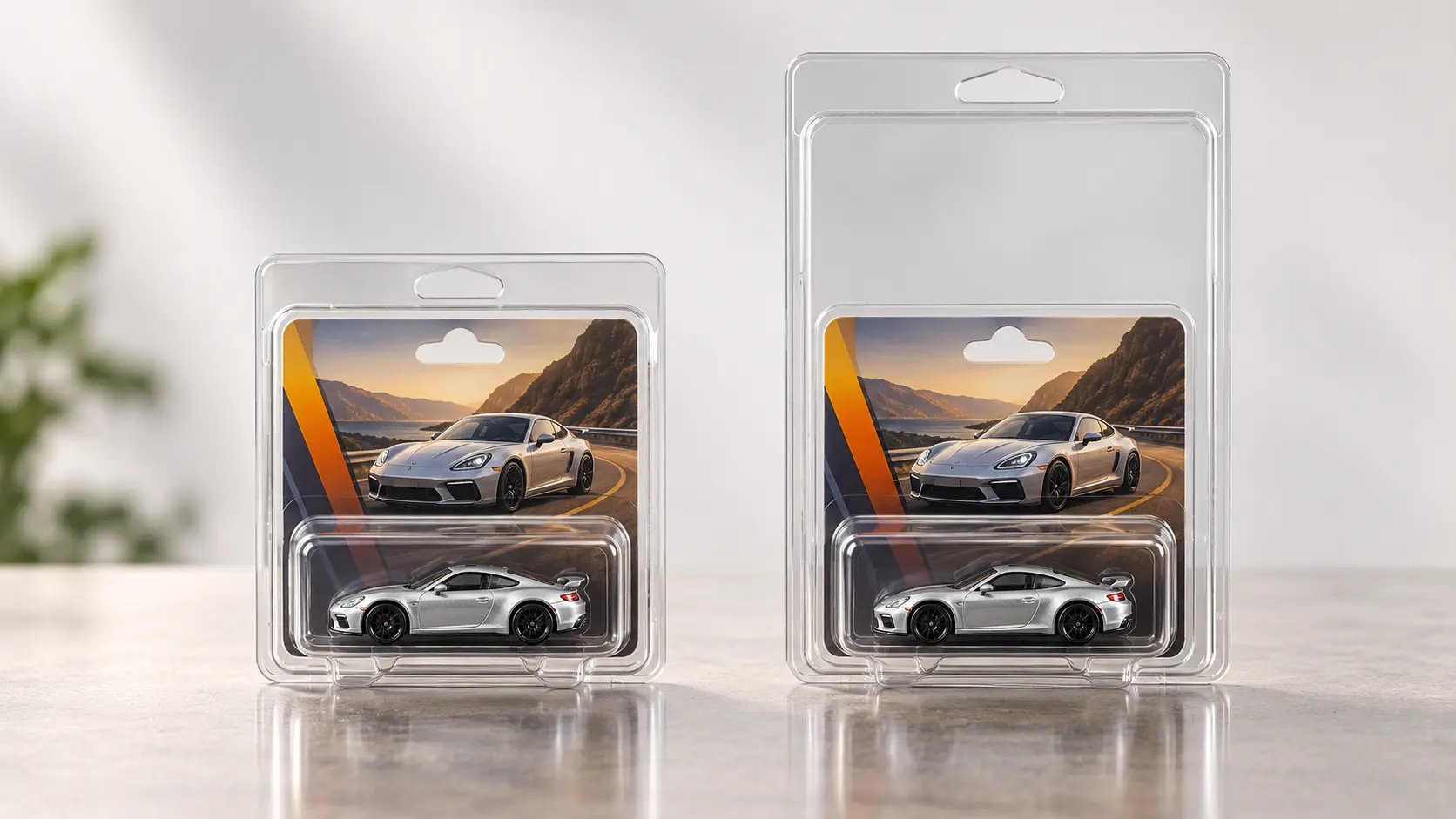
Short cards are the format most US-focused buying guides skip. A large share of European and other international assortments arrive on a roughly square blank rather than the 6.5 inch tall US long card. Put one in a long-card clamshell and the card floats: it slides inside the shell, the blister sits off centre, and the card edges meet the walls every time the case moves.
Platinum’s wholesale specification addresses that directly. It states a 4.25 x 4.25 inch card footprint for short-card Hot Wheels mainlines and comparable short Matchbox formats, acid-free PET construction, a horizontal hinged closure and a perfect-fit-or-refund promise. The manufacturer is explicit that the case is for short cards only, which is a useful kind of honesty in a category full of “fits 1:64” listings.
The horizontal hinge suits a near-square shell, since it keeps the opening along a long edge rather than forcing a short, stiff swing.
Check the pack size before you order. This is the weakest point in the product’s paper trail. The ASIN B0DP5PXQJG appears with a 25-pack title in some third-party listings and a 10-pack in others, and no live US Amazon variation was confirmed during this research. Open the listing and read the selected variation before assuming a pack count.
Check the bubble as well as the card. A protector designed for the short-card footprint may still have too little cavity depth for some castings. Platinum does not publish that clearance in the reviewed source, so unusual blisters require an individual fit check.
Stated specifications
- Card allowance: 4.25 in x 4.25 in, short cards only
- Interior blister clearance: not published (unverified)
- Material: acid-free PET
- Closure: horizontal hinge
- Pack: 25 in the listing researched; a 10-pack variant appears elsewhere, so confirm on Amazon
What the evidence supports
- First-party card footprint published for a format that general-purpose cases handle badly
- Manufacturer states the compatibility limit plainly rather than implying universal fit
- Acid-free PET named specifically, unlike several products in this set
- Manufacturer fit-or-refund promise stated on the wholesale listing
Limitations and checks
- US long cards will not fit. This is not a dual-format case.
- Blister depth is not published, so taller castings on short cards are an unverified fit
- Pack quantity for this ASIN is ambiguous across third-party records. Confirm it on the live listing.
- Short card dimensions have varied by region and production era. A short card label is not proof that every year and variation fits. Measure your own card and bubble first.
- No independent product-specific customer feedback was available at the time of writing
Amazon listings disagree on 10- versus 25-pack variations. Check the selected offer. Price, seller and availability can change.
Sterling Protector Case Premium 17403 (10 Pack)
Modern premium singles 6.5 × 5.25 in
Why it is recommended
Premium Hot Wheels do not sit on mainline cards. Car Culture, Boulevard, Pop Culture and the other Metal/Metal lines ship on a wider blank, and Sterling’s premium line page identifies the 17403 for 6.5 x 5.25 inch cards, with 10, 20, 30 and 60 pack options. That extra inch of width is the point. A premium card pushed into a 4.25 inch mainline shell either will not close or closes under tension, and a case held shut under tension presses on the card edge continuously.
A Sterling wholesale listing publishes the blister allowance at 4.75 x 2.75 x 1.5 inches. Width and height are generous for premium bubbles, which tend to be wider and shallower than mainline blisters because the car sits on a printed plinth. The 1.5 inch depth is the figure to check against your own cars.
As with the mainline case, Sterling describes the material as acid-free without naming the polymer in the sources reviewed, so this guide says acid-free plastic rather than PET.
Premium is not one uniform format. Elite64, Formula 1 and special-release packaging can differ from common Car Culture and Boulevard blanks. Measure the actual card and blister rather than assuming the 17403 accepts every premium release.
Before storing a valuable premium card: inspect the case’s internal edges and closure for molding irregularities, then compare the card and blister with the published allowances. This is a precaution, not a report of a widespread problem with this model.
Depth matters here. Sterling states 1.5 inches of blister allowance for this premium case. If your blister is deeper, choose a protector with a larger published cavity allowance rather than trying to force this case closed.
If you are working out which of your cars belong in a premium case, our Premium vs Mainline Hot Wheels comparison covers the packaging and casting differences.
Stated specifications
- Card allowance: 6.5 in H x 5.25 in W
- Interior blister allowance: 4.75 in x 2.75 in x 1.5 in
- Material: described by the maker as acid-free; polymer not specified in the sources reviewed
- Closure: hinged clamshell
- Pack: 10 (the maker also lists 20, 30 and 60)
What the evidence supports
- Sized for the wider premium blank rather than approximating it
- Publishes a three-dimension blister allowance, which makes a real fit check possible
- Established product line with several pack options
- Pack size matches how premiums are usually bought, in ones and twos
Limitations and checks
- Check the 1.5 inch depth against tall castings. Lifted trucks, vans, high-roof 4x4s and roof-accessory castings can exceed it.
- Does not cover Team Transport, oversized special bubbles or every Elite64 and F1 premium release
- Premium card dimensions are not uniform across sub-lines and release years. Treat 5.25 inches as the design target, not a guarantee.
- No independently measured material gauge, impact or UV data exists for this case
- Not a substitute for a rigid enclosure if the card will be handled or shipped often
Measure deep premium bubbles and special-format releases before ordering. Price, seller and availability can change.
EVORETRO Mainline Acrylic Display Case (2 Pack)
Standard long cards Interior allowance unverified
Why it is recommended
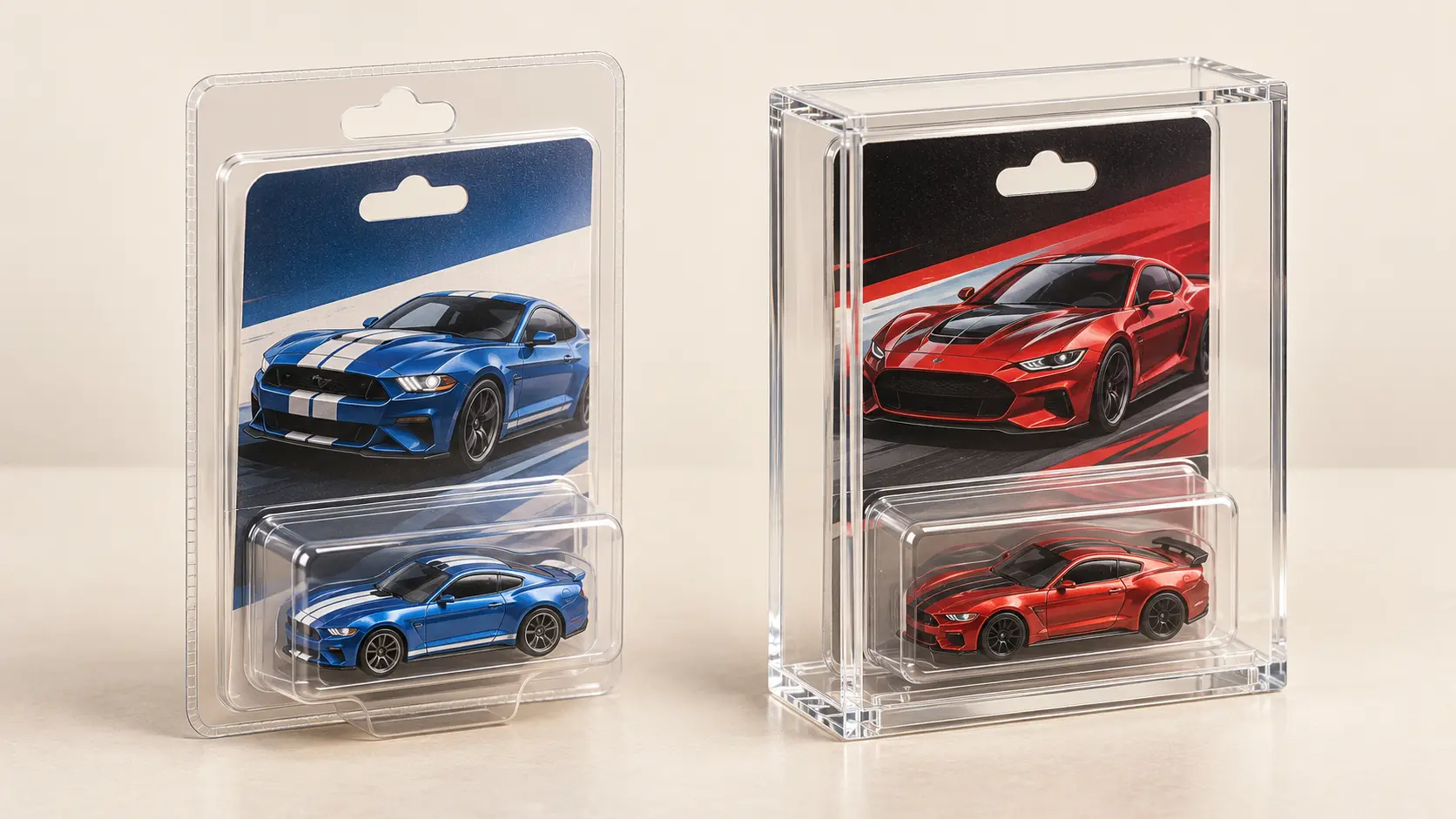
Everything above this entry is a flexible clamshell: thin, light, low cost per unit, and aimed at keeping dust and finger pressure off a card. This is a different class of product. EVORETRO’s mainline acrylic listing states 3 mm acrylic construction and product dimensions of 17.5 x 11.5 x 4.7 cm, intended for standard long-card Hot Wheels and Matchbox.
The meaningful difference is structural rigidity. A 3 mm acrylic wall is substantially more rigid than a thin flexible clamshell, which is why rigid cases are the usual choice for pieces that get moved, shown and handled. That is a statement about material and construction, not a tested load rating. No crush, drop or load testing was published for this product, so it should not be described as crushproof, and nothing here establishes how it behaves with weight on top.
This suits a small number of cards where damage is costly to absorb: a factory sealed Super Treasure Hunt, a signed card, a convention piece. If you are working out which pulls qualify, our guide to spotting Super Treasure Hunts covers the Spectraflame paint and Real Riders tells.
A 2-pack is the honest pack size here. Rigid acrylic is a per-piece purchase, and the sensible build for most collections is bulk clamshells for the collection with rigid cases reserved for a handful of cards. That pairs with the options in our roundup of the best Hot Wheels display shelves.
Inspect fit rather than relying on appearance. The published figure describes the outside of the acrylic enclosure. Internal card supports and retaining features reduce usable space, which is why fit for other brands and unusually deep blisters remains unverified.
On the UV marketing. EVORETRO markets UV protection for this product, but no independently measured transmission or spectral data was found. Do not buy it as a UV solution, and see the conservation section below for what actually governs fading.
Buy the right format. This reviewed acrylic case targets standard long cards. It is not a premium-width enclosure, and similarly named cases are not interchangeable; compare your card and blister before ordering.
Stated specifications
- Material: 3 mm rigid acrylic
- Product dimensions: 17.5 x 11.5 x 4.7 cm, listed by the maker as product dimensions
- Interior usable card and blister clearance: not published (unverified)
- Intended format: standard US long cards
- Pack: 2
On those dimensions: the published figure describes the product, not the space inside it. Interior clearance depends on wall thickness, hinge structure, retaining supports and manufacturing tolerance, none of which are published. Subtracting wall thickness from the exterior does not produce a reliable fit tolerance, so no derived interior figure appears in this guide. Compare a card you own against the case before trusting it with a grail.
What the evidence supports
- 3 mm rigid acrylic, substantially stiffer than the thin flexible clamshells in this set
- Presents well as a standalone display piece
- Designed around the standard long card, the same blank as mainline and Treasure Hunt releases
- One dated collector account describes the rounded card supports favourably
Limitations and checks
- Interior clearance is not published, so fit for any specific card and bubble is unverified
- No published crush, drop or load testing. Rigidity is a material property here, not a measured performance figure.
- UV performance is a marketing claim with no transmission data behind it
- A two-case rigid-acrylic purchase may be less economical for bulk storage; compare current unit pricing
- Acrylic scratches more visibly than thin clamshell plastic and is harder to clean without marring
- Not sized for premium cards, short cards or Team Transport packaging, and one imported review reports a non-fit with another brand’s packaging
This is the mainline version, not EVORETRO’s separate premium acrylic case. Price, seller and availability can change.
EVORETRO Team Transport PET Protectors (10 Pack)
Team Transport packages Card allowance unverified
Why it is here
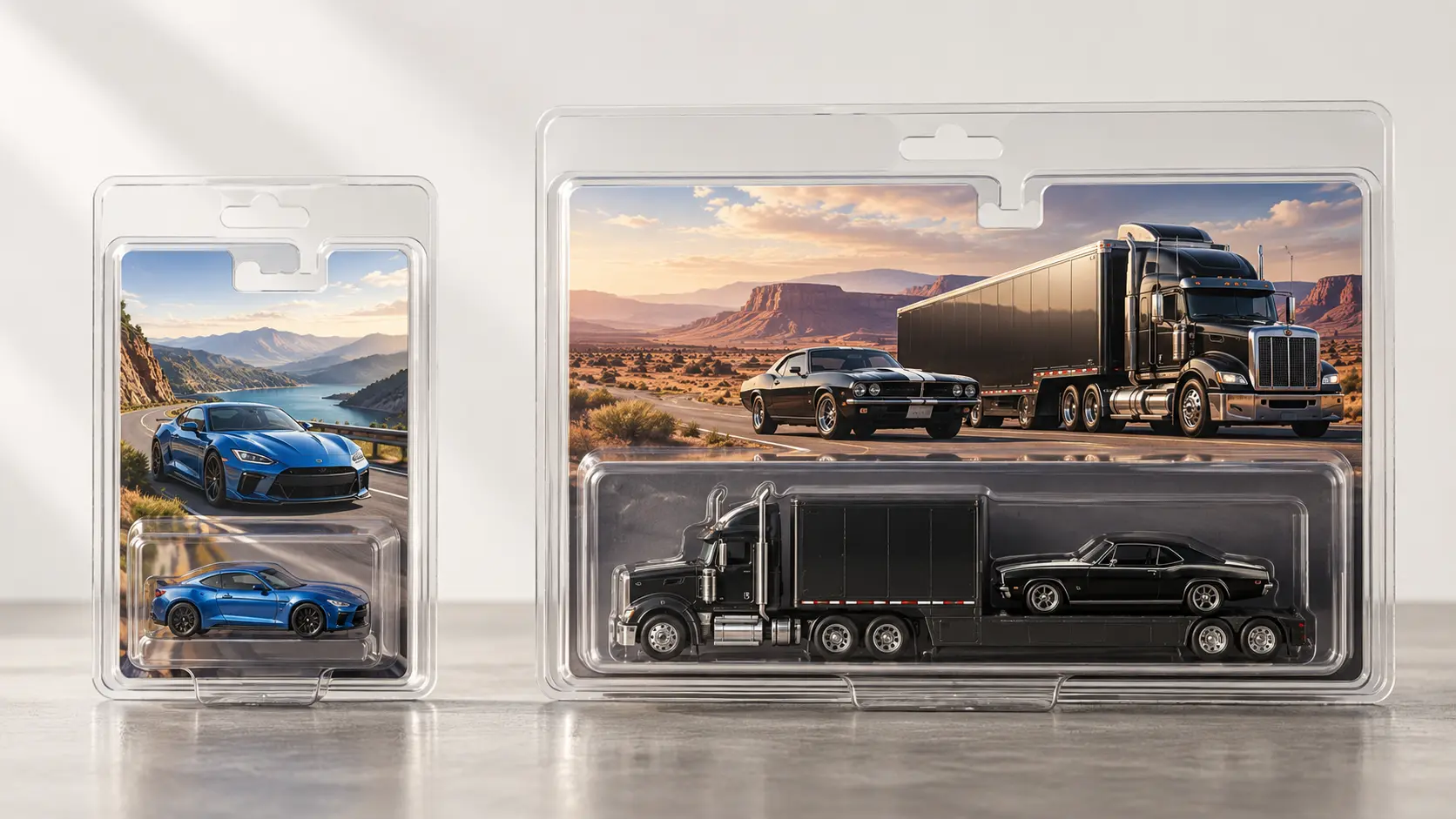
Team Transport breaks every protector above it. The line pairs a 1:64 car with a hauler inside one wide package, and the resulting card is landscape rather than portrait. No long-card or premium clamshell in this set comes close, and buyers regularly discover that after ordering a bulk pack.
EVORETRO’s Team Transport listing states 0.80 mm PET and product dimensions of 22.5 x 6 x 20.3 cm, designated for Hot Wheels Premium Team Transport. The 0.80 mm gauge is heavier than the thin generic shells common in this category, which is a sensible design choice given that a larger panel flexes more at the same thickness. That is a specification comparison, not a controlled durability test.
Compare published fit data before ordering. Specialist Team Transport protectors exist beyond this selected research set. EVORETRO does not publish a usable interior card-and-blister allowance in the source reviewed, so check the package you own and request exact measurements if its blister is unusually deep.
Evidence quality here is the thinnest in this guide. A historical review on the manufacturer site reported distorted protectors in one shipment. That is one order, not evidence of an established manufacturing problem. Check the seller’s handling and return terms when buying.
A separate caution on identity: the working ASIN B0DFLW2Q6B was not independently matched to this exact product variation on Amazon during research. Confirm the listing is the Team Transport 10-pack before ordering.
Our roundup of the best Hot Wheels Team Transport sets covers which releases have held value.
Stated specifications
- Material: 0.80 mm PET
- Product dimensions: 22.5 x 6 x 20.3 cm, listed by the maker as product dimensions
- Interior usable card and blister clearance: not published (unverified)
- Designated fit: Hot Wheels Premium Team Transport
- Pack: 10
On those dimensions: the figure is a product dimension and the source does not state whether it describes the shell closed, the shell flat, or the shipping carton. Interior clearance is unverified, and Team Transport packaging has varied across the line’s run. Compare it against a package you already own.
What the evidence supports
- Addresses a format that standard clamshells do not fit
- 0.80 mm stated gauge is heavier than typical thin generic shells, appropriate for the larger panel
- 10-count pack matches how Team Transport is collected, in individual releases
- First-party specification for material and product size
Limitations and checks
- Interior clearance is not published, and no card or blister allowance is given
- Limited manufacturer-site review evidence includes an isolated report of distorted cases on delivery, not a proven recurring defect.
- The Amazon ASIN was not independently confirmed as this exact variation
- Other oversized protectors exist; compare published cavity dimensions before choosing one
- Single-purpose. It will not serve any other format in your collection.
Confirm the Amazon offer is the Team Transport 10-pack, not a different EVORETRO protector. Price, seller and availability can change.
Collector buyer’s guide
Know which packaging you are protecting
Six formats account for most of what collectors try to put in a case, and they are not interchangeable:
- Standard mainline, US long card. Roughly 6.5 x 4.25 in. Covers basic mainlines, First Editions and regular Treasure Hunts. The default format for most bulk clamshells.
- Premium cards. Car Culture, Boulevard, Pop Culture and related Metal/Metal lines, roughly 6.5 x 5.25 in. Wider than mainline, and the sub-lines are not perfectly uniform. Elite64 and F1 packaging in particular should be measured rather than assumed.
- European and other international short cards. Roughly 4.25 x 4.25 in. Needs a dedicated short card case. Short card dimensions have varied by region and era.
- Carded RLC releases. Red Line Club cars that ship on a card are closer to premium than mainline, but RLC packaging has changed across the club’s history. Measure the specific release.
- Boxed RLC and other boxed collectibles. These do not belong in card protectors at all. A boxed release needs box-appropriate storage, and forcing one into a clamshell is how box corners get crushed.
- Team Transport. A wide landscape package holding a car and a hauler. Needs a purpose-made oversized shell.
No case in this guide covers more than one of these well. Treat a “fits 1:64” claim as marketing rather than a specification.
Card footprint versus blister clearance
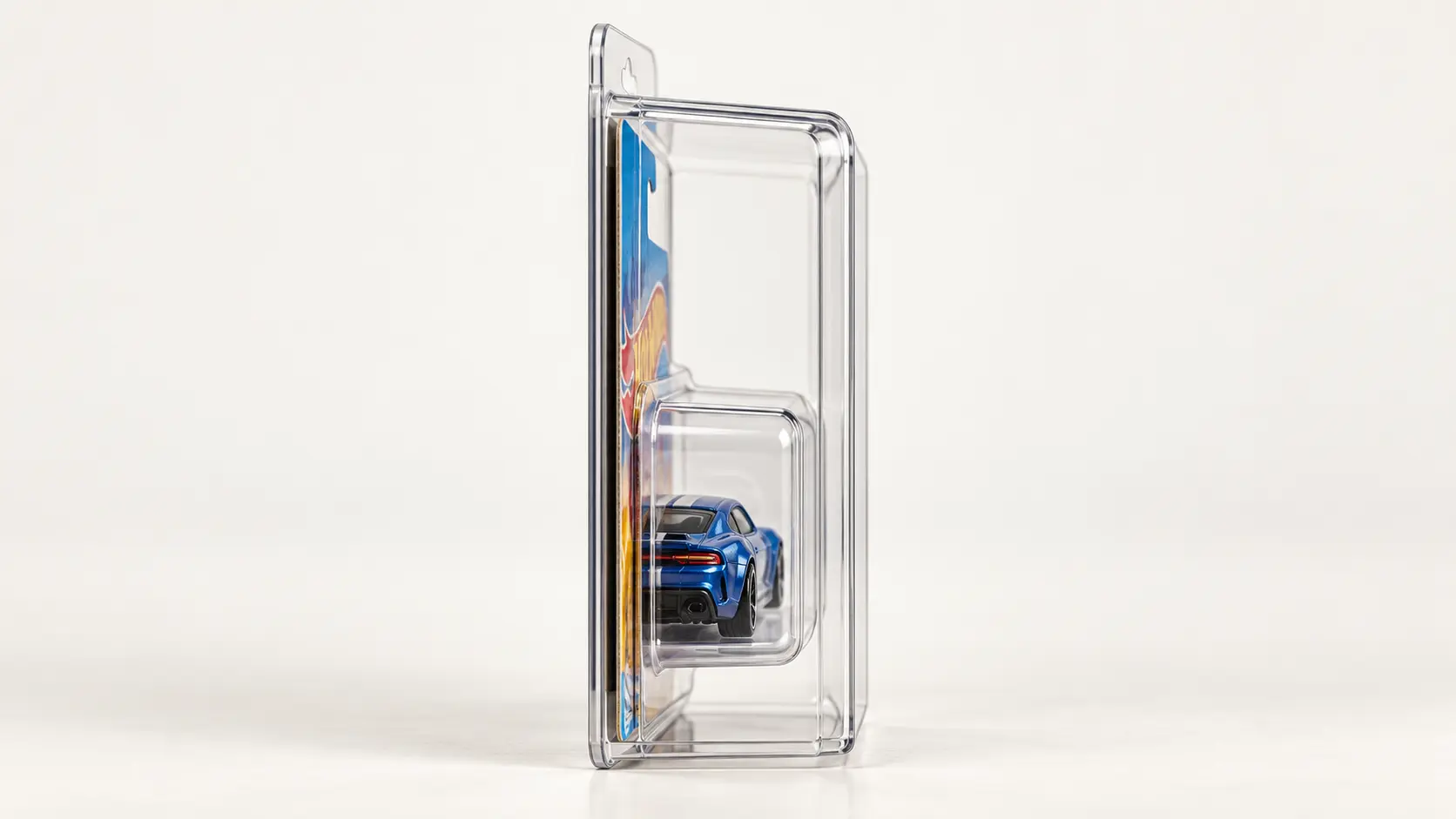
The most common fit failure is not card width. It is blister depth.
A listing’s headline figure is usually the card footprint: the flat rectangle of card stock the shell accepts. That tells you nothing about the dome. Blister depth varies a lot across castings. A low sports car may sit under an inch, while a lifted truck, a van, a roof-rack casting or a tall spoiler can push well past that. Sterling publishes 1.7 inches of blister allowance on the mainline case and 1.5 inches on the premium case. Other case designs may publish larger cavity allowances. The relevant number is the stated usable clearance for the exact protector being considered, not the product’s exterior thickness.
A case that closes under tension concentrates pressure at the lid’s contact point on the blister and along the hinge instead of distributing it. A case you have to force shut is doing less good than no case.
Exterior or product dimensions are not interior clearance. A listing stating 17.5 x 11.5 x 4.7 cm is describing the outside of an object. Wall thickness, hinge structure, internal supports, retaining features and manufacturing tolerance all reduce the usable space inside, and none of those are usually published. Subtracting wall thickness from the exterior does not give you a dependable fit tolerance. Where only an exterior figure exists, treat interior clearance as unverified.
What actually damages card corners
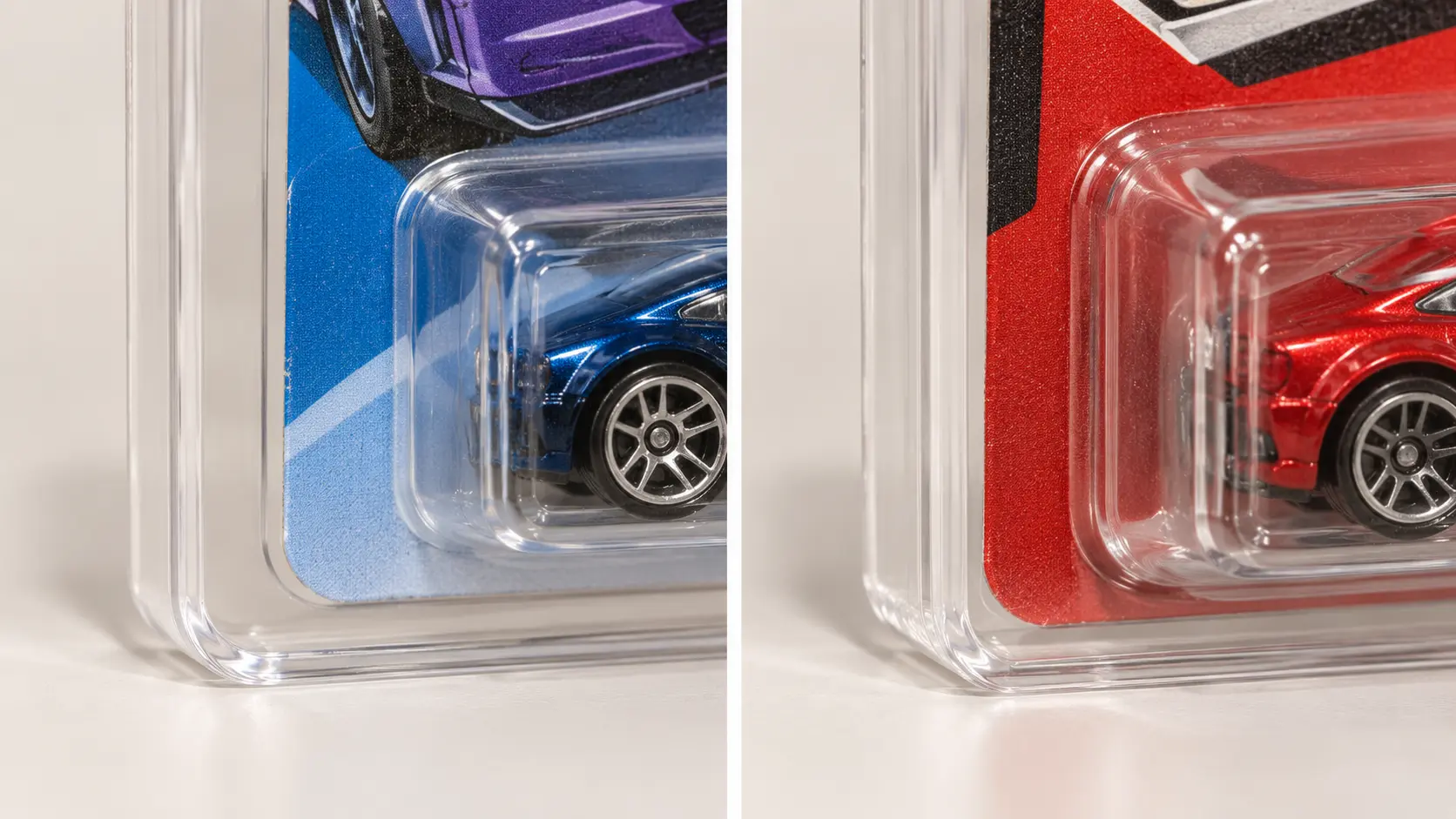
Soft, rounded, slightly furred bottom corners are the most common defect on carded cars, and they are the reason corner clearance gets discussed so much. The honest version of the mechanism is that corners are vulnerable to several ordinary pressures rather than to one guaranteed cause:
- Handling. Repeated insertion into and removal from a case, and repeated picking up and setting down, concentrate force at the corners.
- Compression from a poorly fitted case. A shell that is slightly undersized, or that closes under tension, presses on the card edge continuously.
- Storage pressure and overcrowding. Cards packed tightly, or stacked flat under the weight of others, load their own corners.
- Contact with rigid case walls. A card that can shift inside an oversized shell knocks its corners against the walls every time the case moves.
- Inadequate clearance. A shell with no relief at the corners adds a second pressure point where the card already has one.
Corner relief in a case design addresses the last two of these. It gives the card somewhere to sit without the shell itself bearing on the corner. That is a reasonable design response to a real problem, and it is not a guarantee: no protector prevents all bending or corner damage, and a card that arrived from the factory with a soft corner keeps it.
Light, heat and humidity
This is where clear cases are most often oversold, and where the common correction overshoots in the other direction.
Clear plastic cases protect well against dust, fingerprints, surface abrasion and the bending that comes from handling and stacking. On light, the accurate position is more specific than “plastic does nothing.” Some transparent materials genuinely do incorporate UV-filtering properties, and conservation practice uses UV-filtering glazing and acrylic for exactly that reason. What UV filtering does not do is remove the rest of the problem.
The Canadian Conservation Institute’s guidance on paper objects is direct about this: visible light fades colours found on paper objects and can fade dyed and coloured papers, and preserving materials from light damage requires not just UV filtering, which only changes the ratio of UV within the light, but also reducing visible light levels. Conservation guidance treats light exposure as cumulative. A UV label, even a true one, does not license putting a card somewhere bright.[1] [2]
That has two consequences for buying protectors. A UV claim is only meaningful with credible material specifications or transmission data behind it, and none of the six products here is supported by independently verified transmission data. None should be treated as a verified UV-blocking product, and phrases like museum grade or 100 percent UV blocking do not belong on any of them.
On ageing generally, conservation sources identify light, temperature and relative humidity as the drivers of deterioration in both paper and plastics. Fading, yellowing and adhesive failure in old blister packaging have several contributing causes, including the materials themselves and ambient conditions over years, so attributing any individual card’s condition to sunlight alone overstates what can be known. [3]
Practical guidance that follows from conservation principles rather than product marketing:
- Keep cards out of direct sunlight, and away from positions where sun tracks across them seasonally
- Reduce overall light exposure for cards you are not actively displaying, since exposure accumulates
- Prefer stable, moderate room temperature. Attics, garages and lofts cycle through extremes.
- Keep relative humidity moderate and stable. Published conservation ranges for mixed collections generally sit around 40 to 60 percent. Rapid swings do more damage than a steady value at either end of that band.
- Store cards vertically rather than stacked flat, so no card bears the weight of those above it
- Keep the collection away from exterior walls, which run colder and can condense
A clear case in a dark, stable cupboard beats the same case on a sunny shelf, every time.
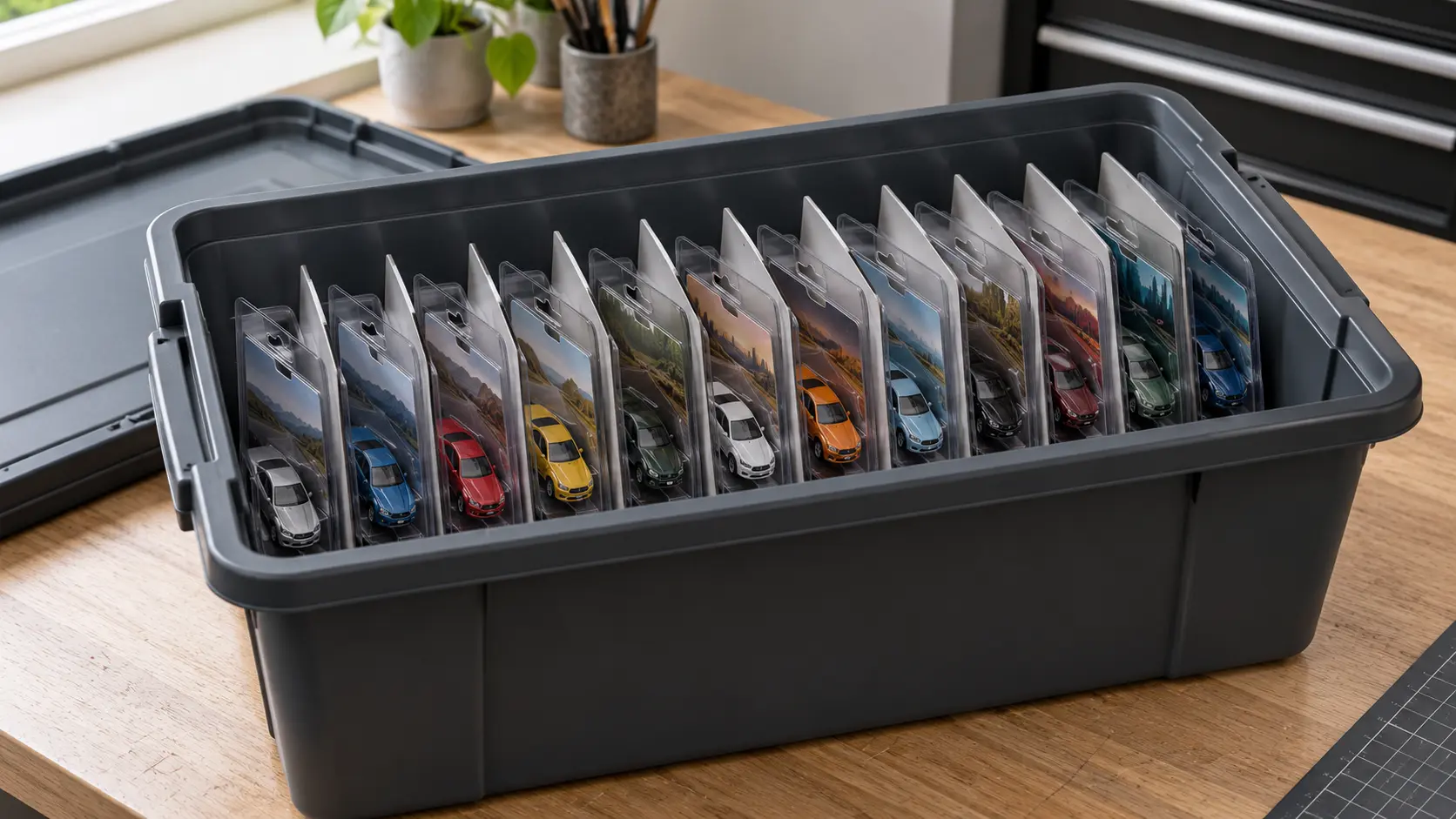
Storage once the cards are in cases
Protectors change the handling characteristics. They do not remove the storage problem, and the container matters as much as the shell. Our roundup of the best Hot Wheels storage cases covers the options for carded and loose collections.
Frequently asked questions
Do standard US card protectors fit European short cards?
No. A US long card protector is cut for a footprint around 6.5 x 4.25 in, while short cards are roughly 4.25 x 4.25 in. The short card will physically go inside the long card shell, which is where the confusion starts, but it sits loose with a large empty gap above it. Loose means the card shifts every time the case moves, and the corners take repeated contact against the shell walls. Short cards need a case cut for their own footprint, such as Platinum’s 4.25 x 4.25 inch clamshell. Measure one of your own cards first, because short card dimensions have varied by region and production era, and confirm the blister depth separately since few short card listings publish it.
Will standard mainline clamshells fit Car Culture or Boulevard premium cars?
No, and this is the most frequent mismatch in the category. Premium lines ship on a wider card, around 5.25 in against the mainline’s 4.25 in. A premium card forced into a mainline shell either will not close or closes under tension, which presses on the card edge continuously.
Premium cards need a premium-width case such as the Sterling 17403, which states a 6.5 x 5.25 in card allowance. Check the blister separately against its stated 1.5 in depth, because a correct card width does not guarantee a correct bubble fit. Premium is also not one single format: collectors have reported size mismatches with Elite64 and F1 packaging specifically, so measure rather than assume for anything outside the common Car Culture and Pop Culture singles.
Do clamshell protectors prevent Hot Wheels cards from yellowing?
Not by themselves, and no product in this guide has evidence behind a UV claim.
The accurate picture is narrower than either marketing or the usual pushback. Some transparent materials do carry UV-filtering properties, and conservation practice uses UV-filtering glazing for that reason. But the Canadian Conservation Institute is explicit that visible light also fades colours on paper, and that protecting against light damage requires reducing visible light levels as well as filtering UV, since filtering only changes the ratio of UV within the light. A clear case is transparent by design, so it passes visible light to the card regardless of any UV treatment.
None of the six products here is supported by independently measured transmission data, so none can be described as a verified UV-blocking product. What a clamshell reliably does is keep dust, skin oils and airborne contaminants off the card, stop handling bends, and prevent flexing when something is stacked on it. For colour preservation you need storage conditions: out of direct sunlight, away from heat, with stable moderate humidity, and with overall light exposure kept low for cards you are not actively displaying.
How should carded Hot Wheels in protectors be stored in storage totes?
Store them vertically, like files in a cabinet, rather than stacked flat. A flat stack puts the weight of every case above onto the bottom one, and thin clamshells are not designed to carry compressive load.
A few further points:
- Use a tote deep enough that cases sit fully below the rim, so the lid never rests on the top edge of a card
- Pack snugly enough that cases do not slump sideways, but not so tight that you have to force one out. Foam board or cardboard dividers help.
- Choose opaque totes over clear ones, since light exposure accumulates even indoors
- Keep totes off concrete floors and away from exterior walls, both of which run cold and can condense
- Avoid attics, garages and lofts. The temperature and humidity swings in those spaces do more damage over a year than careful handling does.
- Label the outside so you are not opening and reshuffling totes to find one card
Collectors discussing carded storage also report softer card stock in humid conditions, which matches conservation guidance on keeping relative humidity moderate and stable. For tote and case formats sized for carded collections, see our guide to the best Hot Wheels storage cases.
Choose by the packaging, not just the car
Begin with your card’s actual height and width, then check the blister’s height, width and depth. For standard long cards, Sterling offers more published fit information within this six-product research set. Platinum is designed for short cards, while premium singles and Team Transport need their own purpose-sized enclosures. Rigid acrylic is a presentation option, not a guarantee against crushing or light damage.
Use a stable, low-light storage location after you choose the protector. Where a case’s usable interior clearance is unpublished, measure your collectible and confirm compatibility before committing a valuable card.
Research references
Independent conservation guidance supporting the advice about preserving printed cards, light exposure and storage. Numbered citations in the article jump to these sources. Product specifications are identified separately as manufacturer-reported and were not independently tested.
- [1] Canadian Conservation Institute: caring for paper objects Canadian government conservation guidance on paper, stable enclosures, visible light, UV radiation, temperature and humidity.↩
- [2] Library of Congress: limiting light damage U.S. Library of Congress guidance on cumulative light exposure and why UV reduction alone does not prevent light damage.↩
- [3] Library of Congress: care and storage of works on paper U.S. Library of Congress general paper-handling and storage guidance. Not a product test or instruction to store carded diecast collectibles flat.↩
These independent sources support general paper conservation and light-exposure advice, not the dimensions or performance of any particular protector. Product specifications and compatibility statements remain attributed to the featured manufacturers; interior measurements and UV performance not documented in the article remain unverified.