Super Treasure Hunts are genuinely difficult to find, but there is no reliable current “1 in X cases” number published by Mattel. Modern collector tracking typically follows 15 Super Treasure Hunt models across the annual A–Q mainline case sequence, with I and O skipped. A case assortment can have a designated STH model without every physical carton containing one.
Research checked August 30, 2026. Current production totals and guaranteed insertion odds remain unpublished; numerical odds without transparent factory/distribution evidence are treated as estimates, not facts.
Finding a Super Treasure Hunt can feel almost impossible because the chase combines limited availability, uneven distribution and strong collector demand. The useful question is not just “how rare are they?” but which parts of that rarity can actually be verified?
This guide separates documented program history, current identification facts, case-tracking information and collector observations from unsupported production or case-ratio claims. For more collecting resources, explore our Hot Wheels Treasure Hunt Guides hub.
Super Treasure Hunt Rarity at a Glance
| Factor | Regular Treasure Hunt | Super Treasure Hunt |
|---|---|---|
| Annual modern lineup | Typically 15 models | Typically 15 models |
| Case sequence | A–Q, excluding I and O | A–Q, excluding I and O |
| Guaranteed in every sealed case? | No published fixed guarantee | No published fixed guarantee |
| Paint | Standard mainline-style finish | Usually Spectraflame |
| Wheels | Standard mainline wheels | Real Riders |
| Vehicle marking | Circle-flame Treasure Hunt symbol | Usually a “TH” graphic/marking |
| Modern card cue | Silver circle-flame indicator where applicable | Gold circle-flame indicator where applicable |
Swipe horizontally on mobile to see the full comparison.
The modern lineup typically contains 15 Super Treasure Hunt models across the A-Q case sequence, excluding I and O. Mattel does not publish current guaranteed insertion rates or per-model production totals. Collector-reported case ratios remain estimates rather than confirmed production numbers.
A case assortment can have a designated Super Treasure Hunt without every physical carton containing one. Factory case mixes, shipment timing, regional distribution, store availability and collector competition all affect the chances of finding an STH.
Limited availability can influence collector demand, but rarity alone does not establish resale value. Casting popularity, packaging condition, timing and recent completed sales are important when evaluating individual Super Treasure Hunts.
2026 reference: the current 2026 Hot Wheels Treasure Hunt tracker follows all 15 used case slots from A through Q, excluding I and O. Use that page for the current model-by-case checklist and this page for rarity and odds context.
For practical identification and hunting information, explore our 2026 Hot Wheels Treasure Hunt guide. To understand assortment letters and vehicle markings, read our Hot Wheels case-code guide.
What Is Known About Super Treasure Hunt Production
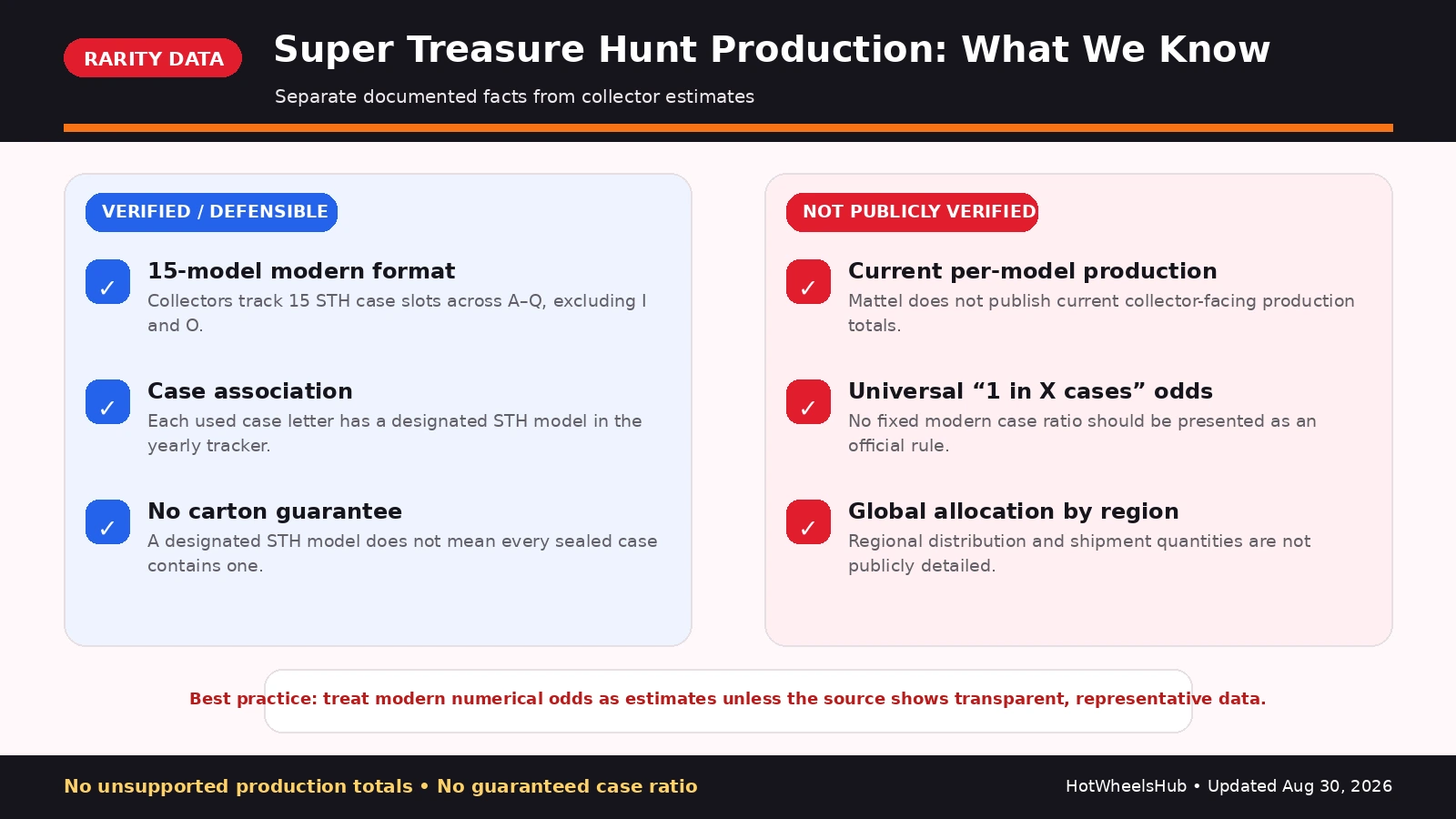
Mattel does not publish current per-model Super Treasure Hunt production totals or a guaranteed insertion rate for sealed mainline cases. That means modern claims such as “one Super per 10 cases,” “one per 12 cases,” or “one per master carton” should not be presented as universal facts without a transparent, representative dataset.
Historical Treasure Hunt production information is useful for understanding how the collector program developed, but it cannot be used to calculate current STH production. Distribution scale, assortment structure and global demand have changed substantially since the earliest Treasure Hunt years.
Why STHs Feel Rarer Than They Actually Are
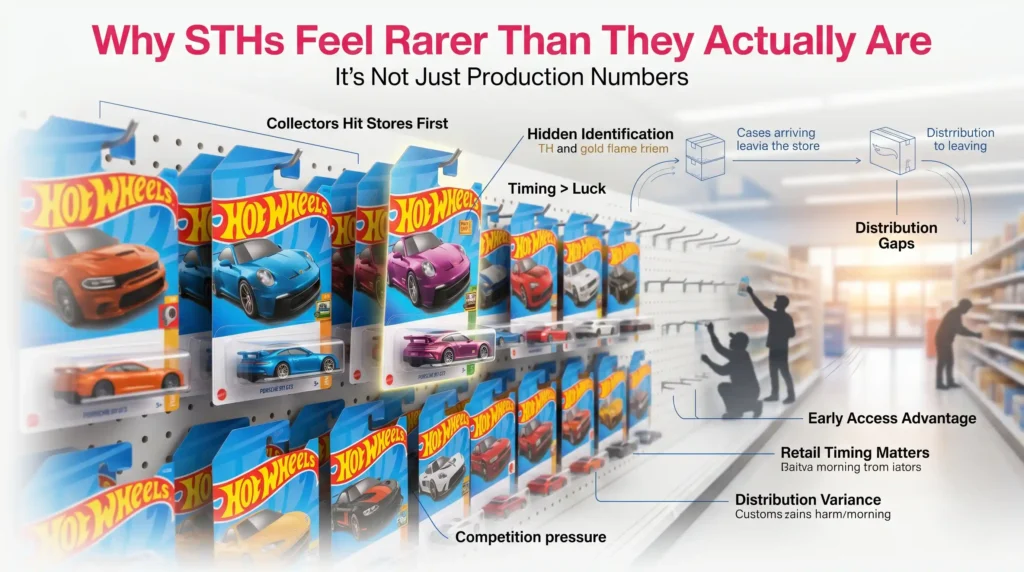
- Fresh stock can be checked quickly: high-demand cars may disappear soon after a display is stocked.
- Regional distribution varies: assortment timing and shipment frequency differ between countries, retailers and distribution centers.
- Local competition changes the hunt: a case that is difficult in one city can be easier in another.
- Case timing overlaps: one retailer may still be receiving an earlier assortment while another has moved to a later case.
- Identification matters: the standard and Super versions can be easy to confuse if you do not compare paint, wheels, vehicle markings and the card.
There is no reliable universal “best restock day.” Recording the actual stock patterns at stores you personally visit is more useful than assuming one weekday or time applies everywhere.
Year-by-Year STH Count: How the Series Has Grown
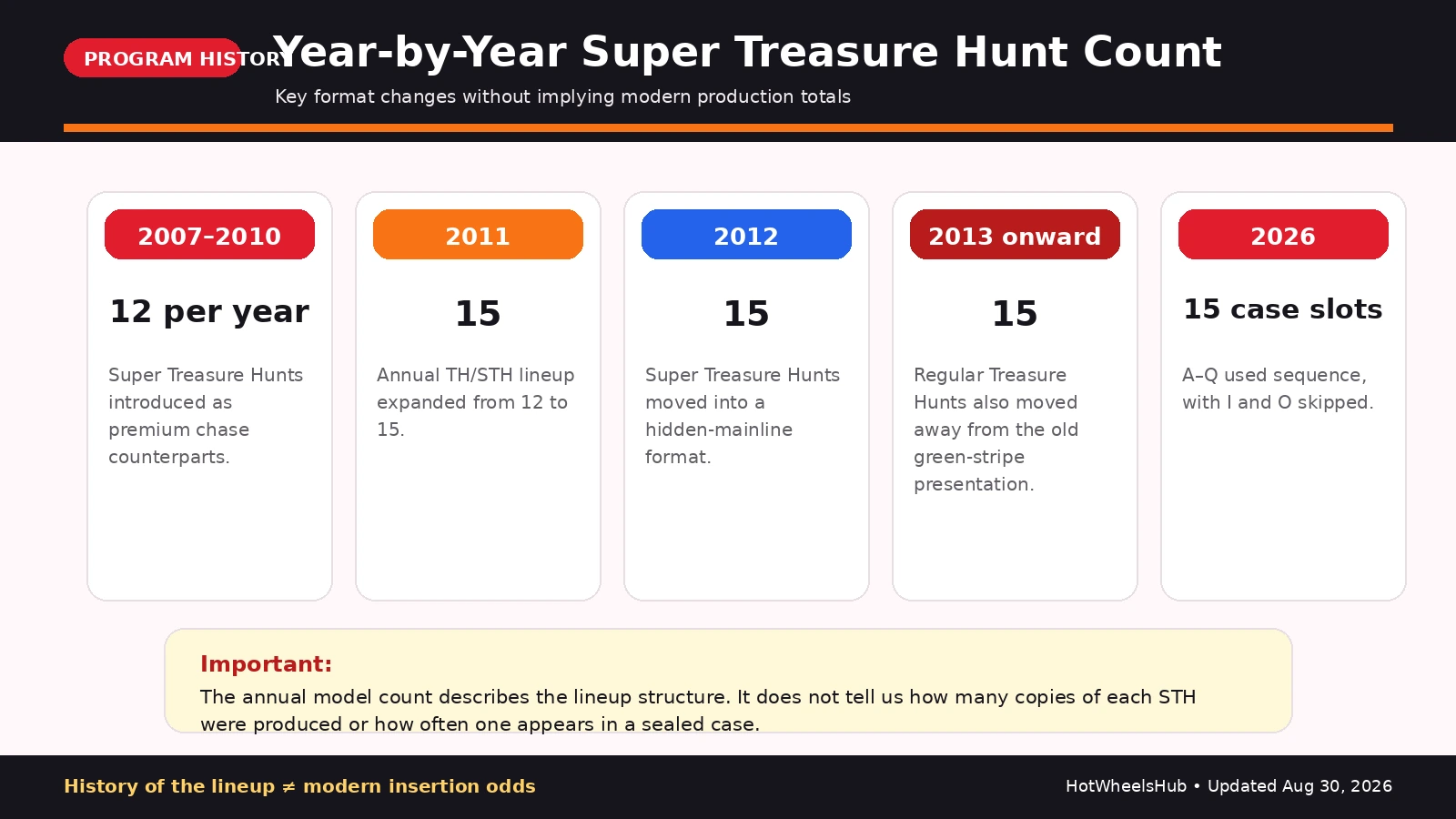
| Period | STH lineup | What changed |
|---|---|---|
| 2007–2010 | 12 per year | Super Treasure Hunts were introduced as premium counterparts to regular Treasure Hunts. |
| 2011 | 15 | The annual Treasure Hunt/Super Treasure Hunt lineup expanded from 12 to 15. |
| 2012 | 15 | Super Treasure Hunts shifted into a hidden-mainline format rather than matching the regular TH model. |
| 2013 onward | 15 in the modern format | Regular Treasure Hunts also moved away from the old green-stripe presentation and became hidden within mainline segments. |
| Current 2026 tracker | 15 | The used case sequence is A, B, C, D, E, F, G, H, J, K, L, M, N, P and Q. |
The history describes the lineup structure, not current production totals or insertion odds.
How to Spot an STH Before Someone Else Does
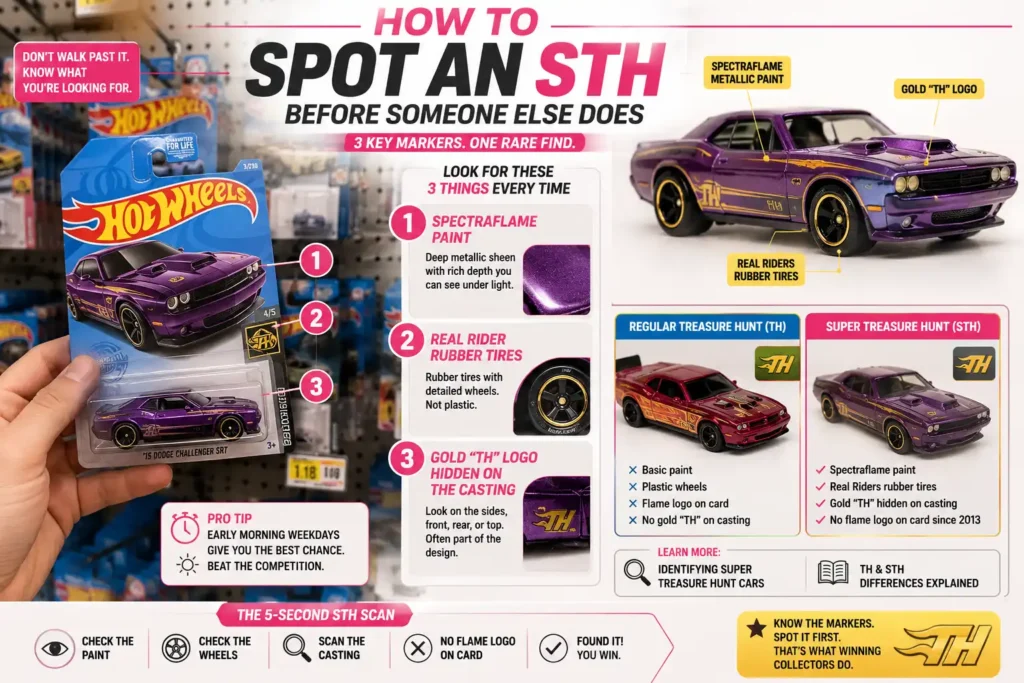
- Spectraflame-style paint: a deeper, more reflective finish than the standard mainline counterpart.
- Real Riders: premium wheels with rubber tires rather than the standard plastic mainline setup.
- “TH” marking: usually integrated into the vehicle graphics or another small area of the casting.
- Gold circle-flame card indicator: behind the vehicle on applicable modern packaging.
For the visual details, see how to spot a Super Treasure Hunt. New collectors should also compare Treasure Hunt vs Super Treasure Hunt.
How Super Treasure Hunt Rarity Affects Resale Value
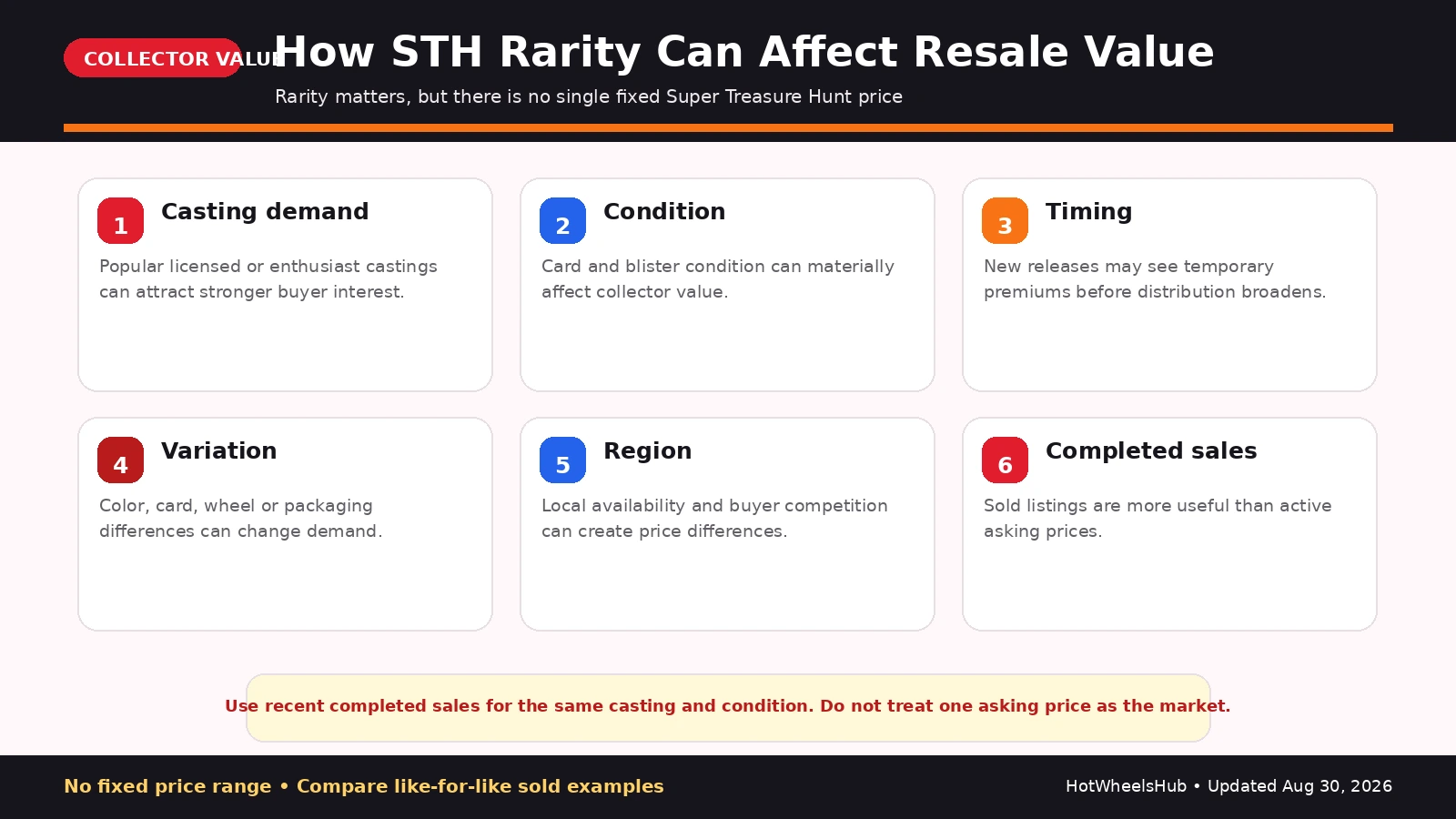
A scarce chase can attract stronger buyer interest, but rarity alone does not determine value. Casting popularity, card condition, variation, timing and current demand all matter. Active asking prices are also not proof of market value.
If you are evaluating a particular model, compare recently completed sales for the same casting and condition rather than applying one general STH price range. For broader collecting context, see the Hot Wheels collecting guide.
What Super Treasure Hunt Odds Claims Should You Trust?
A useful rarity claim should tell you where the number came from. A small case-opening sample, one store’s experience, a forum estimate or an assumed annual production figure can all be interesting, but none establishes a universal factory insertion rate.
Documented annual lineup history, visible vehicle/card identifiers and current case-to-model tracking.
Large collector opening datasets that clearly state sample size, geography and case type.
Unsourced “1 in X” odds, isolated store anecdotes or production totals derived from assumptions.
Sources and Verification
Current 2026 case structure: cross-checked against specialist case/list tracking for the 15 used A–Q case letters, excluding I and O.
Program history: checked against long-running collector references documenting 12 annual Treasure Hunts through 2010, expansion to 15 in 2011 and the 2012–2013 hidden-series changes.
Identification: cross-checked against current specialist references describing Spectraflame paint, Real Riders, a “TH” graphic and the gold circle-flame card emblem for modern Super Treasure Hunts.
Odds/production: no current Mattel-published guaranteed STH insertion rate or per-model production total was located for this update, so this article does not present collector estimates as official odds.
Related Collector Guides
Conclusion
Super Treasure Hunts are genuinely harder to find than ordinary mainline cars and regular Treasure Hunts, but their exact modern rarity cannot be reduced to a verified universal “1 in X cases” number. The dependable facts are the annual case/model structure, the Super-specific identifiers and the reality that actual carton contents and regional distribution vary.
For practical hunting, follow the current case tracker, learn the visual identifiers and record what your own stores receive. That produces better decisions than relying on an unsourced case-ratio claim.
HotWheelsHub is an independent collector resource and is not affiliated with, endorsed by, or an official source of Mattel or Hot Wheels.
Commonly Asked Questions: How Rare Are Super Treasure Hunts?
How rare is a Super Treasure Hunt?
Super Treasure Hunts are difficult to find, but Mattel does not publish a current guaranteed “1 in X cases” insertion rate. A mainline case assortment can have a designated Super Treasure Hunt model without every physical carton containing one. Store-level rarity also varies with distribution, shipment timing and collector competition.
Is there one Super Treasure Hunt in every Hot Wheels case?
No. A specific Super Treasure Hunt may be associated with a case assortment, but that does not guarantee one is packed in every sealed carton. Mattel does not publish a guaranteed collector-facing insertion rate for individual cases.
How many Super Treasure Hunts are released each year?
The modern annual format typically uses 15 Super Treasure Hunt models across the A–Q mainline case sequence, skipping I and O. The 2026 tracker follows 15 used case slots: A, B, C, D, E, F, G, H, J, K, L, M, N, P, and Q.
What makes a Super Treasure Hunt different from a regular Treasure Hunt?
Modern Super Treasure Hunts typically use Spectraflame-style paint, Real Riders with rubber tires, a “TH” marking on the vehicle, and a gold circle-flame card indicator on applicable packaging. Regular Treasure Hunts generally retain standard mainline-style paint and wheels and use the regular Treasure Hunt circle-flame identification system.
Are Super Treasure Hunt production numbers public?
Mattel does not publish current per-model Super Treasure Hunt production totals for collectors. Historical Treasure Hunt production figures and collector estimates should not be used as proof of modern production totals unless a transparent current source supports them.
Is the “one Super Treasure Hunt per 10 or 12 cases” rule accurate?
Treat that as a collector estimate, not a guaranteed rule. Without transparent factory or distribution data, a fixed universal case ratio cannot be verified. Case-opening observations may describe a sample, but they do not establish the contents of every carton or region.
Why are Super Treasure Hunts so hard to find in stores?
Low chase availability combines with uneven regional distribution, shipment timing, and strong collector demand. Fresh stock can be searched quickly, and different retailers or regions may be on different case assortments at the same time.