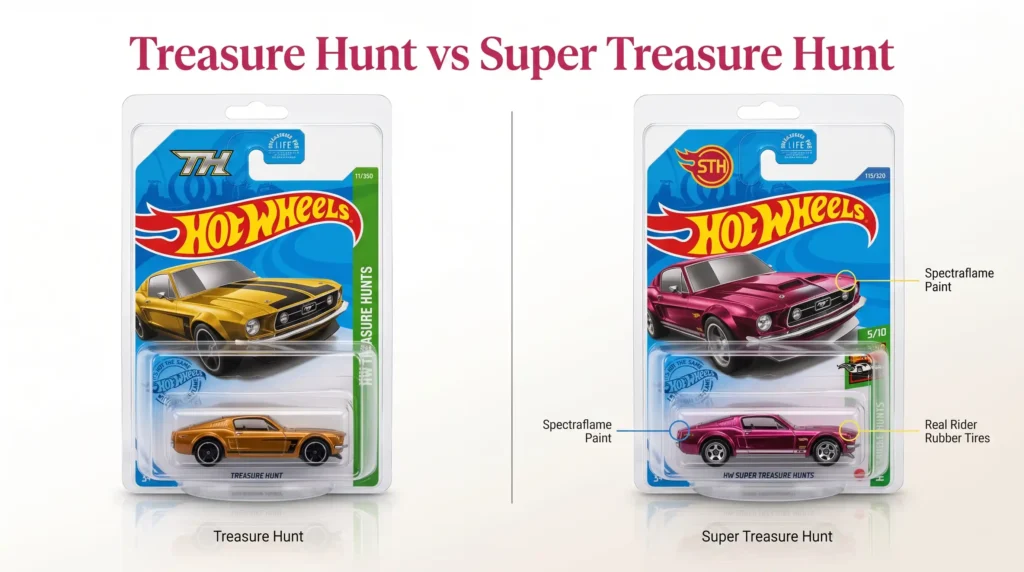
The difference between a Treasure Hunt and a Super Treasure Hunt is something every Hot Wheels collector needs to understand before spending serious money on these cars. Miss it, and you could easily pay a premium for the wrong one, or worse, let a rare find slip right past you at retail price.
Super Treasure Hunts are harder-to-find mainline chase variations that feature Spectraflame paint, Real Riders rubber tires, and distinct vehicle and card identifiers, while regular Treasure Hunts generally use standard mainline-style finishes and wheels.
This article breaks down exactly what separates the two, how to spot each one in the wild, and why that difference matters more than most collectors realize.
Treasure Hunt vs Super Treasure Hunt Comparison at a Glance
| Feature | Regular Treasure Hunt | Super Treasure Hunt |
|---|---|---|
| Paint | Usually standard mainline-style paint | Typically Spectraflame-style paint |
| Wheels | Usually standard plastic mainline wheels | Typically Real Riders with rubber tires |
| Card symbol | Silver circle-flame symbol on applicable modern packaging | Gold circle-flame symbol on applicable modern packaging |
| Vehicle marking | Circle-flame Treasure Hunt marking | Small “TH” graphic incorporated into the vehicle design |
| Rarity | Collector chase model | Generally harder to find than a regular Treasure Hunt |
| Collector value | Varies by casting, year, condition, and demand | Often commands a higher secondary-market price, but value still varies by casting, condition, and demand |
For the current chase lineup, use our 2026 Treasure Hunt tracker. For a complete identification walkthrough, see our 2026 Hot Wheels Treasure Hunt guide.
What’s the Difference Between Treasure Hunt and Super Treasure Hunt: What the Price Tags Won’t Tell You
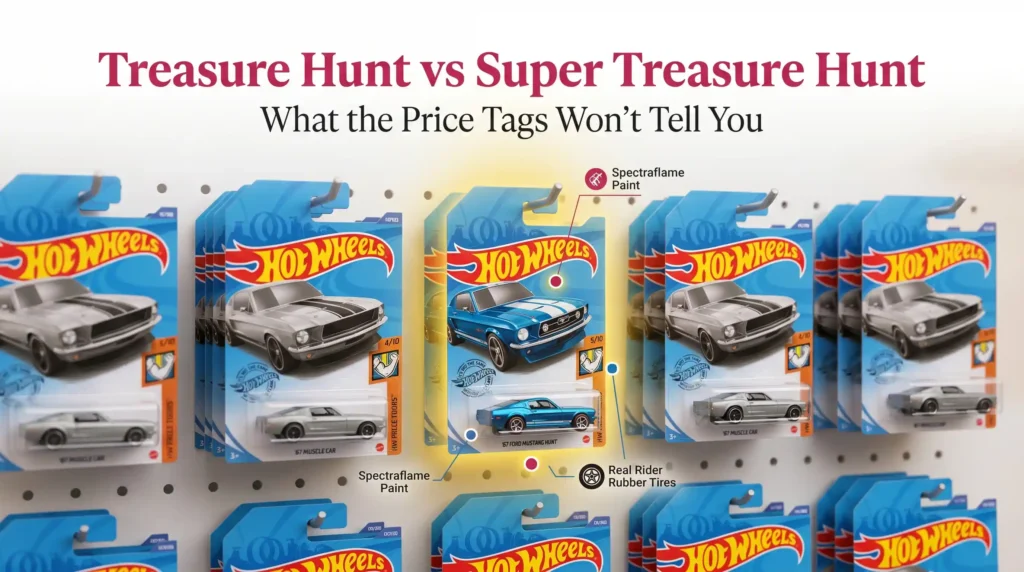
Most collectors assume all Treasure Hunt cars are created equal. They’re not. The gap between a standard Treasure Hunt and a Super Treasure Hunt goes deeper than a logo or a paint job, and once you see it clearly, you’ll never look at a peg of Hot Wheels the same way again.
A Quick History of Treasure Hunt Cars
Hot Wheels introduced Treasure Hunts in 1995, giving collectors harder-to-find vehicles to search for within the mainline assortment. Mattel has confirmed that the original 1995 Treasure Hunt program included 12 cars.
The program later expanded to include Super Treasure Hunts, which are harder-to-find variations of selected mainline castings. Modern Super Treasure Hunts are distinguished by premium details such as Spectraflame paint and Real Riders wheels.
The exact production totals and retail insertion rates for individual modern Treasure Hunt and Super Treasure Hunt castings are not publicly confirmed by Mattel, so collectors should avoid relying on unsupported production estimates.
What Is a Standard Treasure Hunt?
A regular Treasure Hunt is a collector chase vehicle included within the Hot Wheels mainline assortment. Modern regular Treasure Hunts can usually be identified by the circle-flame Treasure Hunt symbol on the vehicle, along with a corresponding card indicator on applicable packaging.
Key features of a modern regular Treasure Hunt:
- A circle-flame Treasure Hunt marking on the vehicle
- A silver circle-flame card indicator on applicable modern packaging
- Usually standard mainline-style paint
- Usually standard plastic mainline wheels
- Generally easier to find than the associated Super Treasure Hunt variation
Regular Treasure Hunts can still be highly collectible, but value varies by casting, year, condition, packaging, demand, and current market activity. Exact modern production totals are not publicly confirmed by Mattel.
What Makes a Super Treasure Hunt Different?
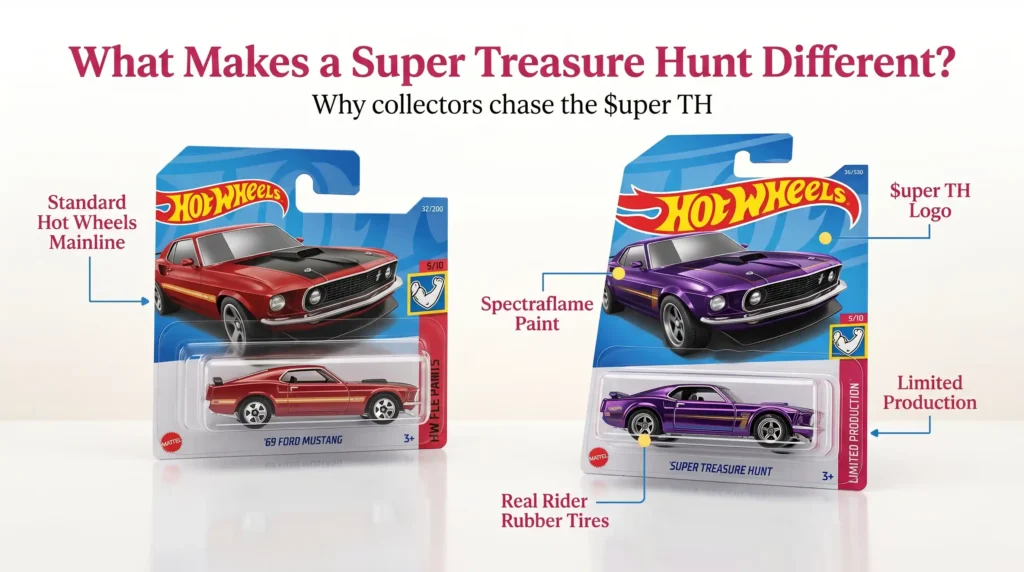
A Super Treasure Hunt is a harder-to-find variation of a selected Hot Wheels mainline casting. Mattel uses premium visual upgrades to distinguish these chase versions from their standard counterparts.
Modern Super Treasure Hunts feature Spectraflame paint and Real Riders wheels with rubber tires. Collectors can also look for a small “TH” graphic incorporated into the vehicle design and a gold circle-flame card indicator on applicable modern packaging.
Key features of a Super Treasure Hunt:
- Spectraflame paint with a richer, reflective finish
- Real Riders wheels with rubber tires
- A small “TH” graphic incorporated into the vehicle design
- A gold circle-flame card indicator on applicable modern packaging
- Generally harder to find at retail than a regular Treasure Hunt
Exact current production totals and guaranteed per-case insertion rates are not publicly confirmed by Mattel.
Treasure Hunt vs Super Treasure Hunt: Side-by-Side
Here’s a direct comparison of the main identification and collector differences.
| Feature | Treasure Hunt | Super Treasure Hunt |
|---|---|---|
| Paint Finish | Usually standard mainline-style paint | Spectraflame-style finish |
| Wheels | Usually standard plastic mainline wheels | Real Riders with rubber tires |
| Vehicle Marking | Circle-flame Treasure Hunt symbol | Small “TH” graphic incorporated into the vehicle design |
| Card Indicator | Silver circle-flame indicator on applicable modern packaging | Gold circle-flame indicator on applicable modern packaging |
| Rarity | Collector chase model | Generally harder to find at retail |
| Collector Value | Varies by casting, year, condition, packaging, and demand | Often attracts stronger secondary-market demand, but value varies significantly |
| Production / Distribution | Exact current production totals are not publicly confirmed | Not guaranteed in every physical case; exact production totals and insertion odds are not publicly confirmed |
Collector prices can vary widely between castings and over time. Recent completed sales for the same model and condition are more useful than fixed value ranges or active asking prices.
How to Spot a Super Treasure Hunt at Retail
Finding a Super Treasure Hunt on a store peg is partly luck and partly knowing the identification signs. Super Treasure Hunt variations appear within mainline assortments, but they are not guaranteed in every physical case. Exact current insertion odds are not publicly confirmed by Mattel.
Case letters can help you understand which assortment you are looking at and which chase model collectors associate with that wave. Use our Hot Wheels case-code guide for assortment and case-letter decoding.
When checking the pegs, compare several physical signs rather than relying on only one. Look for the richer Spectraflame paint, Real Riders rubber tires, the small “TH” graphic incorporated into the vehicle design, and the gold circle-flame card indicator on applicable modern packaging.
A few practical tips:
- Learn the Super Treasure Hunt model associated with the case mix you are checking
- Compare the Super version with photos of the standard mainline version when possible
- Inspect the paint, wheels, vehicle graphics, and card indicator together
- Use case codes as a reference, not as proof that a Super Treasure Hunt must be inside a physical case
Are Super Treasure Hunts Worth More Money?
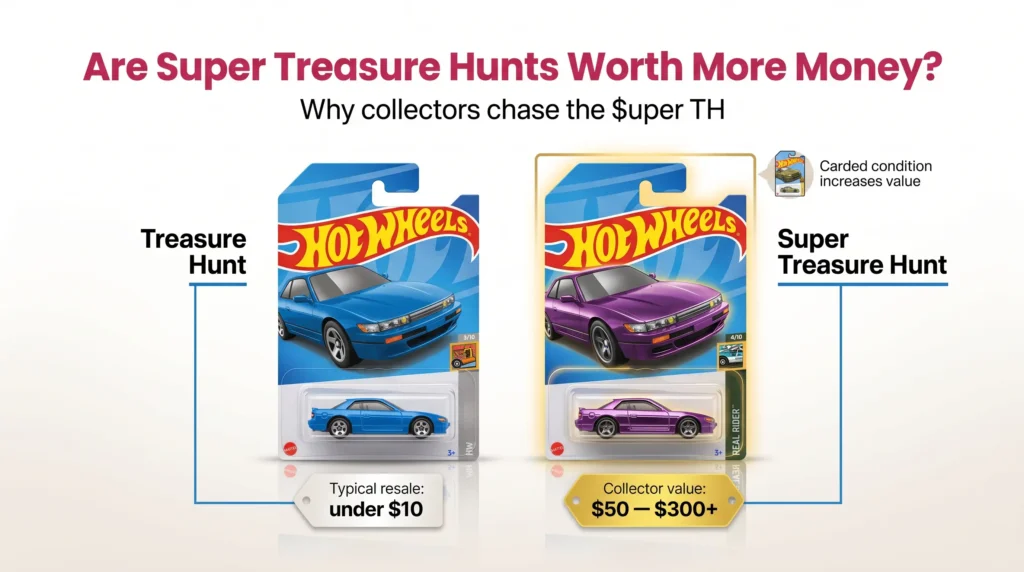
Super Treasure Hunts often attract stronger collector demand and higher secondary-market prices than regular Treasure Hunts, but there is no fixed value range or guaranteed appreciation.
Actual value varies by casting popularity, year, condition, packaging, supply, demand, and release timing. Carded examples can command a premium when packaging condition matters to buyers, but loose examples can also remain desirable depending on the casting and condition.
When estimating value, compare recent completed sales for the same casting, variation, packaging, and condition rather than relying only on active asking prices.
For a deeper look at scarcity, distribution, and what is actually known about availability, see our Super Treasure Hunt rarity guide.
Why Collectors Treat Them Differently
Regular Treasure Hunts and Super Treasure Hunts both have an important place in the hobby, but Super Treasure Hunts often attract more attention because they combine harder-to-find availability with premium visual features such as Spectraflame paint and Real Riders.
Collector demand still varies significantly by casting, manufacturer, year, condition, and personal interest. A chase designation by itself does not guarantee long-term value.
If you are building a Hot Wheels collection, focus on accurate identification, condition, authenticity, and the models you genuinely want to own rather than assuming every chase car will increase in price.
Conclusion
The difference between a regular Treasure Hunt and a Super Treasure Hunt is easiest to recognize through paint, wheels, vehicle markings, card indicators, and relative availability.
Regular Treasure Hunts generally use standard mainline-style finishes and wheels, while Super Treasure Hunts feature premium details such as Spectraflame paint and Real Riders. On applicable modern packaging, the card indicators also differ.
When identifying a potential Super Treasure Hunt, compare multiple signs rather than relying on one detail alone. Exact production totals and guaranteed per-case insertion rates are not publicly confirmed by Mattel.
For more Treasure Hunt identification, rarity, tracking, and comparison resources, browse our Hot Wheels Treasure Hunt guides collector hub.
Frequently Asked Questions About Treasure Hunt and Super Treasure Hunt
Can a regular Treasure Hunt ever be worth more than a Super Treasure Hunt?
Yes. Collector value depends on the specific casting, year, condition, packaging, rarity, demand, and recent sales activity. Some older or especially desirable regular Treasure Hunts can outperform less-demanded Super Treasure Hunts. The designation alone does not determine value.
Do all Super Treasure Hunts use Spectraflame paint and Real Riders?
Modern Super Treasure Hunts are identified by premium features that include Spectraflame paint and Real Riders wheels. Colors, decorations, wheel designs, and exact placement of identification graphics vary by casting.
Where is the Super Treasure Hunt “TH” marking?
The small “TH” graphic is incorporated somewhere into the vehicle decoration, and its location varies by casting. On applicable modern packaging, collectors can also look for the gold circle-flame indicator behind the vehicle.
Use several signs together, including paint, wheels, vehicle graphics, and the card indicator, rather than relying on only one feature.
How many Super Treasure Hunts are produced?
Mattel does not publicly confirm current production totals for individual Super Treasure Hunt castings. Mattel has confirmed that its annual mainline program includes selected Super Treasure Hunt variations, but exact per-casting production quantities should not be presented without a reliable documented source.
Can you find a Super Treasure Hunt in every Hot Wheels case?
No. A Super Treasure Hunt can be associated with a particular mainline case mix, but it is not guaranteed in every physical carton. Distribution can vary by shipment, retailer, region, and assortment, and Mattel does not publish a guaranteed current insertion rate for individual cases.
Are Treasure Hunts and Super Treasure Hunts still part of the current Hot Wheels lineup?
Yes, both lines are still active. Hot Wheels continues releasing standard Treasure Hunts and Super Treasure Hunts as part of its mainline assortment.
The designs and castings rotate annually, bringing a fresh set of models for collectors to hunt. Staying current with the annual lineup is something serious collectors track closely.
Does the Treasure Hunt series include every car segment or just specific models?
Treasure Hunt and Super Treasure Hunt selections can include licensed real-world vehicles as well as Hot Wheels original castings. The mix varies by year and case, so collectors should not assume that only one type of vehicle can receive Treasure Hunt treatment.
For the current lineup and case-by-case pairings, see our 2026 Treasure Hunt tracker